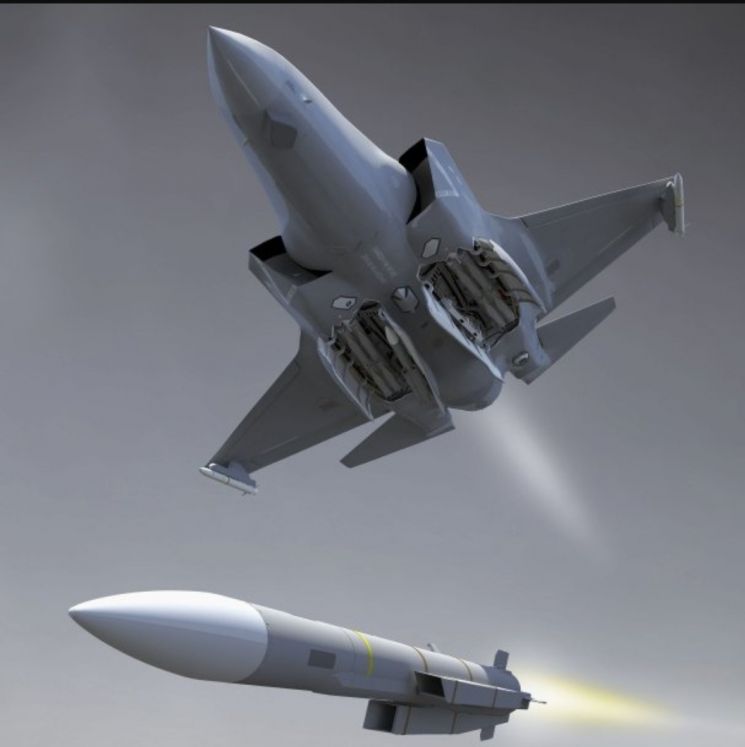
[Monthly Defense Times Editor-in-Chief An Seung-beom] It is well known that the KF-X fighter jet gains a tactical advantage by being able to fire the Meteor air-to-air missile, which is greater than that of the existing AIM-120 air-to-air missiles possessed by the Air Force.
In fact, the difference in air-to-air combat capability between the two is so significant that it is almost incomparable in air-to-air engagements.
? The AMRAAM air-to-air missile, which relies on the energy rapidly accumulated during the short rocket motor burn time immediately after launch to strike the target, can fly without losing energy under conditions where drag is lower than thrust while the solid fuel rocket motor is burning. Under these conditions, a NEZ (No Escape Zone envelope) is formed based on speed and load factor.
? After the rocket motor has consumed all the solid fuel, the missile must fly without thrust using only the energy accumulated during motor operation, resulting in energy loss due to drag generated during maneuvering to intercept the target.
Especially when the angle-off between the launch platform and the target approaches 90 degrees, the missile’s kill zone is significantly reduced.
▲ Operating principle and tactical advantages of the Meteor air-to-air missile = Even after the solid fuel combustion by the rocket motor’s MSIU (Motor Safety Ignition Unit) is complete, the fuel-rich gas generated in a high-temperature gas generator flows into the ducted engine combustion chamber. It enters through the intake duct, meets compressed air, combusts, and generates thrust.
Because thrust is maintained even after the boost phase, the Meteor missile retains energy even when maneuvering with increased drag to track targets with large angle-offs.
In situations where the target attempts beam maneuvers or break maneuvers, the engagement envelope of the Meteor air-to-air missile, propelled by both the rocket motor and ducted engine, is vastly larger than that of the U.S. AMRAAM, French MICA, or Russian R-77 missiles, which rely solely on short-duration rocket motors.
Combined with the advantages of the AESA radar integrated into the KF-X fighter, a synergistic effect can be achieved. When the Meteor is integrated into the KF-X fighter equipped with AESA radar, the engagement envelope against evasive maneuvering targets expands significantly.
Not only against targets with large angle-offs but under almost all conditions, the Meteor missile’s range exceeds that of the AMRAAM missile, which relies solely on the rocket motor.
The Meteor missile possesses a larger engagement envelope and long-range strike capability compared to air-to-air missiles like the AMRAAM.
During the boost phase, the high heat generated by the boost operation heats the internal fuel-rich gas precursor, which is then injected into the ducted engine combustion chamber after boost operation. This gas mixes with the incoming airflow, which has increased dynamic pressure, and combusts to continuously generate thrust.
The process of supplying fuel-rich gas to the combustion chamber is controlled by a gas supply valve, which automatically regulates the fuel gas supply to the ducted engine to prevent depletion before impact.
Therefore, even when the missile maneuvers to track a target, the missile’s Specific Excess Power (SEP) remains positive or thrust equals drag, allowing it to maintain altitude and speed or maintain maneuverability while tracking higher-altitude targets. Even if the missile’s energy decreases, it enters more shallowly with negative excess power compared to missiles flying inertially without thrust, resulting in less energy loss under the same conditions.
In contrast, the AMRAAM missile, which flies inertially without thrust after the boost phase, cannot maintain positive SEP or thrust equal to drag during target tracking maneuvers.
This energy difference during target interception directly translates into a difference in hit probability (Pk: Probability of Kill) between the Meteor and AMRAAM missiles under the same conditions.
© The Asia Business Daily(www.asiae.co.kr). All rights reserved.

















