Not Codified Like an Appeal Procedure
Kang Hyun-gu, Ordered for Repatriation 19 Years Ago
Request for Constitutional Review Dismissed
Single Instance Established by Supreme Court Precedent at the Time
 Son Jung-woo, the operator of the world's largest child sexual exploitation site 'Welcome to Video,' was released on the afternoon of the 6th after the court's decision not to extradite him to the United States, leaving Seoul Detention Center in Uiwang, Gyeonggi Province. [Image source=Yonhap News]
[Asia Economy Reporter Seongpil Cho] Why can't the prosecution file a rehearing against the court's decision to deny extradition of Son Jeong-woo (24), the operator of the world's largest sexual exploitation material site 'Welcome to Video'? Examining the relevant regulation, the Criminal Extradition Act, it only stipulates that "cases related to criminal extradition review and requests fall under the exclusive jurisdiction of the Seoul High Court and Seoul High Prosecutors' Office," but there is no separate clause stating that court decisions cannot be appealed. If there is no explicit regulation, wouldn't the prosecution be able to take appeal procedures? Over 20 years ago, there was a criminal who demanded an answer to this question and went through the rehearing procedure. It was Kang Hyun-gu (American name Eddie Kang), recorded as the first extradition case between the two countries since the Korea-US Extradition Treaty came into effect in December 1999.
Kang, a U.S. citizen, was indicted in 1999 on 45 charges including robbery and rape, and was sentenced to 271 years in prison by the Los Angeles (LA) court in California, USA. However, he was temporarily released on bail and fled to Korea. The U.S. Department of Justice requested the Korean government to extradite Kang. Following the relevant procedures, Kang underwent an extradition review at the Seoul High Court in September 2001. The bench that heard the case granted permission for Kang's extradition to the U.S. after one trial. For Kang, after two years of fleeing, he was finally to return to the U.S. to pay for his crimes.
However, Kang filed a rehearing to the Supreme Court in October of the same year, just one month after the extradition decision. He requested the Supreme Court to review the Seoul High Court's extradition approval decision, which he could not accept. Kang also submitted a petition for constitutional review to the Supreme Court. His argument was that since the Criminal Extradition Act does not provide a provision to appeal the approval decision, it violates Article 27, Paragraph 1 of the Constitution, which guarantees the right to a trial, and Article 37, Paragraph 2 of the same law, which stipulates the principle of prohibition of excessiveness.
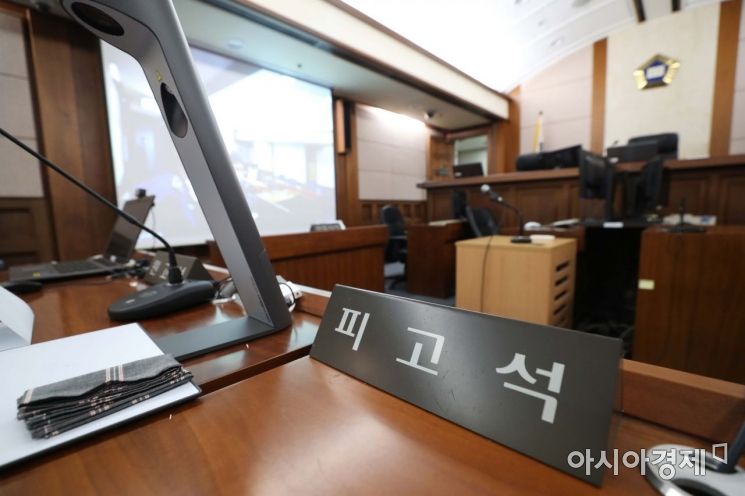 A courtroom at the Seoul High Court where the extradition hearing to decide whether to send Son Jung-woo, the operator of the world's largest child sexual exploitation site 'Welcome to Video,' to the United States was held. Photo by Moon Honam munonam@
The Supreme Court dismissed Kang's petition for constitutional review. At that time, the bench judged that while criminal procedures aimed at confirming the state's criminal jurisdiction have a system of appeal, the extradition approval decision is a special case recognized under the Criminal Extradition Act, not a decision under the Criminal Procedure Act. This meant that the absence of a provision allowing appeals against extradition review results does not imply unconstitutionality. Following this judgment, Kang's rehearing was naturally dismissed, and Kang was extradited to the U.S. A Ministry of Justice official stated, "The fact that Korea's criminal extradition review proceeds as a single-instance system without related regulations is also influenced by this precedent."
On the 9th, following a report by this paper ('Controversy over refusal to extradite Son Jeong-woo to the U.S. spreads... Ministry of Justice to create appeal procedures'), the Ministry of Justice officially announced through a press release, "We will promote amendments to the Criminal Extradition Act to introduce appeal procedures into the current single-instance criminal extradition review system." On the 7th, Song Young-gil, a member of the Democratic Party of Korea, also introduced a bill to amend the Criminal Extradition Act to allow rehearing of Seoul High Court decisions. Among the 78 countries that have extradition treaties with Korea, there is virtually no country where extradition reviews are conducted as a single-instance system without appeal procedures like Korea. Social discussions on related legislative amendments triggered by Son's case are expected to continue for the time being.
© The Asia Business Daily(www.asiae.co.kr). All rights reserved.


















