Annual fines imposed reach 700 billion KRW
Unclear which sectors receive the funds
Moves to amend laws to allocate for traffic safety
Will it be resolved in the 21st National Assembly?
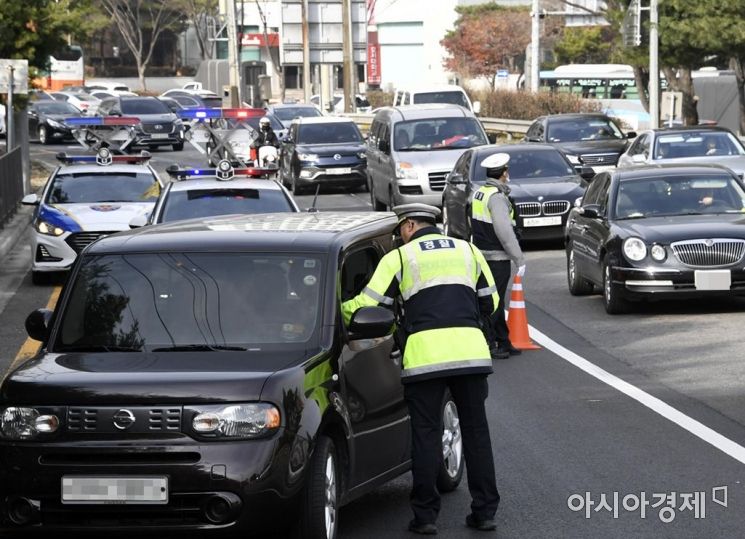
[Asia Economy Reporter Lee Gwan-joo] Although traffic violation fines and penalties amounting to hundreds of billions of won are imposed annually, there is still no way to know how much of this money is actually spent on traffic safety. Previously, numerous bills aimed at improving this issue were proposed in the 20th National Assembly, but all were abolished due to the expiration of the assembly's term. With heightened interest in traffic safety following the enforcement of laws such as the "Min-sik Law (Revised Road Traffic Act)," attention is focused on whether this issue can be resolved in the 21st National Assembly.
According to the National Police Agency on the 10th, traffic violation fines imposed by the police amounted to 726.343 billion won in 2017, 746.547 billion won in 2018, and 788.59 billion won last year, showing an increase each year. This is interpreted as a result of the expansion of unmanned enforcement cameras for securing traffic safety and strengthened police enforcement against violations. During this period, the number of traffic accident fatalities decreased to 4,185, 3,781, and 3,349 respectively.
The problem lies in the fact that fines and penalties imposed as a punitive measure to ensure traffic safety are being used in ways that do not align with their original purpose. All the money collected is incorporated into the national treasury and classified as non-tax revenue in the general account, making it impossible to know where and how it is spent. To address this, several bills were proposed in the 20th National Assembly, including the "Partial Amendment to the Road Traffic Act," the "Special Account Act for Traffic Safety Facilities," the "Special Account Act for Road Traffic Safety," and the "Special Account Act on the Installation and Management of Traffic Safety Facilities," but these were discarded without proper discussion due to the expiration of the term. Although these bills differ in details, they all include provisions to allocate a certain percentage of fines and penalties collected from traffic violations to traffic safety-related projects.
In particular, with the enforcement of the so-called Min-sik Law on March 25, the installation of speed enforcement cameras, speed bumps, traffic lights, and other facilities in school zones became mandatory. In line with this, the Ministry of the Interior and Safety announced plans to install 8,800 new unmanned enforcement cameras in school zones by 2022. Given the need for budgets to expand these facilities, the argument that fines and penalties should be used for traffic safety is gaining credibility. It is also reported that Im Ho-seon, a member of the Democratic Party and former deputy commissioner of the National Police Agency, is preparing to propose an amendment to the Road Traffic Act for this purpose.
The police also support the use of fines and penalties for improving traffic facilities. Since traffic facility improvements are carried out with local government budgets, disparities between regions occur, and the funds should be used for public safety in line with the purpose of imposing fines. A National Police Agency official stated, "We will actively cooperate when the bill is discussed in the National Assembly."
© The Asia Business Daily(www.asiae.co.kr). All rights reserved.
![Clutching a Stolen Dior Bag, Saying "I Hate Being Poor but Real"... The Grotesque Con of a "Human Knockoff" [Slate]](https://cwcontent.asiae.co.kr/asiaresize/183/2026021902243444107_1771435474.jpg)











