Institutional and Foreign Investors Continue Net Buying Amid KOSDAQ Selling Pressure
Reflecting Signs of Hanhanryeong Lift and H2 Earnings Expectations
[Asia Economy Reporter Minji Lee] Institutional and foreign investors, who had maintained a selling bias in the KOSDAQ market since the beginning of this month, have been buying media and entertainment-related stocks. This is interpreted as a sign that the securities industry has turned positive on media and entertainment stocks. Despite a difficult first half of the year due to the impact of COVID-19, there is an expectation of improved performance as China shows signs of lifting the Hanhanryeong (Korean Wave ban).
According to the Korea Exchange on the 10th, the KOSDAQ index surged about 6% from 727.58 to 772.90 in July. The index surpassing the 770 level is the first time in 1 year and 9 months since October 5, 2018 (773.70). During this period, the index is believed to have been driven up by individual investors. While individuals net purchased stocks worth 251.5 billion KRW in the market, foreigners and institutions net sold stocks worth 1.2 billion KRW and 53.8 billion KRW, respectively. In particular, institutions showed a net buying advantage in the KOSDAQ market on only two out of seven trading days this month. Last month as well, institutions maintained a net selling bias on all but five trading days in the KOSDAQ market.
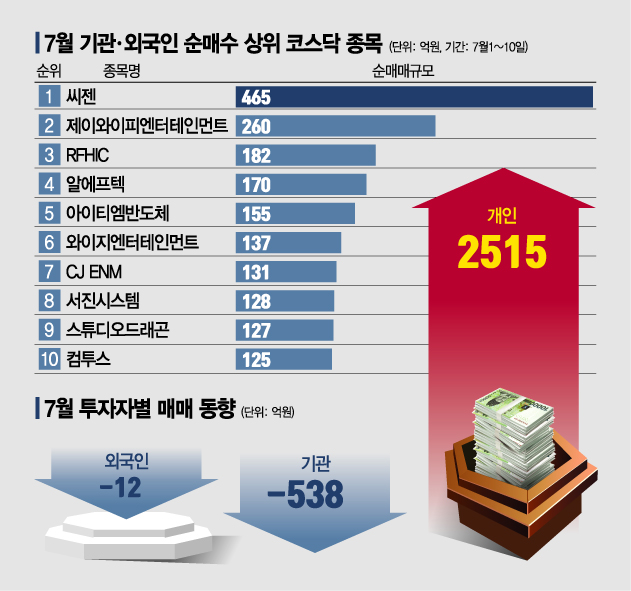
Despite this situation, the stocks favored by major market players were in the media and entertainment sectors. Five out of the top 10 most purchased stocks by institutions and foreigners belonged to the media and entertainment sectors. The stocks bought included JYP Entertainment, YG Entertainment, CJ ENM, Studio Dragon, and Com2uS.
Among these, the stock with the largest net purchase volume was JYP Entertainment, with stocks worth 26 billion KRW acquired. Institutions (19.4 billion KRW) bought more than foreigners (6.7 billion KRW) in this stock. YG Entertainment also saw stronger buying from institutions (11.7 billion KRW) than foreigners (2 billion KRW). Institutional investors also solely purchased stocks worth 30.2 billion KRW in SM Entertainment.
The reason institutional investors maintain a positive view on the three major music production companies in the entertainment sector is the expectation that these stocks will attract attention once the Hanhanryeong is lifted. Yuanta Securities, Hana Financial Investment, and KTB Investment & Securities have also raised their target prices. Even if the Hanhanryeong is lifted, immediate activities in China are unlikely due to COVID-19, but considering their entry into the new business of online concerts, they are judged to have excellent mid- to long-term growth potential.
Researcher Kihoon Lee of Hana Financial Investment explained, "Recently, an artist from YG Entertainment completed a contract as a local brand advertising model in China, and SM C&C, a subsidiary of SM Entertainment, sold the rights to an idol reality program to a Chinese OTT (online video service platform). Considering the current sales to China and the expectations for the lifting of the Hanhanryeong, a strong stock price rise is expected in the second half of the year."
In the media sector, buying interest increased for CJ ENM (13.1 billion KRW) and content production company Studio Dragon (12.7 billion KRW). Although both stocks are unlikely to deliver results exceeding expectations in the second quarter, the anticipation that broadcasting, digital advertising, and the film market will revive from the second half of the year is reflected. Studio Dragon is expected to achieve significant profit improvement as it can gain at least 10 billion KRW more profit per work if the Hanhanryeong is eased. Minjung Kim, a researcher at Hi Investment & Securities, said, "With expectations for the lifting of the Hanhanryeong, the weekly returns of CJ ENM and Studio Dragon reached 16% and 1.4%, respectively. Since securing Korean content is necessary to dominate the Asian OTT market, the corporate value of content production companies will continue to rise."
Among game stocks, Com2uS (12.5 billion KRW) attracted the most interest. Jinseong Choi, a researcher at Hyundai Motor Securities, explained, "Operating profit in the second quarter is estimated to increase by about 64% compared to the previous quarter. The stock price has been rising due to expectations for new releases, and since the company is actively pursuing mergers and acquisitions, the target price is raised by about 24% compared to the previous one."
Meanwhile, individual investors expanded their interest in pharmaceutical and bio stocks. Six out of the top 10 stocks were related to pharmaceuticals and bio. The top stock was Celltrion Healthcare, with purchases worth 247.5 billion KRW. When news spread that Celltrion's antibody under development was effective as a COVID-19 treatment, individuals bought Celltrion Healthcare stocks worth 33.6 billion KRW in a single day. In addition, buying interest increased for Withus Pharmaceutical (38.7 billion KRW), Hugel (37.2 billion KRW), Medison (23.4 billion KRW), Medytox (18.8 billion KRW), and iCure (18.7 billion KRW).
© The Asia Business Daily(www.asiae.co.kr). All rights reserved.

















