Ministry of Land, Infrastructure and Transport Urban Regeneration New Deal Public Contest, 4 Projects Selected with Total Budget of 103.7 Billion KRW
[Asia Economy Honam Reporting Headquarters Reporter Lee Hyung-kwon] Since 2013, Suncheon City's urban regeneration project has become a national standard model where residents directly plan and execute the project through alleyway tent discussions, consultations with experts from various fields, and intensive review meetings with 100 citizens.
According to Suncheon City on the 9th, the ongoing urban regeneration projects are part of the Ministry of Land, Infrastructure and Transport's Urban Regeneration New Deal contest projects. From 2014 to 2019, four projects were selected with a total budget of 103.7 billion KRW.
▶ Suncheon Hyangdong, Expansion of Youth Startups Utilizing Vacant Houses in Okridang-gil after Pilot Project
Hyangdong is a historic area where the Suncheonbu fortress existed during the Joseon Dynasty. Since the Joseon era when the Suncheon Dohobu was established, it was the military, administrative, and commercial center of the eastern Jeollanam-do region, and cultural assets such as the Palma Monument remain intact on Hyangdong Culture Street.
Urban regeneration centered on Hyangdong and Jungang-dong was selected as a pilot project by the Ministry of Land, Infrastructure and Transport in 2014, with a project budget of 20 billion KRW, completed in 2018.
Recognized for its successful urban regeneration, it was selected as the best local government by the Ministry for two consecutive years, and Suncheon City gained nationwide fame as a leading urban regeneration city.
Through the first phase of the pilot urban regeneration project, the floating population in the old downtown increased, about 40 social economy organizations were established, and quality jobs were created.
Most importantly, the residential satisfaction of old downtown residents improved from 72% in 2015 to 91% in 2018.
In 2019, Suncheon City hosted the Ministry of Land, Infrastructure and Transport's Urban Regeneration Festival for the first time among basic local governments, held at Hyangdong Culture Street, the center of the urban regeneration project.
About 80,000 people including local governments, cooperatives, activists, and residents related to urban regeneration nationwide visited Suncheon, and the paid urban regeneration alley tour attracted 1,080 participants from 52 teams across the country, who experienced and learned from Suncheon's excellent urban regeneration cases.
From the end of 2018, as the pilot project was concluding, young entrepreneurs and local artists voluntarily remodeled vacant stores and houses to start businesses. Currently, the area, densely packed with about 40 cafes and restaurants, is called ‘Okridang-gil’ and has gained nationwide fame.
▶ Suncheon Jangcheon-dong, Revitalizing Commercial District to Restore the Former Glory of Cheongsadeul
Jangcheon-dong was once the city center with the city hall and intercity bus terminal, but with the development of new towns in the 1990s, population declined and old and vacant buildings increased.
Suncheon City plans to revitalize the commercial district around Jangcheon-dong bus terminal through spatial innovation and creating a startup ecosystem, and restore the former glory of Cheongsadeul by realizing alley autonomy through various hub spaces.
▶ ‘Commercial Vitality’ through Urban Spatial Innovation
By applying Universal Design (UD) to improve sidewalk environments and replacing signs, a competitive representative scenic street is being created. Customized consulting supports menu improvement and service education for dining businesses to enhance street competitiveness.
Gardens are being created on rooftops of major buildings to strengthen Suncheon's image as an ecological city, and aging accommodation facilities are being improved to attract stay-type tourists by reflecting tourism trends such as ‘living for a month’.
To solve traffic problems, public parking lots are being established, pedestrian convenience facilities for the transportation vulnerable are being expanded, and a ‘Safe and Secure Village Creation’ project led by residents is underway.
▶ Creating a Startup Ecosystem and ‘Job Creation’
Centered on Suncheon Comprehensive Bus Terminal, a startup environment will be created to generate new jobs and revitalize alleys.
Old buildings will be remodeled to create the Mongmirak Center (tentative name), which will combine functions such as shared kitchens, pop-up stores, meeting rooms, and music club rooms, along with small-scale exhibition halls and youth startup spaces.
The city rents vacant stores to aspiring entrepreneurs and plans to create new jobs by planning shared startup workshops. Additionally, through ‘Renovation School’ and ‘Renovation League,’ fresh ideas will be shared and prospective and new entrepreneurs will be discovered.
▶ Strengthening Alley Autonomy to ‘Restore Resident Communities’
Suncheon City plans to promote resident-led projects to build a sustainable urban regeneration platform and preserve community spirit.
An urban regeneration residents' council has been formed to share opinions on creating hub spaces and support various proposal contest projects, realizing alley autonomy.
This will be further systematized by discovering and nurturing social economy organizations such as village management cooperatives to build a ‘Sustainable Urban Regeneration S/W Platform.’
Plans include developing and operating various contents and managing hub facilities to support independence as the main agents of urban regeneration.
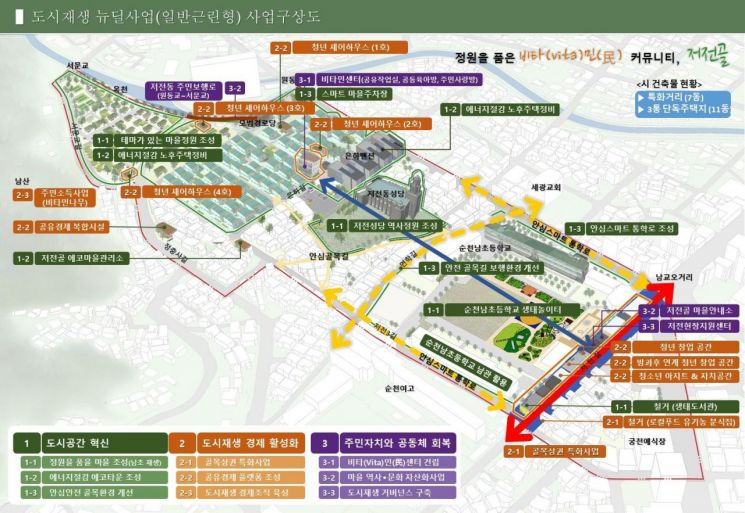
▶ Suncheon Jeojeon-dong, Transforming into a Vibrant Vitamin Garden Village for Residents
Jeojeon-dong is an old residential area of Suncheon, where population outflow and alley commercial decline occurred due to new town development and student number decrease in the 1990s.
Suncheon City plans to revitalize the commercial district and attract youth by implementing the nation’s first school regeneration project and creating a garden village, making it a vibrant vitamin village for residents.
▶ ‘Ecological Village Garden Creation’ with Residents
Suncheon City is promoting an urban regeneration project themed on gardens to restore resident participation and local community.
Fences on public and private land will be lowered, and gate rooms demolished to create gardens. The project aims to create village gardens by greening alleys, rooftops, and walls to form gardens in daily life.
Participants will create and maintain their own gardens with the help of garden experts. Additionally, a Jeojeon-dong village hotel linked to the garden village will be created to realize village profit projects.
This shift in awareness to create the entire city as a garden with residents will be the cornerstone for the successful hosting of the 2023 Suncheon Bay International Garden Expo.
▶ Nation’s First ‘School Regeneration Innovation Role Model’ Promotion
Suncheon City is collaborating with Suncheon Nam Elementary School to create a school regeneration role model. The project aims to utilize idle school spaces due to declining student numbers as hub spaces for students and the local community.
The four main projects are ‘Ecological Playground Creation,’ ‘Fence Landscape Improvement,’ ‘Smart School Route Creation,’ and ‘Nam Building Resident Shared Space Creation.’ To this end, a ‘School Regeneration Design Team’ was formed with Nam Elementary students to design the ecological playground and create a safety map around the school.
▶ ‘Commercial Revitalization’ Using Vacant Stores
Suncheon City supports vacant store startups and specialized street creation projects on the one-way street in Jeojeon-dong (Namgyo Five-way Intersection to Suncheon Girls' High School).
The Sangsang University course supporting vacant store startups is open to individuals or groups with startup ideas. Through startup consulting, education, and branding (BI construction), ideas are concretized and store remodeling is supported.
Suncheon City plans to induce the formation of commercial communities linking urban regeneration and startups and prepare sustainable operation and management plans after project completion.
▶ Creating ‘Vibrant Urban Spaces’ through Youth Population Influx
Suncheon City is resolving youth housing issues and creating vibrant urban spaces by operating Suncheon-style share houses using vacant houses in Jeojeon-dong.
Operators for five vacant buildings have been selected, and resident spaces are being prepared. Once space preparation is complete, operators will recruit youth residents and run share houses through community and settlement programs.
Youth residents will play a leading role in creating a lively community by participating in resident workshops and local community activities.
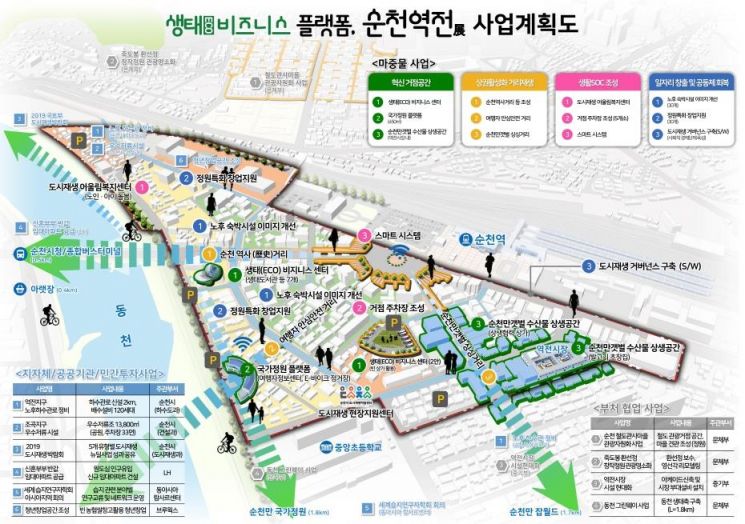
▶ Suncheon Station Area, Drawing a Blueprint for a 21st Century Railway Renaissance Future City
The Suncheon station area is a typical old town around the station, experiencing decline in population, number of businesses, and building aging. Although the KTX station maintains floating population, the central commercial functions have rapidly diminished due to urban expansion.
Therefore, around Suncheon Station, hub spaces such as the Eco Business Platform, Merchant Win-Win Cooperation Center, and Harmony Welfare Center are being created, focusing on startups and resident job creation.
In particular, the startup incubation center, AR/VR hub center, and smart city projects will be promoted alongside urban regeneration to draw a blueprint for a 21st-century railway renaissance future city.
▶ Leading the Future Economy through Startup Incubation and Smart City Infrastructure
Suncheon is the only city nationwide selected for a smart city-type urban regeneration project, implementing smart streets where visitors can experience necessary information through humanoid smart robots providing ecological tourism information services, augmented reality (AR), and mixed reality (MR).
The ‘Eco Business Platform,’ a newly constructed three-story building near Dongcheon Greenway, will house the largest startup incubation space in the Honam region, VR/AR production hub center, and business caf?, becoming the center of the future smart city.
At the Eco Business Platform, prospective entrepreneurs will be discovered, nurtured, and supported, and startup companies created, providing one-stop support at each stage to succeed with just one idea.
▶ Revitalizing Traditional Market Commercial District through Win-Win Cooperation at Station Fish Market
Suncheon Station Fish Market, operating since the 1970s every dawn, is the largest seafood market in eastern Jeollanam-do with 75 stores.
Although loved as a traditional market for a long time, it has poor conditions with almost no rest areas, educational spaces for merchants, or convenience facilities for users.
While promoting station area urban regeneration, the city is improving poor conditions such as creating rest areas, photo zones, and convenience facilities in cooperation with the merchants' association, and especially plans to improve hygiene issues in the seafood market to make it a traditional market that visitors want to return to.
The Win-Win Cooperation Center, a shared space for merchants, will operate an urban regeneration university offering consulting, customer service, accounting, and other small business education, as well as a community space for merchants and users and a small business startup academy.
▶ Fostering Local Communities and Street Regeneration as ‘Vitality for Residents’ Lives’
Four years ago, the grain warehouse in the Suncheon station area was remodeled into ‘Cheongchun Warehouse,’ a youth startup incubator space, gaining nationwide fame. As youth startup success models were created, startups have spread to surrounding areas.
Diverse community activities involving youth entrepreneurs, existing merchants, and residents are being attempted.
Through resident community profit projects, busking performances, idea festivals, and resident capacity-building education, youth entrepreneurs and existing merchants will coexist and become new sources of vitality for the region.
Suncheon is undergoing a transformation through urban regeneration projects created by residents focusing on ecology and economy.
© The Asia Business Daily(www.asiae.co.kr). All rights reserved.


















