SK Telecom, Korea Meteorological Administration, and Kyungpook National University Pilot 'Earthquake Observation Network'
Install Plug-in Sensors Priced Around 60,000 KRW... Distinguish Between Normal Vibrations and Earthquakes
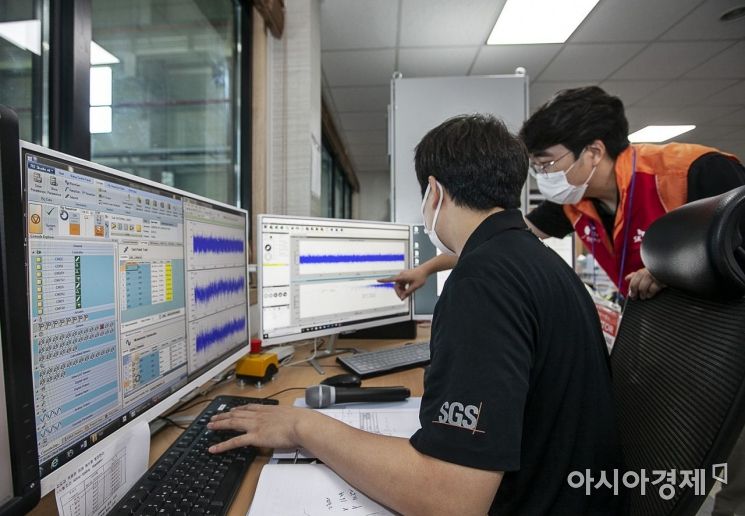 An SK Telecom engineer is inspecting an earthquake detection sensor linked with a base station. (Photo by SKT)
[Asia Economy Reporter Han Jinju] SK Telecom will install sensors capable of detecting earthquakes at 3,000 base stations and agency locations. Based on densely collected data at a low cost, they are exploring ways to collaborate with the Korea Meteorological Administration (KMA) to utilize the data for earthquake information services.
On the 9th, SK Telecom conducted a simulated earthquake test together with the KMA and Kyungpook National University at the Korea SGS Dongtan Testing Center located in Hwaseong-si, Gyeonggi-do. They demonstrated the process of collecting vibration data from sensors installed at base stations by generating vibrations similar to an earthquake of magnitude 6.0 or higher. As the simulated earthquake equipment moved at a magnitude 6.0 level, the base station equipment shook, and the sensors installed on the base station recognized the vibrations, displaying waveforms on the monitor.
The KMA collects earthquake information from 338 seismic observation stations and issues an earthquake early warning within 7 to 25 seconds after detecting an earthquake. Earthquake waves come in various forms, among which the P-wave (primary wave) propagates first, followed by the secondary S-wave. The earthquake early warning service is issued upon detecting the P-wave before the S-wave arrives. This allows disaster messages to be received before feeling the S-wave vibrations. Typically, if it takes 5 seconds for the S-wave to arrive, nearby evacuation such as getting under a desk is possible, and if it takes more than 10 seconds, evacuation outside the building is also feasible.
The data used by the KMA to analyze earthquakes is collected from seismic observation stations. The equipment used at these stations is high-performance and therefore expensive. Installing two sensors, an accelerometer and a velocimeter, costs up to 200 million KRW. To install seismic observation equipment, strict standards such as optical sensor performance must be met. In South Korea, observation stations are installed approximately every 18 km. Since the Gyeongju earthquake in 2016, the frequency of earthquakes in the country has increased. Last year, there were a total of 88 earthquakes of magnitude 2.0 or higher on the Korean Peninsula.
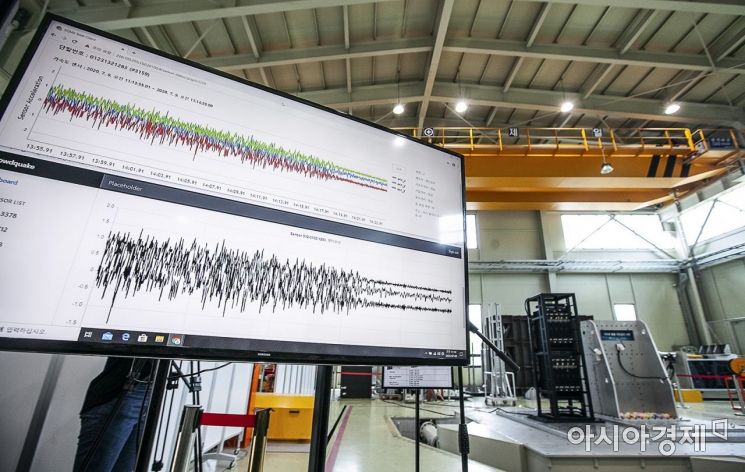 Demonstration of the 'Earthquake Observation Network' that can be linked with the earthquake detection and warning system (Photo by SKT)
Professor Kwon Young-woo of the Department of Computer Science at Kyungpook National University said, "I started this research thinking that by using small sensors, Internet of Things (IoT) technology, and cloud computing, we could supplement the earthquake early warning service even if the accuracy is somewhat lower." He added, "Analyzing the performance of the earthquake detection sensors, we found that they could sufficiently detect earthquakes of magnitude 3.0 or higher within 10 km."
The small accelerometer sensor developed by SK Telecom is about the size of a hand span and plugs into a 220V outlet. Although its accuracy is lower compared to the equipment used at observation stations, its price is only around 60,000 KRW per unit, and it is easy to install. It collects vibration data 100 times per second and distinguishes between general vibrations and earthquakes. SK Telecom, together with the KMA and Kyungpook National University, is piloting the construction of an "earthquake observation network" that can be linked to the Korean Peninsula's earthquake detection and warning system.
Lee Ji-min, a researcher at the KMA's Earthquake and Volcano Research Division, explained, "Installing seismic observation equipment requires meeting various conditions, but the small accelerometer sensor developed by SKT is low-cost and can be densely installed and operated at base stations, allowing detailed measurement of information around the base stations."
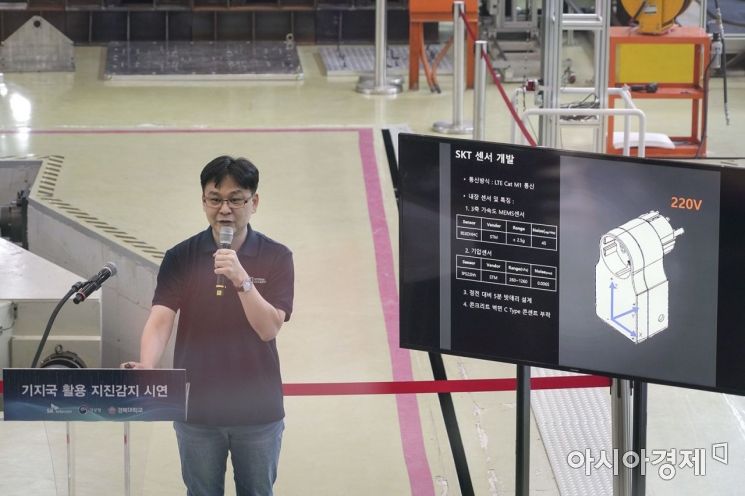 Lee Sang-jin, Head of SKT 5GX Infra BM Team, is explaining the 'Seismic Observation Network' pilot construction project at Korea SGS Co., Ltd. Dongtan Testing Center.
SK Telecom plans to expand the earthquake detection sensors installed at 3,000 agencies and base stations to 8,000 locations nationwide, including police stations and elementary schools, within this year. They expect that the earthquake observation network thus established can be used as auxiliary equipment for earthquake observation by the KMA. SK Telecom, the KMA, and Kyungpook National University will promote research to advance the national earthquake response system until 2021. Although currently at the research stage, if the accuracy of the information collected by SKT's sensors meets certain standards, it is anticipated that a public-private cooperative earthquake information service can be established.
SK Telecom classifies 24-hour real-time vibration data and atmospheric pressure detected by the earthquake detection sensors through the SKT collection server (EQMS) and sends it to the KMA. The KMA is conducting research to integrate the provided vibration data with the national earthquake observation network to utilize it for seismic intensity information production and earthquake early warning analysis.
Lee Ji-min, a researcher at the KMA, said, "To effectively deliver early warnings, high-quality observation equipment and precise monitoring are essential. The use of sensors in actual earthquake observation will be reviewed after the research concludes next year." She added, "Within the limits of avoiding false alarms, the reliability of these sensors for rapid earthquake early warning has not yet been secured."
© The Asia Business Daily(www.asiae.co.kr). All rights reserved.



















