First Positive Case Confirmed at Gangbuk-gu Daycare Center Through 'Pooling Method' Testing
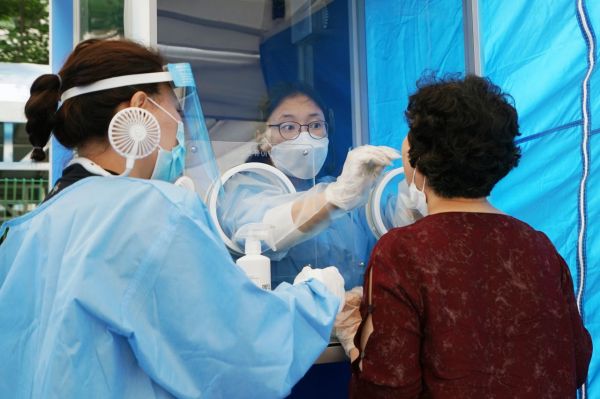
[Asia Economy Reporter Jo In-kyung] Seoul City has reported its first asymptomatic COVID-19 case through proactive testing conducted at high-risk facilities, workplaces, and public recruitment of the general population as part of its coronavirus prevention efforts.
Park Yumi, the quarantine controller of Seoul City's Disaster and Safety Countermeasures Headquarters, held a briefing on the afternoon of the 9th and announced that the first asymptomatic confirmed case was identified through proactive testing that day. Currently, a pooling test method is used, combining samples from 5 to 10 people for testing. In the early morning of that day, a group of 5 people tested positive, and individual tests are now underway, according to Seoul City’s explanation.
The city immediately took measures equivalent to those for confirmed cases, placing all residents and staff of the daycare center under proactive self-quarantine and conducting emergency disinfection.
Earlier, after an octogenarian resident who used the Seongsim Daycare Center in Dobong-gu tested positive on the 12th of last month, 47 confirmed cases occurred among users, their families, and acquaintances. In response, the city prioritized proactive testing for all staff and users of elderly welfare facilities such as nursing homes and daycare centers across the city, and by the 8th of this month, a total of 11,382 people had been tested.
Including this, the total number of people tested proactively by the city since last month is 22,394, comprising 20,432 high-risk groups and 1,962 general public recruited through open calls. Among them, 595 staff members of English kindergartens in Seocho-gu, 6,597 boarding middle and high school students and faculty, 1,858 homeless people, residents of jjokbangchon (small-room villages), undocumented foreign residents, and the general public recruited through open calls all tested negative.
Controller Park said, "A cluster infection almost occurred at a center used by elderly people with vulnerable health, but proactive testing allowed us to detect asymptomatic carriers first and preemptively block 'silent transmission.' Although the city's active diagnostic testing seems to have reduced asymptomatic transmission, the proportion of 'cases with unknown infection routes' is increasing, so we cannot be complacent."
The city plans to further expand the scope of proactive testing, considering that recent confirmed cases are concentrated in the metropolitan area and the need to prepare for a second wave. The testing targets will be expanded to include not only high-risk facilities and the general public selected by the proactive testing committee but also workers at facilities where confirmed cases have occurred but were excluded from testing because they were not classified as contacts. Additionally, the city plans to identify more high-risk areas where cluster infections could occur.
Controller Park said, "General citizens can also receive free proactive testing simply by applying through the city’s website. If applications close during the week, they can apply again the following Monday, ensuring that all citizens who want to be tested can do so."
© The Asia Business Daily(www.asiae.co.kr). All rights reserved.

















