Courier Worker in Gyeongnam Dies of Acute Myocardial Infarction on 28th Last Month... Average 16-Hour Workdays
Labor Intensity Increases Due to Surge in Volume Amid COVID-19
Frequent Violations of Labor Standards Act... Inadequate Protection for Working Hours and Pay
Courier Union Urges Prompt Measures to Prevent Recurrence
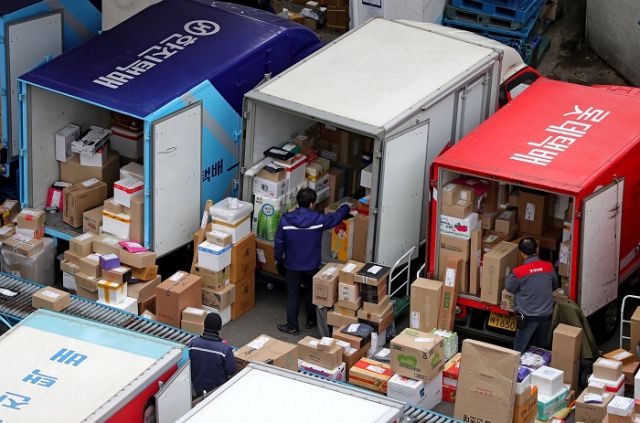
[Asia Economy reporters Seunggon Han and intern Yeonju Kim] Due to the COVID-19 pandemic, face-to-face shopping has decreased, while non-face-to-face services such as parcel delivery have unexpectedly flourished. As a result, there have been consecutive deaths from overwork among delivery workers, raising calls to improve their working conditions.
On the 28th of last month, Seo Hyungwook (47, male), who worked at a CJ Logistics branch in Gimhae, Gyeongnam, died of acute myocardial infarction. Seo reportedly worked 16 hours a day as the volume surged due to COVID-19. It was reported that he had been experiencing chest pain for two months before his death but had no time to visit a hospital because of work.
Seo’s case is not unique in facing health threats due to overwork leading to death. In May, a delivery worker in his 40s in Gwangju suddenly died while handling about 600 parcels daily. He reportedly forced himself to work about 14 hours a day to meet the set delivery volume.
According to a 2017 report by the Korea Labor and Society Institute, the average daily working hours of delivery workers is 13 hours and 22 minutes. Their annual average working hours exceed twice the OECD average. With the increase in non-face-to-face transactions due to COVID-19, the workload has also increased, intensifying labor intensity.
Despite the consecutive deaths from overwork among delivery workers, improvements in their working conditions have not been easily achieved.
Delivery workers are classified as 'special employment workers.' Therefore, they are recognized as individual business owners who find customers or provide labor under delegation or subcontract contracts rather than employment contracts, and receive allowances based on performance. Because of this, they are not guaranteed rights as workers, including working and rest hours specified under the Labor Standards Act.
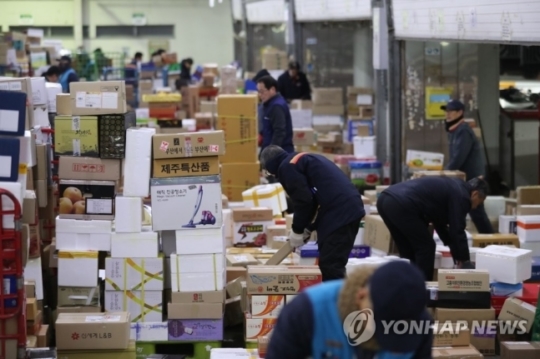
According to a labor inspection conducted by the Ministry of Employment and Labor on the 28th of last month targeting 11 logistics centers of four major parcel delivery companies and 17 subcontractors, there were 98 violations of labor standards laws, including wage and working hour regulations.
Among these, non-payment of overtime, night, and holiday work allowances (28 cases) was the most frequent, and the total unpaid amount for overtime, night, holiday work allowances, weekly holiday allowances, and annual leave allowances at the 17 subcontractors under inspection reached about 1.2 billion KRW.
There were also eight cases where legally mandated rest periods were not applied. Six companies violated the regulation requiring 11 consecutive hours of rest between working days. According to the Labor Standards Act, if working hours are 4 hours, at least 30 minutes of rest must be given; if 8 hours, at least 1 hour of rest must be provided.
However, even if the employer violates the Labor Standards Act, there is little recourse. Being workers outside the legal framework and in a subordinate ('eul') position on site, they have no choice but to endure unfair treatment or illness silently.
Delivery worker Kim (40) said, "When I ask to rest because I can’t endure it anymore, they respond as if telling me to quit, so it’s hard to complain," adding, "I think workers’ rights should be legally protected. If this pressure over workload continues, more people will keep dying."
He continued, "Parcel volumes have increased about 1.5 times due to COVID-19, but the labor intensity felt by delivery workers has increased nearly 2 to 3 times," and said, "I hope they can at least let us rest once or twice a year."
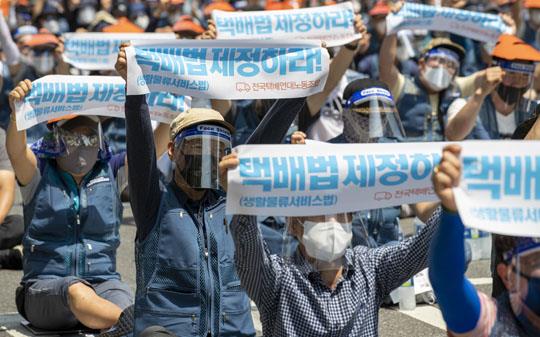 On the afternoon of the 28th of last month, members of the National Courier Solidarity Labor Union urged the enactment of the "Courier Act" at the 2020 National Courier Workers' Rally held near Euljiro Entrance in Seoul. Photo by Yonhap News
Kim Segyu, Director of Education and Publicity at the National Parcel Delivery Solidarity Union, told Asia Economy in a phone interview, "The most serious problem is the long hours of hard labor," and pointed out, "The labor intensity has worsened due to the prolonged COVID-19 situation."
Kim emphasized, "Basic rights must be guaranteed so that workers can rest if they feel even slight physical abnormalities," and added, "Creating an environment where workers can comfortably visit hospitals when sick can prevent the overwork deaths of delivery workers that have occurred since before."
Meanwhile, the National Parcel Delivery Solidarity Union under the Korean Confederation of Trade Unions (KCTU) held a press conference on the 8th, urging, "Provide answers regarding the repeated overwork deaths of delivery workers since the COVID-19 pandemic."
The union stated, "There have been tragic cases of healthy workers dying from overwork," and noted, "This is already the third death this year following the March death of a Coupang delivery worker and the May death of a CJ Logistics delivery worker in Gwangju."
They added, "Delivery workers have been handling increased volumes without even guaranteed rest time since COVID-19," and stressed, "The government and parcel delivery companies must take responsibility for the continued deaths of delivery workers and prepare measures in response to the deceased’s deaths."
© The Asia Business Daily(www.asiae.co.kr). All rights reserved.



















