Police Reform Network Presents 'Three Major Directions and Six Proposals for Police Reform'
[Asia Economy Reporter Song Seung-yoon] As the adjustment of investigative authority between the prosecution and police is expected to expand the police's powers, civic groups have proposed police reform measures such as strengthening democratic control, decentralizing and reducing powers, separating investigative and administrative police, and abolishing intelligence police.
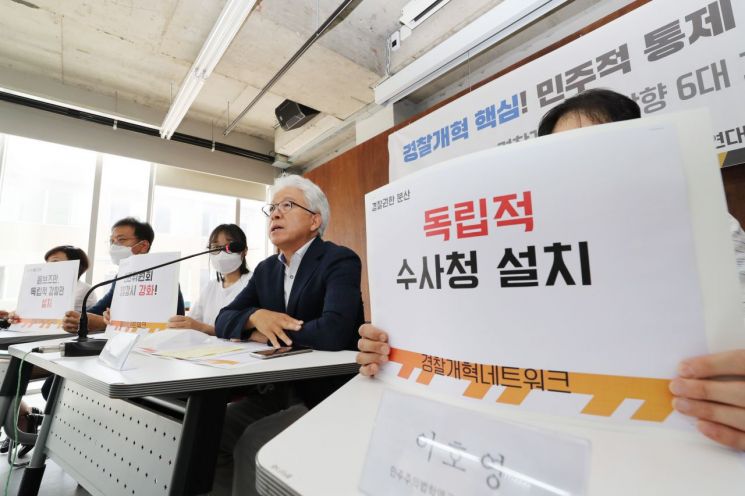
The Police Reform Network, launched by organizations including People’s Solidarity for Participatory Democracy, the Citizens’ Coalition for Economic Justice, and the Lawyers for a Democratic Society, held a press conference at People’s Solidarity on the morning of the 9th demanding police reform and presented three major directions and six proposals for police reform.
The Police Reform Network suggested ▲strengthening democratic control ▲decentralizing police powers ▲reducing police powers as the three major directions for police reform. Among these, they identified democratic control measures as the priority issue for discussion. They argued that for democratic control of the police, the Police Commission, which currently functions mainly as an advisory body, should be established as a substantive ministerial-level administrative agency, guaranteeing authority over police personnel including the Commissioner General and the head of the investigative agency, as well as budget review and approval rights.
Lee Ho-young, General Secretary of the Democracy Law Research Association, stated, "The exercise of police power involves coercive force and can at any time infringe on citizens’ fundamental rights, so ‘democratic control’ is the most important aspect of police reform," emphasizing, "In light of the recent ‘adjustment of investigative authority between prosecution and police,’ democratic control over the expanded police powers must be urgently discussed."
According to the three major directions, the Police Reform Network also proposed six measures: ▲realizing the Police Commission as a collegiate administrative agency ▲establishing an ombudsman and an independent inspector general and strengthening police oversight by the National Human Rights Commission ▲separating judicial police and administrative police: establishing an independent investigative agency ▲introducing a substantive autonomous police system: fully transferring administrative police functions ▲abolishing intelligence police ▲reducing security police.
The Police Reform Network claimed that citizens’ voices are being excluded from the current police reform discussions led mainly by the government and ruling party. They also pointed out that the police reform measures currently under discussion tend to expand the police organization and powers rather than guarantee citizens’ fundamental rights and reduce the powers of law enforcement agencies.
The Police Reform Network plans to hold a series of discussions on the 15th, 22nd, and 29th of this month on the topics of decentralization of police powers and the autonomous police system, democratic control of the police and realization of the Police Commission, and abolition of intelligence police and reduction of security police, continuing the discussion on the police reform measures announced on this day.
© The Asia Business Daily(www.asiae.co.kr). All rights reserved.
![Clutching a Stolen Dior Bag, Saying "I Hate Being Poor but Real"... The Grotesque Con of a "Human Knockoff" [Slate]](https://cwcontent.asiae.co.kr/asiaresize/183/2026021902243444107_1771435474.jpg)
















