Dollar in 'Death Cross' State - Gold on the Rise... Different Pattern from Last March
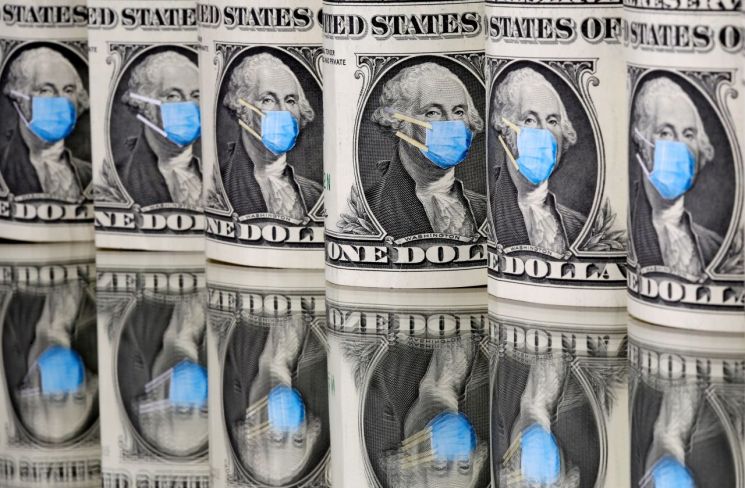
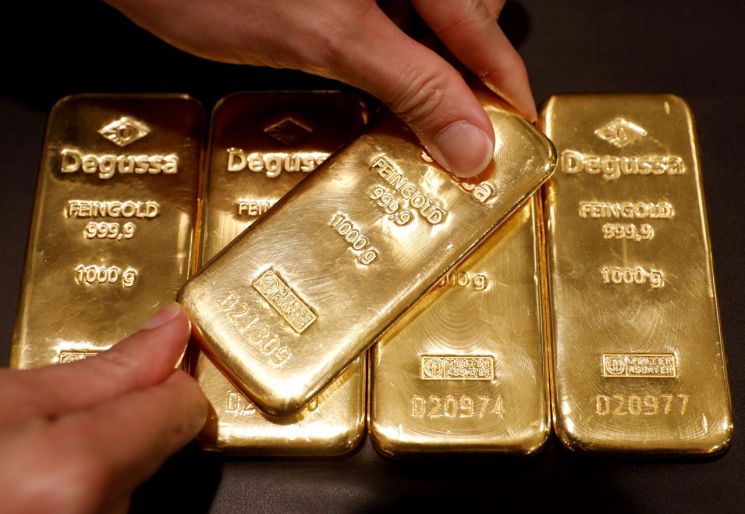
[Asia Economy Reporter Jeong Hyunjin] As concerns over the resurgence of the novel coronavirus infection (COVID-19) grow, the fortunes of safe-haven assets, the dollar and gold, are once again diverging. Unlike last March when the spread of COVID-19 began in the United States, the dollar has recently shown weakness while gold prices have surpassed $1,820, the highest level in nine years. The aggressive fiscal and monetary policies implemented over the past four months and ongoing concerns about a COVID-19 resurgence are believed to have altered the trajectories of these two safe-haven assets.
In particular, the dollar has experienced a death cross phenomenon, where the 50-day short-term moving average falls below the long-term moving average, suggesting that the dollar's weakness may continue as a trend.
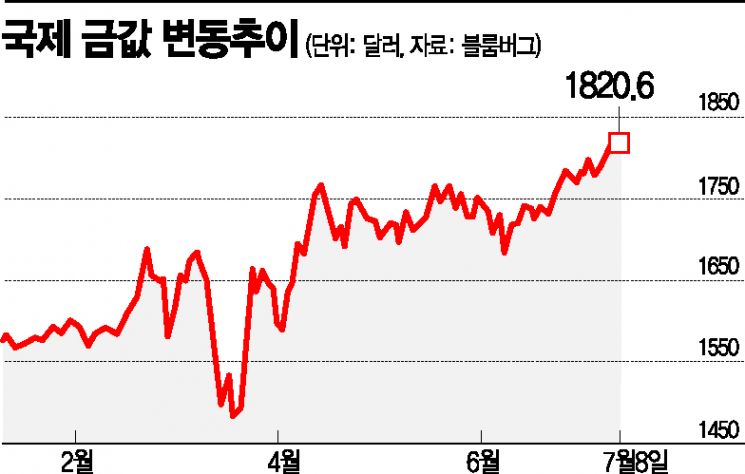
According to Bloomberg and others on the 8th (local time), August delivery gold on the New York Mercantile Exchange closed at $1,820.60 per ounce, up 0.59% ($10.70) from the previous day. Gold prices surpassed $1,800 for the second consecutive day, setting a new nine-year high. After falling to the $1,400 range last March, gold prices have been rising steadily. The market is watching closely to see if gold will surpass the all-time high of $1,891.90 set in August 2011.
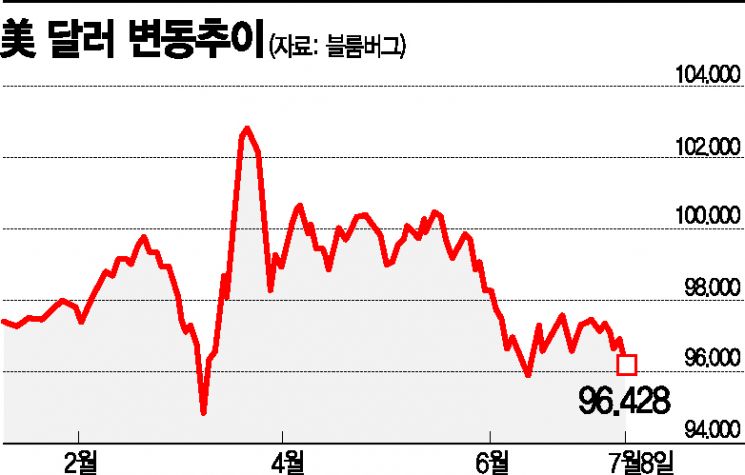
On the other hand, the dollar's value is steadily declining. The dollar index fell 0.47% to 96.428 compared to the previous day. After reaching a peak of 102.817 on March 20, the dollar index fluctuated before plunging sharply in late May and early June amid ongoing anti-racism protests in the U.S. and growing concerns over a COVID-19 resurgence, resulting in an overall weak trend. The dollar index on this day was the lowest since June 9.
The shift in the status of safe-haven assets is due to the responses aimed at mitigating the impact of COVID-19 influencing investor behavior. After the outbreak of COVID-19, the U.S. Federal Reserve (Fed) sharply cut the benchmark interest rate, which also lowered Treasury yields, relatively boosting gold's position among safe-haven assets. The World Gold Council announced that $39.5 billion (734 tons of gold) flowed into gold-backed exchange-traded funds (ETFs) in the first half of this year. This volume surpasses 646 tons in 2009 and $23 billion in dollar terms in 2016.
The dollar's popularity has waned as liquidity increased due to the Fed's repeated asset purchases. Although the Consumer Price Index (CPI) remains below 1%, expectations are growing that it will eventually rise, eroding the currency's value. Additionally, with the possibility of a significant increase in the U.S. fiscal deficit due to multi-trillion-dollar large-scale fiscal policies, there is ample potential for the dollar's value to decline.
Bank of America (BoA) analyzed on this day that, based on early-week conditions, the dollar is showing a 'death cross' pattern where the 50-day moving average falls below the 200-day moving average. The occurrence of a death cross indicates a high likelihood of a long-term decline in the dollar. BoA's analysis supports the outlook for a long-term weakening of the dollar. Following Professor Barry Eichengreen of UC Berkeley last month, this month Ray Dalio, CEO of the world's largest hedge fund Bridgewater, and Jeffrey Gundlach, CEO of DoubleLine Capital known as the 'New Bond King,' have also predicted a long-term dollar weakness, stating that the dollar is in a 'crisis' situation.
However, some argue that optimism about the U.S. economy could revive depending on the COVID-19 resurgence in the U.S., the Trump administration's response, the outcome of the upcoming U.S. presidential election, and consumer spending willingness, which could improve investor sentiment and increase the dollar's value.
© The Asia Business Daily(www.asiae.co.kr). All rights reserved.



















