Transfer of Financial Services Commission Functions, Strengthening Independence of Sanctions Committee
Continuous Legislative Efforts for Fundamental Reorganization of Policy and Supervision
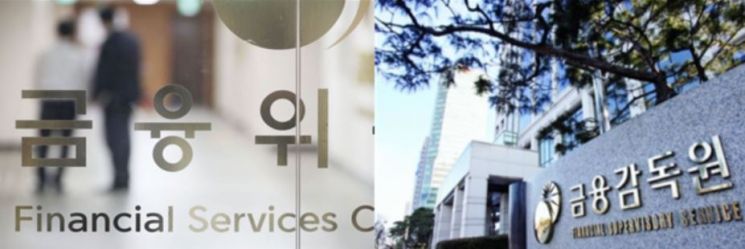
[Asia Economy Reporter Kim Hyo-jin] Attempts to structurally reform the formulation of financial policies and the functions of financial supervision are continuously emerging in the National Assembly. There is even a legislative push to dismantle the Financial Services Commission (FSC).
Amid frequent recent financial accidents and the responses to them, criticism toward financial and supervisory authorities has intensified, and internal conflicts have also surfaced. If discussions become full-fledged, the entire financial sector's interest is expected to rise further.
According to financial and political circles on the 9th, Seong Il-jong, a member of the Future United Party, is preparing to propose a Financial Supervisory Service Act and a Government Organization Act amendment that fundamentally reorganize the policy functions of the FSC and the supervisory functions of the Financial Supervisory Service (FSS).
The core of the bill is to transfer the domestic financial policy functions performed by the FSC to the Ministry of Economy and Finance, and to transfer the financial supervisory functions to the FSS. Additionally, the bill establishes a Financial Supervisory Committee within the FSS as the highest decision-making body to deliberate and resolve matters related to financial supervision and financial consumer protection.
Currently, the FSS performs financial supervisory duties entrusted by the FSC. According to the bill, the FSC would be abolished.
Seong pointed out, "Currently, the FSC performs multiple functions simultaneously, including financial policy, supervision, inspection, and sanctions of financial companies, which leads to criticism that supervisory functions are neglected."
He also explained the background of the legislative push, saying, "The Ministry of Economy and Finance handles international financial policy, while the FSC handles domestic financial policy, causing a policy gap and reducing the efficiency and consistency of financial policies."
To propose the bill, the consent of more than 10 lawmakers is required. Because the issue is highly disruptive, initially, few lawmakers were willing to join the proposal, but recently, the number of lawmakers expressing sympathy has increased, according to Seong's office.
Seong originally planned to propose the bill last month. A staff member from his office said, "We expect to propose the bill soon," adding, "Once proposed, we plan to actively conduct various discussions and debates."
From the same party, Song Eon-seok proposed an amendment to the Financial Services Commission Establishment Act last month. The amendment aims to enhance the independence and objectivity of the Sanctions Review Committee, which is the FSS’s financial company sanctions body.
To this end, the amendment stipulates the legal basis for the FSS Sanctions Review Committee and requires that civilian members be appointed based on recommendations from external organizations and associations such as the Korea Federation of Banks and the Korea Insurance Association.
The FSS Sanctions Review Committee consists of four FSS officials and up to 20 civilian members. Currently, all civilian members are appointed by the FSS Governor.
Song criticized, "Civilian members appointed by the FSS Governor find it difficult to oppose the FSS’s opinions, so the sanction decisions are merely procedural formalities and are effectively decided according to the FSS’s will."
Earlier this year, the FSS imposed heavy sanctions on CEOs of financial companies over the incomplete sales of overseas interest rate-linked derivative-linked funds (DLF). These CEOs filed administrative lawsuits against the sanctions, and during the litigation, courts pointed out the possibility of the FSS’s overreach, escalating the controversy.
A financial sector official said, "The two bills differ in direction and problem recognition, but both raise structural issues regarding the duplicated and dualized financial policy and supervisory functions, so overall, they can be seen as 'financial authority reform bills.'"
The official added, "If the current situation continues, where the FSC and FSS engage in a blame game over successive private equity fund accidents, voices saying 'this can no longer be tolerated' will grow louder. If they fail to find an effective coexistence method on their own, they will equally face reform efforts."
© The Asia Business Daily(www.asiae.co.kr). All rights reserved.

















