After Official High-Level Foreign Ministry Talks, Emphasizing ROK-US Alliance to Korea and Urging North Korea to Change Attitude
Deadlock in Denuclearization Talks, Shifting Responsibility to North Korea... Unusual Criticism Linking Choe Son-hui and Bolton as "Trapped in Old Mindset"
Public Backlash Leads to 'ROK-US Working Group' Improvement, No Concrete Discussions Yet
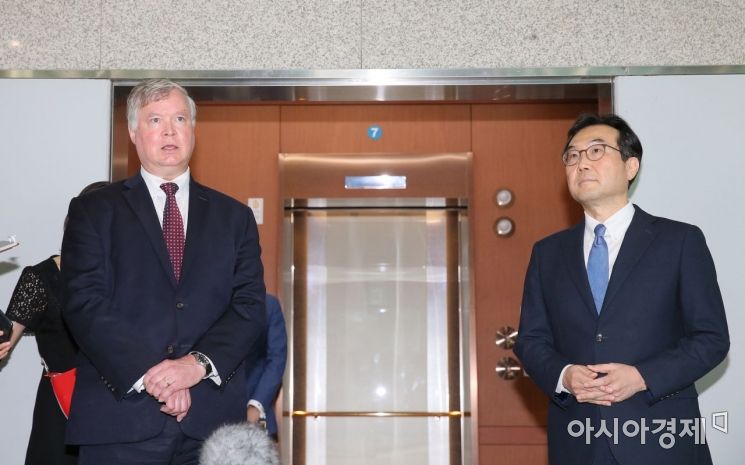 Lee Do-hoon, Director General for Korean Peninsula Peace and Security Affairs, and Stephen Biegun, U.S. Deputy Secretary of State and Special Representative for North Korea Policy, are leaving the Ministry of Foreign Affairs building in Seoul on the morning of the 8th after concluding their talks and are giving an interview to the press. Photo by Joint Press Corps
[Asia Economy Reporter Lim Cheol-young] There was no 'message to North Korea' that could lead the change in the rapidly frozen situation on the Korean Peninsula after the dialogue deadlock. Steven Biegun, U.S. Deputy Secretary of State and Special Representative for North Korea, who visited Korea for the first time in seven months, emphasized the ROK-U.S. alliance and urged North Korea to change its attitude after a series of meetings at the Ministry of Foreign Affairs with Minister Kang Kyung-wha, First Vice Minister Cho Se-young, and Lee Do-hoon, Director-General for Korean Peninsula Peace and Security Affairs.
However, no concrete moves to prepare alternatives to bring North Korea to the negotiating table and promote the Korean Peninsula peace process were detected. On the contrary, U.S. Secretary of Defense Mark Esper attracted attention on the 8th (local time) by calling North Korea and Iran 'rogue states' in a video message to the military marking his first year in office, emphasizing that "we will deter aggressive actions by these countries." The U.S. appears to be urging dialogue on the surface while simultaneously increasing military pressure.
In the press briefing following the much-anticipated consultation between Special Representatives Biegun and Lee Do-hoon, no remarks suggested progress toward resuming North Korea-U.S. talks. On the 8th, the ROK-U.S. chief negotiators, Lee and Biegun, emphasized that they are ready to talk with North Korea at any time but avoided direct mention of the ROK-U.S. working group, which is facing domestic criticism. Biegun stated, "I believe inter-Korean cooperation is an important factor in creating a more stable environment on the Korean Peninsula," and added, "We fully support the Korean government in pursuing inter-Korean cooperation goals." A diplomatic source familiar with the chief negotiators' talks said, "Discussions on improving the operation of the ROK-U.S. working group were not a major agenda item."
Instead, Biegun's blunt criticism of North Korea's actions stood out. There were remarks that seemed to shift responsibility for the deadlocked denuclearization talks onto North Korea. Starting with "let me also clarify one thing," Biegun publicly responded to First Vice Foreign Minister Choe Son-hui and Director Kwon Jong-geun, who handles U.S. affairs, stating in a joint statement that North Korea has no intention to engage in face-to-face talks with the U.S., saying, "We have never requested a meeting with North Korea, and this visit is to meet with our allies."
He then effectively vetoed First Vice Minister Choe by linking her with former White House National Security Advisor John Bolton. Biegun said, "I do not take orders from First Vice Minister Choe Son-hui, nor from former Advisor Bolton," emphasizing, "When North Korea appoints an authorized negotiating counterpart, we will confirm that we are ready to talk."
In the press release from the U.S. Embassy in Korea containing Biegun's remarks after the chief negotiators' talks, both First Vice Minister Choe and former Advisor Bolton were criticized as "both locked in an old way of thinking, focusing only on the negative and the impossible rather than thinking creatively about what is possible." Although this criticism was omitted from the press briefing, it appears the original text was distributed as a press release.
Biegun's approach contrasts with U.S. President Donald Trump's statement on the 7th (local time) in an interview with Gray TV that "if it helps, a third North Korea-U.S. summit could take place." It seems that, like North Korea, President Trump is playing the 'good cop' role while Biegun acts as the 'bad cop.' Professor Jung Dae-jin of Ajou University explained, "Biegun visited Korea more as Deputy Secretary of State than as Special Representative for North Korea, focusing on managing the situation regarding the Korean Peninsula," adding, "It is likely that the recent talks remained at the level of confirming mutual principles."
Meanwhile, Biegun is scheduled to leave for Japan in the afternoon on the 9th after completing unofficial meetings with the Blue House's diplomatic and security officials.
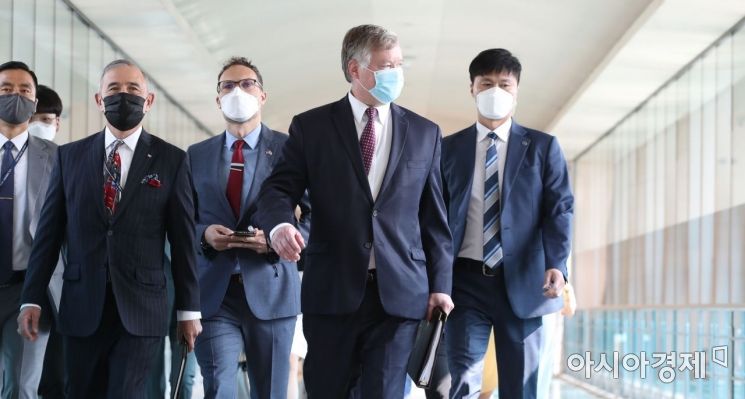 Steven Biegun, U.S. Deputy Secretary of State and Special Representative for North Korea Policy, currently visiting Korea, arrived at the Government Seoul Office in Sejongno, Seoul on the morning of the 8th to pay a courtesy call on Kang Kyung-wha, Minister of Foreign Affairs. As he moved toward the Ministry of Foreign Affairs building, he observed a press conference held by members of the Peace and Democracy Solidarity. On the left is Harry Harris, U.S. Ambassador to Korea. Photo by Joint Press Corps
© The Asia Business Daily(www.asiae.co.kr). All rights reserved.


















