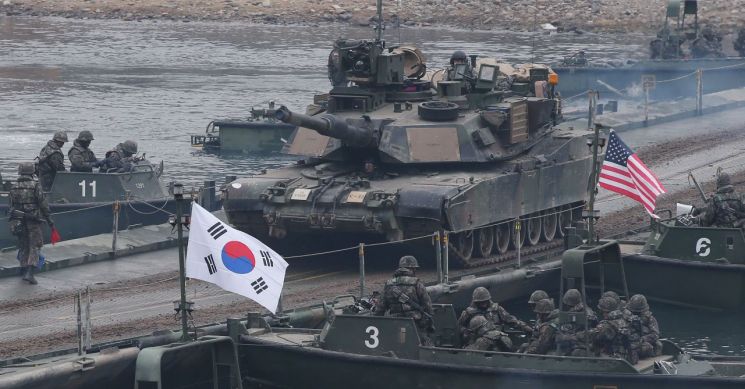
 It has been reported that South Korea and the United States will begin joint military exercises starting on the 5th. The photo shows a US 2nd Infantry Division M1A2 SEP tank crossing a pontoon bridge during the South Korea-US joint river crossing operation training held at the Hantan River in Yeoncheon-gun, Gyeonggi Province, in December 2015.
 [Asia Economy Yang Nak-gyu Reporter] South Korea and the United States have yet to narrow their differences over the timing and implementation method of the upcoming ROK-US joint military exercises scheduled for next month, causing delays in coordination. The South Korean military insists that the exercises must be conducted in August to verify the transfer of wartime operational control (OPCON). On the other hand, the U.S. side maintains the October schedule, citing difficulties in participation by U.S. forces from the mainland due to a two-week quarantine requirement caused by the COVID-19 pandemic.
There is also a sharp disagreement over the scale of the exercises. If the August exercises proceed as the South Korean military claims, they are expected to focus mainly on computer simulations in the form of a "wargame," with only U.S. forces stationed in South Korea participating, similar to last year.
Conversely, the U.S. military argues that if the exercise timing is postponed to October, the scale should be expanded to include U.S. forces from the mainland. The South Korean military has expressed reluctance, citing that the period overlaps with personnel changes in the military leadership.
On the 9th, a senior official from the Ministry of National Defense stated, "Defense Minister Jeong Kyeong-doo and ROK-US Combined Forces Command Commander Robert Abrams held an emergency meeting the day before to coordinate on whether to conduct the joint exercises, but due to significant differences in timing and implementation methods, no final decision was made."
The South Korean military insists that the exercises must be held next month to ensure the OPCON transfer. Since the exercises were postponed earlier this year due to COVID-19, they believe further delays are unacceptable. This is why Minister Jeong and Commander Abrams held an unscheduled emergency meeting.
Internally, the military has tentatively decided to begin the Crisis Management Staff Training (CMST), a pre-exercise rehearsal for the joint exercises, from the 10th of next month; the first phase of defense exercises from the 17th; and the second phase of counterattack exercises from the 24th. Operational commands and subordinate units of each service branch have already completed preparations for the joint command post exercise (CPX) and have started operational planning education. This exercise will be conducted in the form of a wargame using computer simulations without actual troop or equipment mobilization.
Meanwhile, Commander Abrams reportedly proposed during the emergency meeting that the exercise be postponed to October because, due to COVID-19, combat staff from the U.S. mainland cannot effectively participate. If U.S. forces enter from the mainland, they must undergo a two-week self-quarantine, which would extend the preparation period and pose a burden. Recently, four U.S. soldiers stationed at a U.S. military base in South Korea tested positive for COVID-19.
The South Korean military foresees that if the joint exercises are held in October, the planned military leadership personnel changes will prevent proper verification of the Future Combined Forces Command's Full Operational Capability (FOC). Furthermore, if only U.S. forces stationed in South Korea participate without those dispatched from the mainland, the effectiveness of the FOC verification will inevitably be reduced.
There is a variable. If North Korea provokes using the joint exercises as a pretext, it is analyzed that the U.S. might insist on proceeding with the joint exercises focusing not on FOC verification but on checking the "fight tonight" (constant combat readiness) posture. Last August, during the ROK-US joint exercises, North Korea launched eight short-range ballistic missiles (including two claimed as new-type multiple rocket launchers) in four separate launches.
Regarding this, a military official said, "If U.S. forces are excluded even from the second phase counterattack exercises, it would mean that since the personnel changes at the corps commander level last year, there has never been a joint exercise preparing for full-scale war between South Korea and the U.S."
© The Asia Business Daily(www.asiae.co.kr). All rights reserved.

















