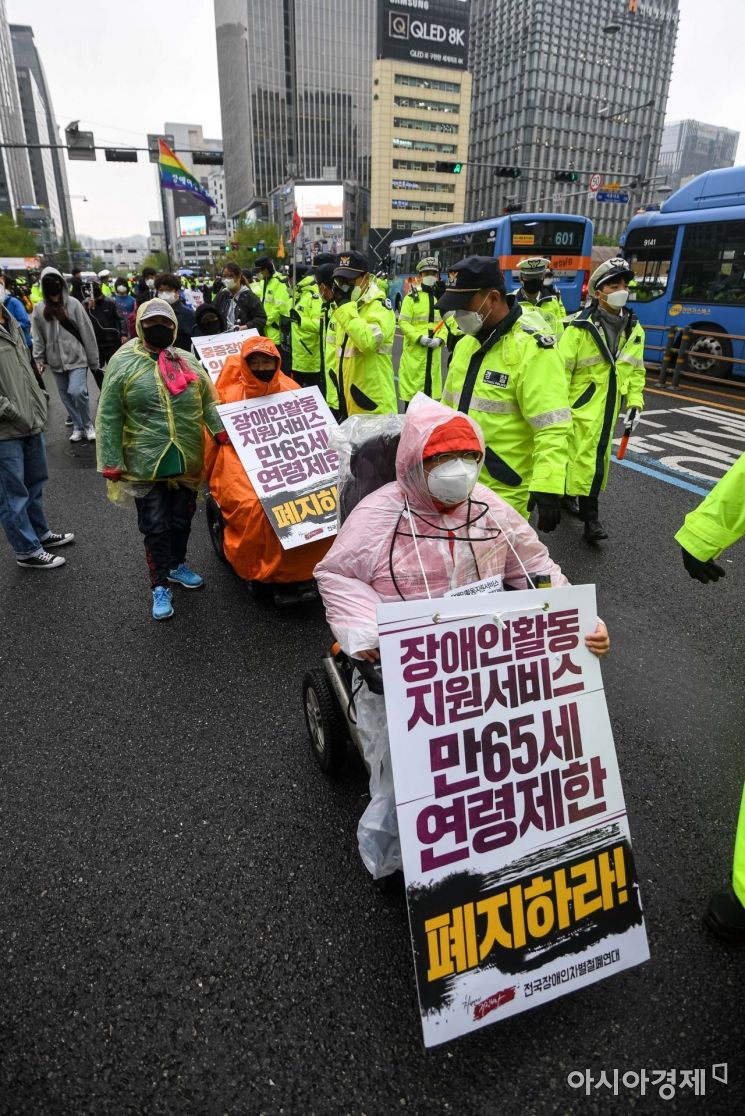
 Last April, officials belonging to the Joint Struggle Group for the Elimination of Discrimination Against Persons with Disabilities marched in Sejong-ro, Jongno-gu, Seoul, urging the elimination of discrimination against persons with disabilities and a comprehensive plan for customized support for persons with disabilities during COVID-19. Photo by Jinhyung Kang aymsdream@
[Asia Economy Reporter Choi Dae-yeol] Since the revision of the support system for persons with disabilities in July last year, the average monthly assistance time has increased by about 20 hours.
The Ministry of Health and Welfare and related ministries discussed a demand-centered revision plan for the support system for persons with disabilities at the Social Relations Ministers' Meeting held on the 8th. In response to the demands from the disability community, the government has been implementing a phased revision plan since July last year. The first phase focused on abolishing the disability grading system, introducing a comprehensive survey in daily life areas, and strengthening the delivery system.
As a result of about one year of implementing the first phase revision plan, it was found that the average monthly activity support benefit hours increased by 20.5 hours. Disability activity support is a program that assists persons with severe disabilities who have difficulties in daily life or social activities by supporting physical, household activities, mobility, or providing visiting nursing and bathing services. Previously, the average was about 119.4 hours, but after the revision, it increased to 139.9 hours.
The Ministry of Health and Welfare explained, "If the activity support benefits previously increased in a stepwise manner, after introducing the comprehensive survey, the benefits are now proportional to the degree of functional limitation of the disabled, providing more benefits to persons with severe disabilities, thus improving the appropriateness of benefits."
Persons with mild disabilities, who previously could not apply for activity support, were also allowed to apply for services in line with the abolition of the disability grading system. By March this year, 1,246 people were selected as recipients of activity support and could receive an average of 92.2 hours of service per month. The Ministry stated that this reflects the principle of supporting services based on the individual needs and environment of the disabled, rather than their disability grade.
Building on these achievements, from the second half of this year, the government plans to supplement issues raised during the first phase and proceed with the second phase revision plan. First, the benefit calculation method will be revised to expand activity support services, and a dedicated investigator system for appeals will be introduced. Since benefit levels may vary depending on the investigator or region, this measure aims to allow individuals to seek redress for their rights.
Additionally, to guarantee mobility rights, the comprehensive service support survey will be expanded to include the mobility support area, and mobility support services such as low-floor buses will be expanded. Mobility support services will be provided to those who do not meet the walking disability criteria but require additional protection. To minimize inconvenience for existing service recipients, scores will be applied so that benefits increase by only about 5%, and enforcement against illegal parking in disabled parking zones will be strengthened.
Furthermore, at the local government level, cooperation will be strengthened to ensure that special transportation equipped with wheelchair boarding facilities is provided according to the scale stipulated by relevant laws, and infrastructure such as voucher taxis and low-floor buses will be increased. The scope of the barrier-free living environment certification system will be expanded, and measures to improve the mobility convenience of transportation-vulnerable groups will be promoted. Related laws, notifications, and systems will be revised by October.
Minister of Health and Welfare Park Neung-hoo said, "This is a process of paradigm shift in disability support policies, and we will continuously improve and supplement various disability policies to mature them further."
© The Asia Business Daily(www.asiae.co.kr). All rights reserved.

















