Lee "Measures Needed for Banpo Apartments"
Unusual Criticism Toward Blue House Insider
President Moon Silent on Questions About Lame Duck Concerns and Presidential Ambitions
[Asia Economy Reporter Kang Nahum] "It's regrettable. I hope there will be appropriate conduct and measures."
On the 7th, this was the brief comment made by Lee Nak-yeon, a member of the Democratic Party of Korea, to reporters asking about Chief Presidential Secretary Noh Young-min's 'Banpo apartment controversy.' Lee's sharp remark directed at a key Blue House official is considered unusual. Since Lee is aiming beyond party leadership to the presidency, this single comment could be interpreted as a clash between the 'future power' and the 'current power.'
For now, Chief Secretary Noh has decided to dispose of the Banpo apartment. This came just one day after Lee's criticism. On the 8th, Noh said, "Contrary to my intention, disposing of the apartment in Cheongju while keeping the apartment in Seoul appeared as if I was trying to keep the Seoul apartment, which did not meet the public's expectations. I apologize."
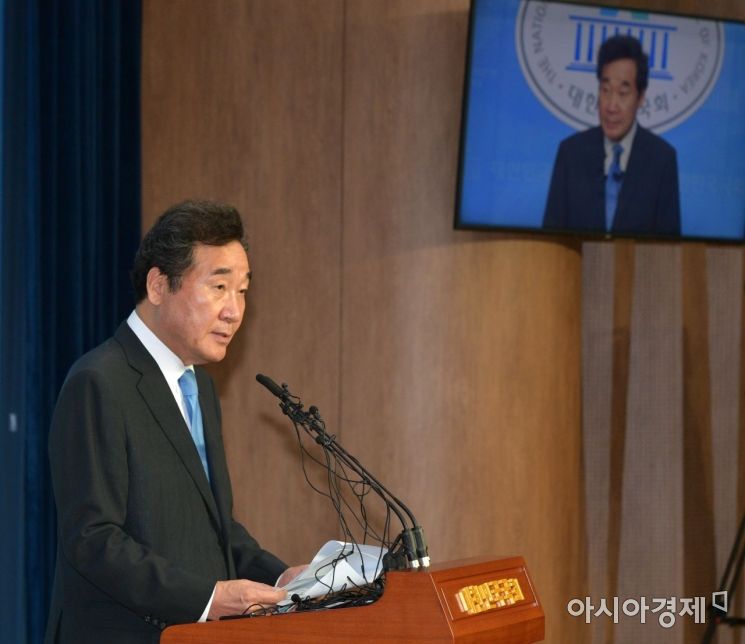 Lee Nak-yeon, a member of the Democratic Party of Korea, is holding a press conference to announce his candidacy for party leader at the National Assembly on the 7th. Photo by Yoon Dong-ju doso7@
In the party leadership candidacy declaration read by Lee that day, there was no content hinting at a presidential bid. The 2,500-character declaration was filled with the Democratic Party's aspirations and legislative tasks to overcome the COVID-19 economic crisis. Even during the Q&A session immediately after the declaration, Lee tried to avoid questions about the presidency as much as possible.
When reporters asked, "What do you see as the spirit of the next presidential election era, and what values do you want to pursue as the Democratic Party's direction?" Lee replied, "The declaration is about 2,500 characters, and there is no mention of 'regime re-creation.' I believe now is the time to focus on overcoming the national crisis." Regarding the era's spirit, he said, "I will talk about that later," avoiding the answer. This contrasts somewhat with his firm response to the Noh controversy, leading to speculation that he is managing his message carefully.
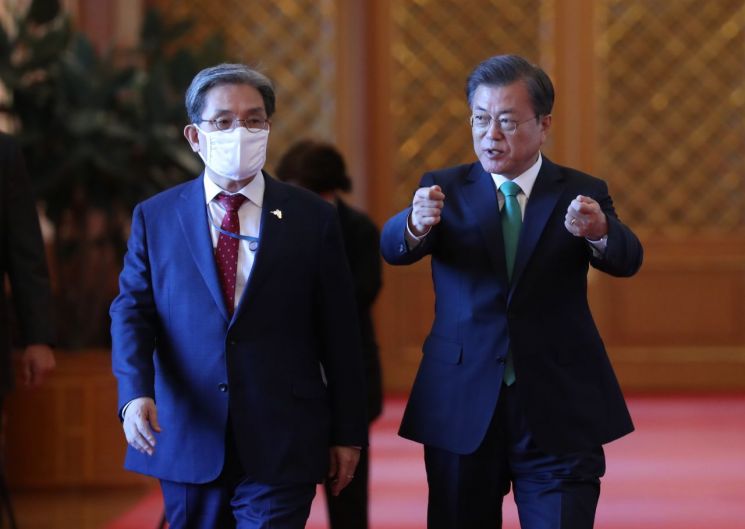
In the power succession process during the latter half of the administration, a lame-duck phenomenon is inevitable. The future power must criticize the current power to justify regime re-creation. However, excessive criticism risks alienating the support base, so appropriate moderation is necessary. This is why message management is so important.
If party leadership returns to Lee, he could raise his voice on an almost equal footing with the president. It is expected that Lee, as the future power and a 'presidential-type party leader,' will have even more influence. This is also why Lee, who needs to shed the image of 'No. 2 in the Moon Jae-in administration' and build the image of a 'presidential candidate,' is putting effort into balanced message delivery.
Despite being a leading presidential contender, Lee has so far refrained from proposing major agendas related to the 'post-COVID' era, which analysts attribute to concerns about President Moon's lame-duck status. A Democratic Party member said, "If the future power's agenda conflicts with the current power's agenda, namely Moon Jae-in's agenda, criticism may arise that he is undermining the president. This is why Lee did not easily answer reporters' repeated questions about his vision before running for party leadership."
Lee also appears to be minimizing comments on the 'Korean New Deal,' a key government initiative to overcome the COVID-19 economic crisis. This is interpreted as stemming from the perception that the policy belongs to President Moon rather than himself. In fact, on the 1st, at the Global Health and Welfare Forum, Lee said, "Digital transformation and the Green New Deal have sufficient economic effects and jobs. But considering global market changes, if I had to choose one, I would pick bio-health," showing some distance from the current administration's policies.
© The Asia Business Daily(www.asiae.co.kr). All rights reserved.


















