If the Three Lease Laws Pass, Registered Rental Housing Becomes Ineffective
Landlords Protest... "Unilateral Cancellation of Promised Benefits"
Ministry of Land, Infrastructure and Transport Deliberates on System's Future
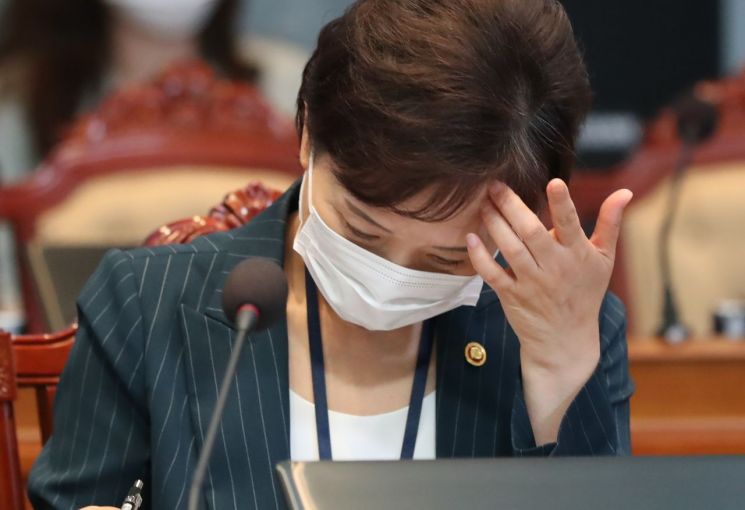 Minister of Land, Infrastructure and Transport Kim Hyun-mi is reviewing documents at the Cabinet meeting held at the Blue House on the morning of the 7th.
 (Photo by Yonhap News)
[Asia Economy Reporter Moon Jiwon] The 'Registered Rental Housing' system, promoted by the Ministry of Land, Infrastructure and Transport under the pretext of stabilizing the private rental market, is facing the risk of abolition. If the so-called 'Three Rental Laws' being pushed by the ruling party and the government pass the National Assembly, the differences between general housing and existing registered rental housing in terms of rental period and rent restrictions will virtually disappear. Bills reducing benefits for existing rental business operators have already been proposed. Since the registered rental housing system was promoted as part of the current government's early market stabilization policies, its abolition is expected to remain a representative case of policy failure.
According to the National Assembly and the Ministry of Land on the 8th, the government is deliberating on the operational plan for the registered rental housing system. If the Three Rental Laws?Jeonwolse Reporting System, Jeonwolse Rent Cap System, and Contract Renewal Request Right System?are passed, landlords will have to maintain rental contracts for at least four years and will not be allowed to raise rent by more than 5% upon renewal. This is almost the same obligation applied to the existing mandatory four-year registered rental housing.
Moreover, various benefits previously granted to the registered rental housing system are also at risk of disappearing, threatening the very meaning of maintaining the system. Kang Byung-won, a member of the Democratic Party of Korea, has proposed an amendment to the Comprehensive Real Estate Tax Act to include private rental housing in the tax base for comprehensive real estate tax, thereby reducing tax benefits for rental business operators. The reason given is that "it is inappropriate to expand exceptions to the tax base amid various side effects such as overheating and disruption in the real estate market."
This law includes provisions to reduce tax benefits not only for new but also for existing rental housing, sparking controversy over retroactive legislation. While it does not reclaim tax benefits already received, it will no longer provide tax reduction benefits for taxes to be paid in the future.
The government announced measures to revitalize rental housing registration only two and a half years ago, in December 2017. The plan was to promote it by lowering health insurance premiums and increasing the long-term holding special deduction rate for capital gains tax, and if ineffective, to make it mandatory from 2020. However, as the rental registration activation policy was exploited as a tax-saving method by multi-homeowners, benefits were reduced in September of the following year, just nine months later, by imposing heavy capital gains tax and comprehensive real estate tax on housing in adjusted areas. Since then, benefits for the registered rental housing system have continued to decrease, and with the promotion of the 'Three Rental Laws,' it has effectively reached the stage of abolition.
The National Assembly's legislative notice site is flooded with protest comments from existing rental business operators. They argue that "the government's unilateral cancellation of promised benefits undermines the fundamental principle of trust in legal norms." Mr. A, a rental business operator in Suwon, Gyeonggi Province, said, "If the Three Rental Laws pass, it means the existing system will be abolished. Who would trust the government if policies are flipped over like turning the palm of a hand?" Voices from the industry say that the government frequently overturns existing systems depending on the situation, lowering the credibility of its policies.
© The Asia Business Daily(www.asiae.co.kr). All rights reserved.
![From Bar Hostess to Organ Seller to High Society... The Grotesque Con of a "Human Counterfeit" [Slate]](https://cwcontent.asiae.co.kr/asiaresize/183/2026021902243444107_1771435474.jpg)
















