Ministry of the Interior and Safety, Resident Registration Population by City and Province as of Late June
Population Decreased by 10,000 in 6 Months While Number of Households Increased by 310,000
[Asia Economy Reporter Jo In-kyung] This year, South Korea's total population has slightly decreased, while the number of single-person households continues to rise.
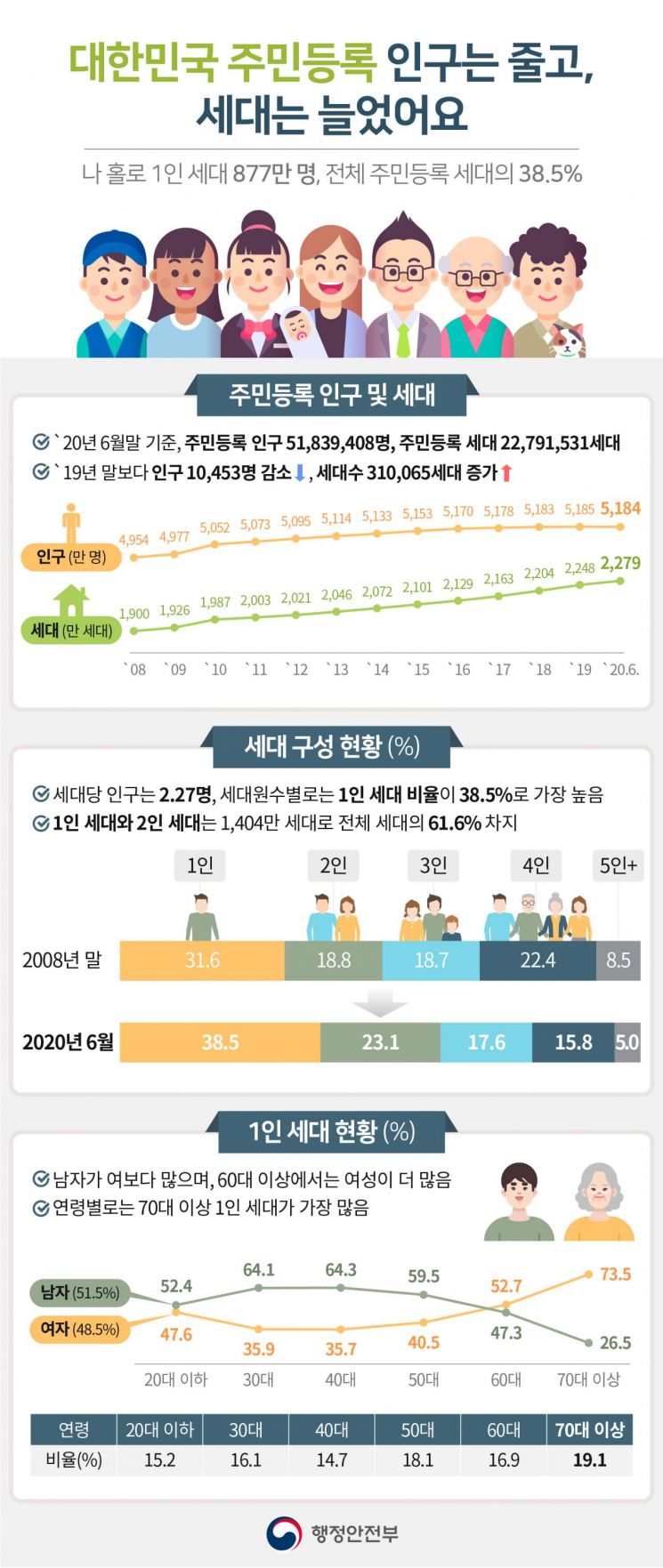
According to the 'Resident Registration Population and Household Status' data released by the Ministry of the Interior and Safety on the 8th, as of the end of June 2020, the registered resident population in the country was 51,839,408, and the number of registered households was 22,791,531.
The population decreased by 10,453 compared to 51,849,861 at the end of last year, whereas the number of households increased by 310,065 from 22,481,466 during the same period.
This is interpreted as a rapid increase in one- to two-person households compared to traditional household compositions. Even looking at the trend from 2017 to 2019, the population increased by an average of 50,000 per year, but the number of households increased by an average of 400,000 per year.
The average number of people per household is 2.27, and by household size, the proportion of single-person households is the highest at 38.5%, followed by two-person households at 23.1%, three-person households at 17.6%, and four-person households at 15.8%.
Among these, one- and two-person households accounted for 14.04 million households, representing 61.6% of all households. The proportion of four-person households, which was the second largest after single-person households in the 2008 survey, decreased from 22.4% to 15.8% during this period, becoming even lower than the proportion of three-person households.
According to resident registration, single-person households were more common among men (51.5%) than women (48.5%), but among those aged 60 and over, female single-person households were more prevalent.
By age group, single-person households aged 70 and over were the most common at 19.1%, followed by those in their 50s at 18.1%, and those in their 60s at 16.9%.
By region, the metropolitan area had 172,758 more people than non-metropolitan areas, but the number of households was 387,587 more in non-metropolitan areas than in the metropolitan area.
By local government, the proportion of single-person households was highest in Jeonnam (44.1%) and Gangwon (42.8%) provinces, and lowest in Sejong (32.4%), Ulsan (32.8%), and Gyeonggi (35.0%).
Among cities, counties, and districts, Incheon Ongjin (59.2%), Gyeongbuk Ulleung (59.1%), and Seoul Gwanak (57.5%) had high proportions of single-person households, while Ulsan Buk-gu (25.2%), Gyeonggi Gwacheon (25.8%), and Chungnam Gyeryong (26.7%) had the lowest.
An official from the Ministry of the Interior and Safety explained, "The composition ratio of single-person households by age group varies greatly by region. For example, in Seoul Gwanak-gu, the proportion of single-person households aged 30 and under is the highest, whereas in Jeonnam Goheung, single-person households aged 65 and over are more common."
© The Asia Business Daily(www.asiae.co.kr). All rights reserved.

















