Focus on South Korea-US Issues Amid North Korea-US Standoff...Low Possibility of Contact with North Korea
Much Time Spent in Talks with Vice Foreign Minister Cho Se-young
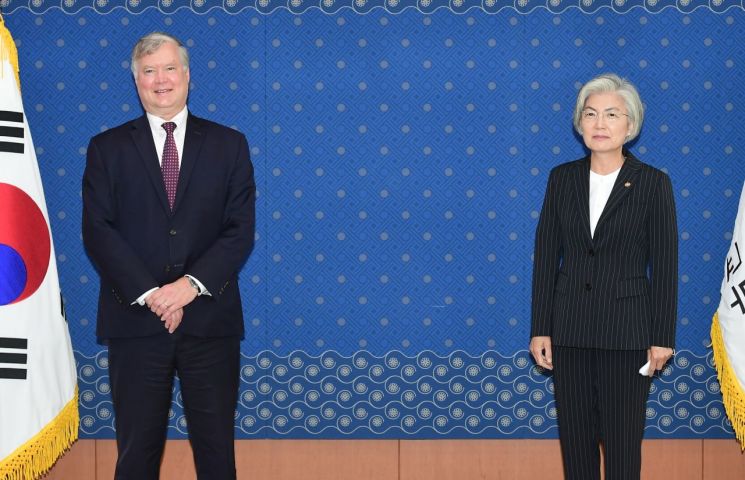
[Asia Economy Reporter Lim Cheol-young] Steven Biegun, U.S. Deputy Secretary of State and Special Representative for North Korea, who arrived on the 7th and completed quarantine procedures, began his official visit to Korea on the 8th by paying a courtesy call to Foreign Minister Kang Kyung-wha. Deputy Secretary Biegun spent much of the day discussing key issues between South Korea and the U.S., including strengthening the ROK-U.S. alliance. Given the intense pre-visit standoff between North Korea and the U.S., it appears that the much-anticipated Panmunjom North Korea-U.S. contact is unlikely.
At around 9:20 a.m. that day, Deputy Secretary Biegun met with Foreign Minister Kang Kyung-wha and subsequently held a series of meetings with First Vice Foreign Minister Cho Se-young and Lee Do-hoon, Director General of the Office for Peace and Security Affairs on the Korean Peninsula. This was his first visit to Korea in seven months since December last year and his first as Deputy Secretary. Allison Hooker, Senior Director for Asia at the White House National Security Council (NSC), who has been closely involved in North Korea negotiations, did not accompany the delegation on this trip.
During his meeting with Minister Kang, Deputy Secretary Biegun said, “The journey was complicated due to COVID-19, but thank you for cooperating on the details to ensure my safe arrival.” Minister Kang responded, “It has been a long time since we last met. You have arrived at a very important time.”
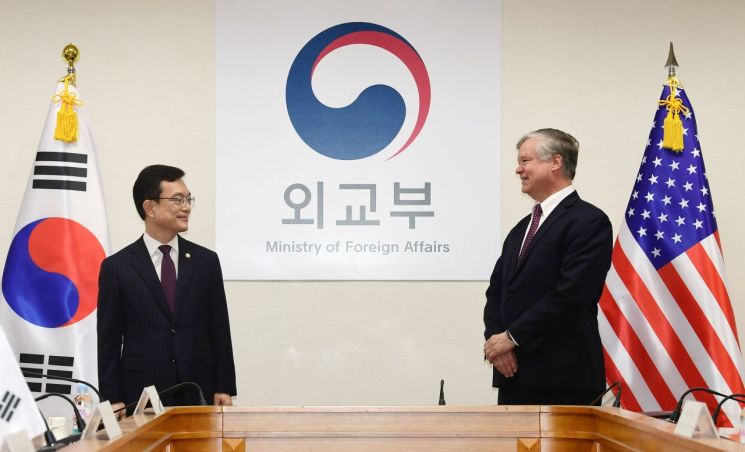
Deputy Secretary Biegun devoted considerable time to the strategic dialogue with Vice Foreign Minister Cho Se-young, which started 20 minutes later than scheduled. Although he has held bilateral and multilateral video conferences since his promotion to Deputy Secretary, this was his first face-to-face consultation with Vice Minister Cho. The ROK and U.S. have numerous issues to address, including cooperation on COVID-19, the expansion of the Group of Seven (G7) proposed by U.S. President Donald Trump, participation in the Economic Prosperity Network (EPN)?an anti-China economic bloc?and negotiations on the Special Measures Agreement (SMA) on defense cost-sharing, which has been in a seven-month stalemate.
Deputy Secretary Biegun also held talks with Lee Do-hoon, the Special Representative for Korean Peninsula Peace and Security Affairs, in his capacity as Special Representative for North Korea, but diplomatic circles predict a low possibility of contact with North Korea. Since the breakdown of the Hanoi North Korea-U.S. summit and the collapse of working-level talks in Stockholm, the deadlock in North Korea-U.S. dialogue has accelerated the deterioration of inter-Korean relations. Therefore, Deputy Secretary Biegun’s visit has attracted unprecedented attention both domestically and internationally. Voices calling for improvements in the ROK-U.S. working group, mainly from the ruling party, continue to grow, and with the possibility of a third North Korea-U.S. summit before the U.S. presidential election in November, there is considerable hope that this visit will mark a turning point in the situation on the Korean Peninsula.
However, just before Deputy Secretary Biegun’s visit, North Korea and the U.S. engaged in intense off-the-record standoffs, lowering expectations. Through statements by Choe Son-hui, First Vice Minister of the North Korean Ministry of Foreign Affairs, and Kwon Jong-gun, Director General for U.S. Affairs, North Korea made it clear that it would not sit down with the U.S. until the U.S. changes its calculation method. The U.S. also clarified that the purpose of Deputy Secretary Biegun’s visit was to strengthen coordination on FFVD (Final, Fully Verified Denuclearization). While leaving the door open for dialogue, both sides reiterated that there is no change in their denuclearization stance.
After completing official schedules with senior Foreign Ministry officials, Deputy Secretary Biegun is expected to meet with President Moon Jae-in as well as the recently reshuffled Blue House foreign and security officials. President Moon has appointed Seo Hoon as the new National Security Office Director, Park Jie-won as Director of the National Intelligence Service, and Lee In-young as the nominee for Minister of Unification.
© The Asia Business Daily(www.asiae.co.kr). All rights reserved.


















