[Asia Economy Reporter Ki-min Lee] Major countries are making every effort to revitalize domestic tourism through support for their citizens as well as liquidity support for the tourism industry to save the crisis-hit tourism sector.
For this reason, it has been pointed out that South Korea should take the damage caused by the novel coronavirus infection (COVID-19) as an opportunity to strengthen the competitiveness of tourism resources and review mid- to long-term strategies, and prepare tourism infrastructure that can continuously generate demand.
The Federation of Korean Industries announced on the 8th that after analyzing global tourism industry strategies and directions, it is necessary to support domestic tourism vouchers for citizens and develop tourism infrastructure that can continuously generate revenue.
The tourism industry suffered direct damage due to worldwide entry and exit restrictions, closures of tourist sites, and postponements of major events and festivals caused by COVID-19.
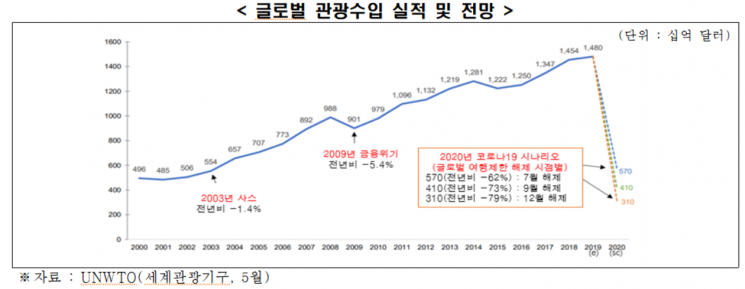
The United Nations World Tourism Organization (UNWTO) reported that the tourism industry is facing the worst crisis since international tourism statistics began in 1950 due to COVID-19, predicting that more than 100 million tourism jobs will be lost due to the labor-intensive nature of the tourism industry. It also forecasted that global tourism revenue this year will fall below $570 billion (approximately 685 trillion KRW), a decrease of more than 62.0% compared to last year's $1.48 trillion (approximately 1,777 trillion KRW).
Therefore, major tourist countries are seeking to revitalize domestic tourism through policies promoting the opening of tourist sites and stimulating domestic tourism demand, based on thorough management and control of quarantine and hygiene.
Japan allocated an additional budget of 1.6794 trillion yen (approximately 18.7 trillion KRW) for the ‘Go To’ campaign to encourage domestic tourism. From the end of August, it plans to support discount benefits in the form of coupons in four major sectors: travel (‘Go to Travel’), dining out (‘Go to Eat’), events (‘Go to Event’), and shopping (‘Go to Shoten-gai (商店街)’). In particular, for domestic accommodations in Japan, discounts of up to 50% can be received with a limit of 20,000 yen (approximately 230,000 KRW) per night.
Italy provides a ‘Holiday Bonus’ to households with an annual income below 40,000 euros (approximately 54 million KRW). Italy supports 150 euros (approximately 200,000 KRW) for single-person households, 300 euros (approximately 400,000 KRW) for two-person households, and 500 euros (approximately 680,000 KRW) for households with three or more people. Additionally, it plans to establish a 50 million euro Tourism Fund to improve domestic accommodation facilities. Slovenia also provides domestic tourism vouchers worth a total of 345 million euros (465.5 billion KRW) usable until the end of the year to all citizens.
Australia has applied free admission to national parks (Budj Bim, Kakadu, Uluru Kata Tjuta, etc.) from March 16 until the end of the year, with the waived admission fees expected to total 11.2 million Australian dollars (approximately 9.3 billion KRW). South Korea is also operating the ‘2020 Special Travel Week’ from July 1, offering transportation discounts such as half-price KTX tickets, as well as accommodation and experience discounts, while seeking to disperse summer vacation crowds.
Like Australia and South Korea, other countries are seeking to stimulate domestic demand by reducing taxes on tourism infrastructure usage fees. Greece decided to reduce the value-added tax rate on all transportation means including air, rail, and bus from 24% to 13% from June 1 to the end of October. Norway will reduce the value-added tax rate applied to the tourism industry, including tourist attractions, passenger transport, and accommodation facilities, from the existing 12% to 8% until October 31 this year. Turkey and Iceland will exempt accommodation taxes on hotels and tourism facilities until November this year and the end of next year, respectively.
France announced a tourism industry support plan worth a total of 18 billion euros (approximately 24.3 trillion KRW) last May. To prevent large-scale unemployment in the tourism industry, it decided to extend the temporary unemployment benefit support program (which covers 70% of regular wages) scheduled to end in June until the end of September. It also provides solidarity funds of up to 10,000 euros (approximately 13.5 million KRW) per company to companies with fewer than 20 employees and annual sales below 2 million euros (approximately 270 million KRW), with the total fund size reaching 7 billion euros (approximately 9.5 trillion KRW).
Spain exempted 50% of social security tax payments for regular employees in the tourism industry from February to June this year, and allowed small and medium-sized tourism companies and self-employed individuals who applied in advance to defer tax payments for six months. Social security tax refers to regular wage pre-deductions such as pension insurance, employment insurance, industrial accident insurance, and vocational training fees.
On the other hand, South Korea provided special loans with an interest rate of 1.0% worth a total of 100 billion KRW to small and medium-sized tourism businesses, supporting operating expenses such as labor costs and rent with a limit of 2 billion KRW per company. It also deferred principal repayment obligations for loans from the Tourism Fund totaling 200 billion KRW for one year for companies currently repaying or with repayment due within one year. All of these supports were exhausted early in April.
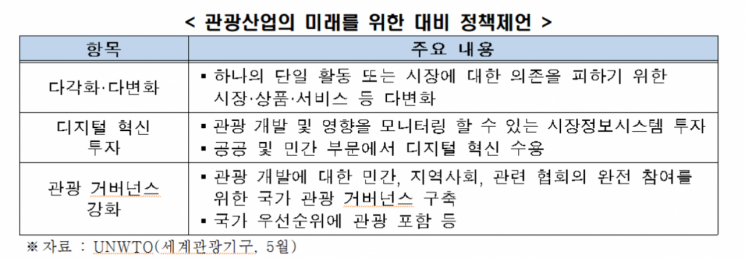
The UNWTO suggested that beyond mitigating the social and economic impacts of COVID-19 and recovering damages, it is ultimately necessary to prepare for the future of the tourism industry. It recommended diversifying markets, products, and services, embracing and investing in digital innovation, and including tourism as a national policy priority to promote job creation and economic growth.
Yoo Hwan-ik, head of corporate policy at the Federation of Korean Industries, emphasized, “In the short term, it is necessary to extend South Korea’s travel weeks and additionally consider expanding voucher payments to revitalize domestic tourism. The tourism industry crisis caused by the COVID-19 pandemic should be taken as an opportunity to review the competitiveness of South Korea’s tourism resources and mid- to long-term strategies, and prepare tourism infrastructure that can continuously generate demand.”
© The Asia Business Daily(www.asiae.co.kr). All rights reserved.
!["The Woman Who Threw Herself into the Water Clutching a Stolen Dior Bag"...A Grotesque Success Story That Shakes the Korean Psyche [Slate]](https://cwcontent.asiae.co.kr/asiaresize/183/2026021902243444107_1771435474.jpg)

















