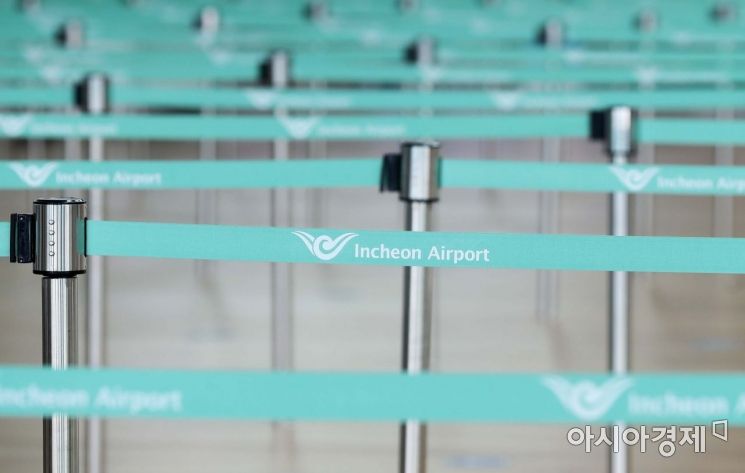
 On the 18th, the departure hall of Terminal 1 at Incheon International Airport was deserted due to the impact of the novel coronavirus infection (COVID-19), as the aviation industry, hit hard by COVID-19, faces severe layoffs. Photo by Moon Honam munonam@
[Asia Economy Reporter Yu Je-hoon] A survey has revealed that the travel sentiment of global travelers regarding air travel has rapidly deteriorated due to the COVID-19 pandemic. While the dominant forecast is that it will take at least 1 to 2 years for the industry to fully recover, industry insiders and experts predict that the business model itself could change due to COVID-19, beyond just a prolonged recession.
The International Air Transport Association (IATA) announced on the 7th (local time) that a survey conducted in June with 4,700 air travelers showed that only 47% planned to travel "within a few months" after the pandemic subsides, a 16 percentage point drop compared to the April survey. The survey was commissioned by IATA to Rockland Dalton Consulting and targeted air travelers from 11 countries including the United States, Japan, Germany, India, the United Kingdom, France, Canada, Australia, Singapore, and the United Arab Emirates (UAE), with 50% traveling for business and 50% for tourism.
Specifically, those who responded they would travel "immediately" after the pandemic subsides decreased by 2 percentage points to 12%, and those who said they would wait "about 1 to 2 months" dropped by 14 percentage points to 33%. Conversely, those planning to wait "more than 6 months" increased by 12 percentage points to 36%, and those waiting "more than a year" rose by 6 percentage points to 8%. The percentage of respondents who said they would "not resume normal travel plans" also increased by 1 percentage point to 5%.
While the percentage of respondents concerned about COVID-19 infection slightly decreased from 90% in April to 83% in June, air travel sentiment clearly worsened. IATA analyzed the survey results by stating, "It shows that people have not lost their desire to travel," but also noted that "(the COVID-19 pandemic) remains a barrier to returning to pre-crisis levels."
In the aviation industry, back in March and April when the COVID-19 pandemic had just begun, there were optimistic forecasts for demand recovery by the end of the year, and after entering the stabilization phase, some hopeful analyses suggested that suppressed travel demand could rapidly expand due to "revenge travel" sentiment. However, as vaccine development has been delayed and concerns have arisen that even developed vaccines may have limited effectiveness, hope is turning into pessimism.
Accordingly, domestic airlines are facing deep concerns. The securities industry estimates that operating losses for domestic airlines in the second quarter will reach hundreds of billions of won, with Korean Air at 45.6 billion won, Jeju Air at 84.6 billion won, Jin Air at 63.4 billion won, and T'way Air at 53 billion won. Although some analyses predict a return to profitability for major airlines supported by rising air cargo rates, the industry expects that even if realized, the scale will not be significant.
An industry insider said, "For now, airlines are surviving on cargo revenue, but the challenge is to endure the gap until passenger demand recovers if rates fall," adding, "This year, airlines will barely survive through asset sales and capital increases, but from early next year, a second wave could fully materialize."
Meanwhile, experts and industry insiders also predict that beyond a prolonged recession, the aviation business model itself could change. In fact, in this survey, air travelers identified in-flight concerns after the pandemic subsides as sitting next to a suspected infected person (65%), using shared facilities such as in-flight restrooms (42%), and breathing inside the cabin (37%). Airport-related concerns included crowded buses and trains when using aircraft (59%) and check-in, security screening, and boarding waiting areas (42%). Additionally, the proportion of respondents worried (very or somewhat) about the mandatory 14-day quarantine upon entry and exit reached 85% and 80%, respectively.
Professor Heo Hee-young of Korea Aerospace University commented, "These survey results indicate that people's lifestyles are changing in the COVID-19 era," adding, "Leading aircraft manufacturers are also considering seat arrangements, and the aviation market before and after COVID-19 will face rapid changes not only in demand and supply but also in business models."
© The Asia Business Daily(www.asiae.co.kr). All rights reserved.

















