As the Fourth Industrial Revolution approaches, intellectual capital is emerging as a key evaluation criterion for companies, making intangible assets increasingly important. In particular, knowledge industry centers advocating 'Green Capital,' which goes beyond intellectual capital, are drawing attention in the industry.
Green Capital is a new theory that not only encompasses the intellectual capital companies have traditionally held but also maximizes it by considering green spaces as capital. Companies can enhance their competitiveness through improved work efficiency and cost savings enabled by green spaces.
Research proving the economic effects of green spaces has been steadily emerging. In 2011, the Seoul Metropolitan Government revealed through monitoring the use of rooftop parks that rooftop greenery such as rooftop parks and rooftop gardens can reduce heating and cooling costs. According to the study, creating rooftop parks can save approximately 7,356 KRW/㎡ (monthly average 1,839 KRW/㎡) in cooling costs during the summer period (June to September), and about 4,180 KRW/㎡ (monthly average 836 KRW/㎡) in heating costs during the winter period (November to March).
Furthermore, a 2014 study published in the Journal of Experimental Psychology showed that offices with plants increased workers' happiness and boosted productivity by up to 15%. Urban forests and green curtains also provide economic benefits.
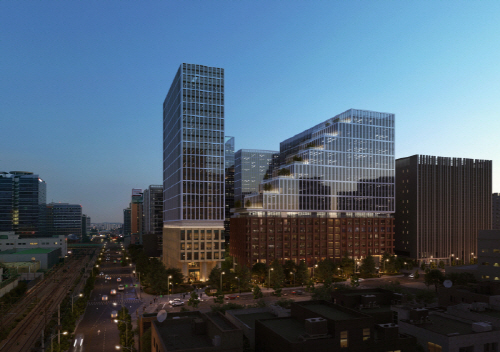
Among these, Hyundai Engineering & Construction plans to supply 'Green Capital' to tenant companies by securing large-scale landscaping spaces within the complex of 'Hyundai Knowledge Industry Center Gasan Public,' which will be unveiled in July on the former Samsung C&T logistics center site in the Seoul Digital Industrial Complex (60-26, 60-49 Gasan-dong, Geumcheon-gu).
'Hyundai Knowledge Industry Center Gasan Public' will be the largest in Seoul, consisting of three buildings from five basement floors to 27 above-ground floors, with a total floor area of approximately 250,000㎡. Commercial facilities will be located from basement level 1 to the 2nd floor, and a total of 567 units of 'Public House (dormitory)' will be provided on separate buildings from the 6th to 26th floors, enabling one-stop living with work, residence, and commercial facilities within the complex. The Public House has separate entrances from the office facilities for privacy and includes various amenities such as lounges, coin laundries, and shared kitchens to enhance tenant convenience.
Hyundai Knowledge Industry Center Gasan Public applies a specialized design themed around green spaces, which are emerging as a new element of intellectual capital. The ecological area ratio within the complex reaches 33%, enhancing work efficiency in a pleasant environment.
Additionally, facilities such as a public hall with 375 seats, a premium drop-off zone located in the office building's basement (previously seen only in prime offices), meeting rooms connected to the drop-off zone, shared meeting rooms and lounges, and a deli cafe will be established. The underground parking lot secures about 176% more spaces than legally required, providing ample parking. The expanded parking spaces accommodate large vehicles conveniently, and the ceiling height is designed up to 2.8 meters to improve accessibility for cargo and emergency vehicles.
The commercial facilities within the complex are designed as village-style units based on single-story units, reminiscent of a small village. This open space includes convenience facilities for workers as well as mall functions for local residents.
Moreover, the facilities are arranged around a park, allowing visitors to enjoy both relaxation and shopping for extended periods. The design connects the sunken structure and ground-level-like basement floors to provide a comfortable shopping environment.
Hyundai Knowledge Industry Center Gasan Public offers optimal location conditions for corporate activities. It is a transit-oriented complex within walking distance of Gasan Digital Complex Station, a transfer station for subway lines 1 and 7, facilitating easy commuting for employees. Nearby road networks include Seobu Expressway, Nambu Beltway, and Export Bridge. Especially, using Seobu Expressway provides excellent connectivity to major highways such as Olympic-daero, Seohaean Expressway, Gangnam Beltway, and the 2nd Gyeongin Expressway, making travel convenient throughout Seoul and the metropolitan area.
Within walking distance, fashion outlets such as Mario Outlet, W Mall, Hyundai Outlet (Gasan branch), and Lotte Factory Outlet (Gasan branch) are concentrated. Large retail facilities including Big Market (Geumcheon branch), Homeplus (Geumcheon branch), and E-Mart (Guro branch) are located within approximately 1 km radius.
© The Asia Business Daily(www.asiae.co.kr). All rights reserved.
![A Woman Who Jumps Holding a Stolen Dior Bag... The Mind-Shaking, Bizarre Con of a "Human Knockoff" [Slate]](https://cwcontent.asiae.co.kr/asiaresize/183/2026021902243444107_1771435474.jpg)
















