Students with student visas cannot take 100% online classes
New visas not allowed, existing visas to be canceled
To stay in the US, students must attend schools with offline classes
Fall semester 100% online universities like Harvard face issues for international students
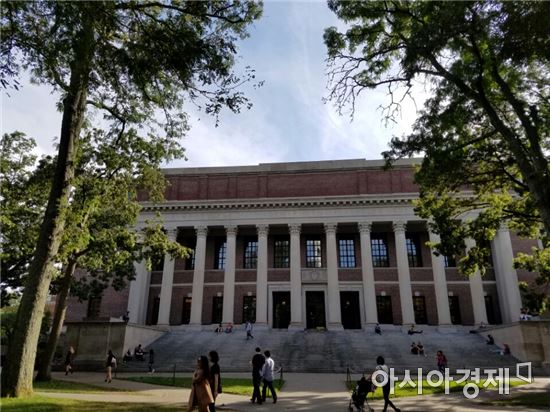 Library within Harvard University
[Asia Economy New York=Correspondent Baek Jong-min] The Donald Trump administration in the United States has ordered international students who are only able to take online classes due to the COVID-19 pandemic to leave the country. Since many U.S. universities, including Harvard University, have announced 100% online lectures for the fall semester, the impact on Korean international students is also expected to be inevitable.
The Immigration and Customs Enforcement (ICE) under the Department of Homeland Security announced on the 6th (local time) that "international students staying in the U.S. must leave the country if their school or academy decides to conduct only online classes for the fall semester." ICE also stated that the U.S. Customs and Border Protection (CBP) will not allow these students to enter the United States.
This means that if offline classes are not held at the school, the visa will be canceled even if it has already been issued. The visas in question are non-immigrant visas such as F-1 and M-1. F-1 students pursue academic courses, while M-1 students pursue vocational courses. Students holding these visas cannot take only online courses nor remain in the U.S. To maintain legal residency status, they must transfer to a school offering offline classes. However, it is possible to stay in the U.S. if online and offline classes are combined. In this case, F-1 students can take one class or at least 3 credits online.
According to ICE data, the State Department issued 388,839 F visas and 9,518 M visas in the 2019 fiscal year.
The U.S. government had not issued F-1 visas to students taking only online classes until now. However, after the outbreak of COVID-19, as schools shifted to online classes, international students have been affected as well.
US News & World Report, which ranks universities in the U.S., reported that this measure came while many universities and educational institutions are deliberating whether to conduct offline classes for the upcoming fall semester. According to this media, 8% of universities in the U.S. plan to conduct classes entirely online this year. On the same day, Harvard University announced that all classes for the fall semester starting in September will be conducted online.
With Harvard's decision to hold 100% online classes, existing international students residing in the U.S. must leave the country. New students or international students staying overseas, including in their home countries, will be unable to enter the U.S. Princeton University also plans to conduct most classes online.
According to the Associated Press, Terry Hartle, senior vice president of the American Council on Education, the representative organization of university presidents, said, "The new guidelines are likely to cause tremendous confusion among colleges preparing for the fall semester." This U.S. measure is becoming the target of international criticism. Countries with many U.S. international students, such as China and India, are also reporting this decision as major news.
© The Asia Business Daily(www.asiae.co.kr). All rights reserved.
















