[Asia Economy Reporters Yuri Kim and Donghyun Choi] Although the government has proposed strengthening tax burdens on multi-homeowners along with the card of 'expanding supply' to stabilize housing prices, Seoul City, which holds the key to housing supply, is criticized for neither presenting a proper solution nor establishing a clear direction. This is because, despite the sharp rise in sales and monthly rent prices stemming from a shortage of middle-class residential housing, the approach taken is to resolve the issue through the expansion of public rental housing, which primarily serves low-income groups. It is also pointed out that Seoul’s insistence on utilizing idle land?whose effectiveness is even questioned?while completely excluding redevelopment and reconstruction, which are key supply sources for middle-class housing, as well as greenbelt areas, is exacerbating housing price instability.
On the 6th, at a press conference marking the second anniversary of the 7th term of elected officials, Seoul Mayor Park Won-soon stated, "By the end of my term (late June 2022), Seoul will have 400,000 public rental housing units, including those from the Korea Land and Housing Corporation (LH)," adding, "This accounts for more than 10% of Seoul’s 3.8 million housing units."
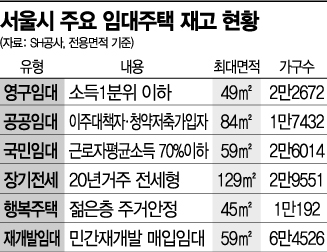
However, experts point out that the supply of public housing by Seoul City alone will not help stabilize soaring housing prices or monthly rents due to a mismatch in the rental market. In fact, among the 212,111 rental housing units managed by the Seoul Housing and Communities Corporation (SH Corporation), only 39,551 are long-term lease houses for the middle class. The rest are mostly small-sized units targeted at low-income groups or young people.
Furthermore, on the same day, Mayor Park reiterated in a broadcast interview, "The greenbelt cannot be lifted." When Seoul faced pressure from the Ministry of Land, Infrastructure and Transport in September 2018 to lift the greenbelt due to supply issues within the city, Seoul responded by proposing to supply an additional 80,000 units using idle land within the city instead of lifting the greenbelt. However, as of last year, only 13 out of 47 idle land sites in the additional 80,000-unit plan have entered the project implementation stage (with 5 under construction). Some projects face opposition from residents, and most are small-scale, making it insufficient to meet demand. Recently, Seoul also announced a plan to supply 8,000 units on the Yongsan Maintenance Depot site, but this amount is far too small to satisfy demand.
Experts say that ultimately, the public sector should move away from the idea of solving everything and instead instill confidence among market participants that private supply, such as redevelopment projects, will proceed smoothly in the future. Professor Kwon Dae-jung of Myongji University’s Graduate School of Real Estate said, "Public rental housing emphasized by Mayor Park is necessary for stabilizing housing for low-income residents by lowering rents, but it is not a policy for price stabilization," adding, "It is necessary to supply apartments through deregulation of reconstruction and redevelopment, which constitute a large part of Seoul’s housing supply." He also said, "To achieve this, supply must proceed smoothly by increasing floor area ratios and relaxing the 35-floor height limit."
© The Asia Business Daily(www.asiae.co.kr). All rights reserved.


















