May Sillim Station and July Heunginjimun Area Pilot Projects Completed... Significant Improvement in Pedestrian Environment
Permit Granted Upon Compliance with Obligations Such as Usage Fee Payment... Achieving 'Coexistence and Mutual Growth' Through Commercial Recovery
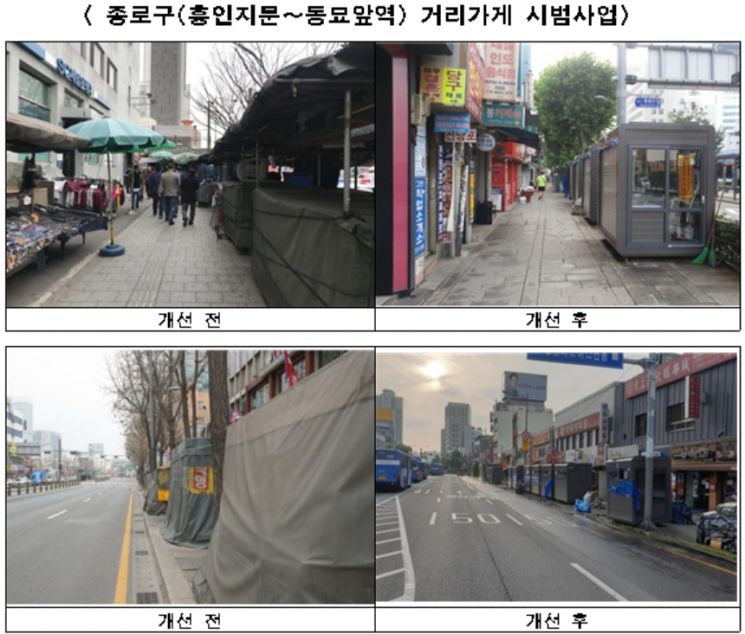
[Asia Economy Reporter Jo In-kyung] Unauthorized street vendors, which have long occupied sidewalks and been perceived negatively due to hygiene and urban aesthetics, are transforming into neat 'street stalls.'
The Seoul Metropolitan Government announced on the 7th that it is expanding the 'Street Stall Permit System,' which authorizes and manages unauthorized street stalls (vendors) to restore pedestrian rights and secure the survival rights of street stalls, to all autonomous districts.
By the end of this month, a special street stall maintenance pilot project will be completed for about 100 street vendors along a 1.2 km section from Heunginjimun to Dongmyo Station, where maintenance work had been stalled for about 40 years. The area around Changsin-dong, Dongdaemun Station, and Dongmyo Station is a commercial district and attraction with toy streets, sewing streets, food alleys, and Hanok villages, attracting many tourists and visitors. However, the sidewalks are narrow compared to the pedestrian population, and the irregular sizes of each street stall have caused inconvenience not only for passage but also for store use.
Accordingly, the street vendors that have filled this area for over 40 years will be reborn as neat street stalls that visitors can use with greater confidence, developing into a new attraction connecting the Dongmyo secondhand goods street and the Dongdaemun shopping area.
Previously, Seoul completed the street maintenance in front of Yeongdeungpo Station (Yeongjung-ro), known for congestion, fulfilling a long-standing citizen wish of about 50 years. This year, following the area around Sillim Station in Gwanak-gu in May, and by the end of July, the area around Jongno-gu (Heunginjimun to Dongmyo Station) will be completed, marking the completion of three out of five pilot projects. Pilot projects in Jungnang-gu (Taereung Market) and Dongdaemun-gu (Cheongnyangni Wholesale Market, etc.) will also proceed sequentially.
Separately from the pilot projects, the street stall permit system projects in four other locations around Cheongnyangni Station were successfully completed at the end of last year.
The city has been implementing the street stall permit system policy, which guarantees citizens' pedestrian rights and street stalls' survival rights, since last year, the first among metropolitan governments. Official road occupancy permits are granted to street stalls that meet certain conditions without damaging urban aesthetics, and operators are encouraged to operate stably by fulfilling related obligations such as paying occupancy fees.
This year, projects are underway in the areas around Seoul National University Station in Gwanak-gu, Yeonseo Market in Yeonsinnae, Eunpyeong-gu, Saemaeul Market in Songpa-gu, and two small-scale projects.
Hwang Bo-yeon, Director of the Seoul City Urban Transportation Office, said, "The street stall permit system project requires considerable effort at every stage until completion, as it involves dozens to hundreds of consultations and discussions among stakeholders on site. We hope that street stalls, merchants, and citizens can realize the value of coexistence together and become a model of exemplary win-win cooperation."
© The Asia Business Daily(www.asiae.co.kr). All rights reserved.

![Clutching a Stolen Dior Bag, Saying "I Hate Being Poor but Real"... The Grotesque Con of a "Human Knockoff" [Slate]](https://cwcontent.asiae.co.kr/asiaresize/183/2026021902243444107_1771435474.jpg)














