Announcement of the 'Korean New Deal Comprehensive Plan' on the 13th
Expansion of government direct jobs from 550,000 to 2.2 million+a
Concerns over fiscal soundness deterioration
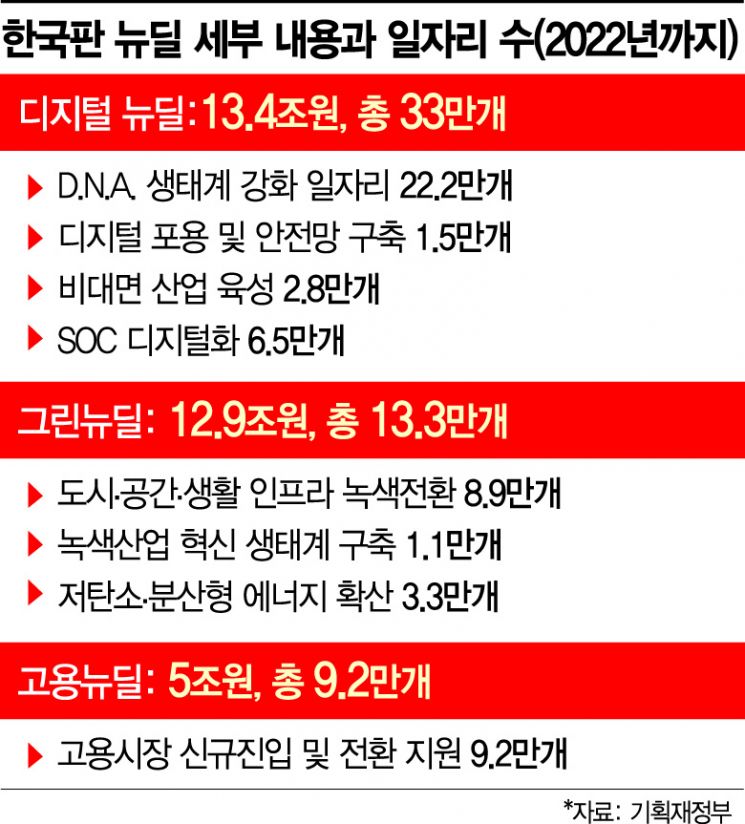
[Asia Economy Reporter Jang Sehee] The government plans to invest approximately 100 trillion won by 2025 to create more than 2 million 'Korean New Deal jobs.' This number is about four times higher than the initially announced 550,000 jobs by 2022 in the economic policy direction for the second half of the year. However, some raise doubts about the sustainability and effectiveness of the government's job projects.
According to related ministries such as the Ministry of Economy and Finance and the Ministry of Employment and Labor on the 7th, the government is expected to announce the 'Korean New Deal Comprehensive Plan' containing these details at a meeting presided over by President Moon Jae-in on the 13th. A government official stated, "Future growth engine projects such as electric vehicles and hydrogen cars have been added to the Korean New Deal projects," and added, "We will create 2 million+a Korean New Deal jobs through a mid- to long-term job creation plan over five years." The Korean New Deal is being carried out on two pillars: the Digital New Deal and the Green New Deal.
Accordingly, the scale of the Korean New Deal projects will also increase. The government previously announced that it would invest a total of 76 trillion won, including 31 trillion won by 2022 and 45 trillion won from 2023 to 2025, in the basic direction of the Korean New Deal. The government plans to expand this to 100 trillion won.
With many 'new projects' included in the Korean New Deal, the size of next year's main budget is also expected to grow further. On the 30th of last month, Deputy Prime Minister and Minister of Economy and Finance Hong Nam-ki emphasized that the government's direct job provision was an inevitable choice to overcome the employment shock caused by the COVID-19 pandemic. Regarding the need to increase the budget related to jobs, Minister Hong said, "I think the more, the better compared to the current situation."
As government spending increases, fiscal soundness inevitably deteriorates. According to the Ministry of Economy and Finance's fiscal trends, national debt, which was 660.2 trillion won in 2017 (under the Park Geun-hye administration), increased by 48.9% to 1,030.5 trillion won in 2022 (at the end of Moon Jae-in's administration). Professor Kim Sang-bong of Hansung University’s Department of Economics emphasized, "If 100 trillion won is invested over five years, it means spending 20 trillion won annually," adding, "If the amount increases from the original plan, fiscal soundness could worsen."
There are also concerns that repeated government job supply could weaken the market's resilience. When the government supplies short-term jobs, there is a limit because these jobs are not sustainable. Contrary to popular belief, unemployment in the United States did not significantly decrease even after the New Deal policy.
Professor Kim So-young of Seoul National University’s Department of Economics pointed out, "When government spending increases, the market reduces spending by at least that amount," adding, "If the government directly provides jobs, the market's job resilience may weaken, and the work motivation of other workers may decrease." She continued, "To maximize labor productivity, private sector-led job creation is important."
There is also doubt whether the Korean New Deal comprehensive plan can be continuously promoted. The year 2025, presented by the government, marks the end of the Moon Jae-in administration's term. The longer the mid- to long-term projects, the larger the project budget becomes, but it is more difficult to achieve project goals. A government official said, "Currently, most projects are not being executed due to COVID-19," and added, "The longer the project cycle, the harder it is to achieve the goals."
© The Asia Business Daily(www.asiae.co.kr). All rights reserved.

















