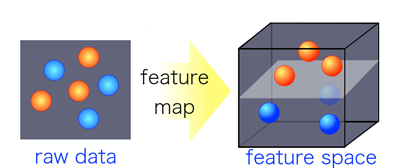
 Feature Classification Technology Using Nonlinear Kernels in Classification through Artificial Intelligence
[Asia Economy Reporter Junho Hwang] Domestic researchers have devised and demonstrated an algorithm that forms the basis of quantum artificial intelligence. This technology enables computational tasks that are difficult to distinguish even with artificial intelligence or require significant time and resources to be processed at once through quantum computing technology.
The Korea Advanced Institute of Science and Technology (KAIST) announced on the 7th that Professor Jungoo Lee's research team from the Department of Electrical Engineering and Computer Science and the AI Quantum Computing IT Human Resources Development Research Center, in collaboration with research teams from Germany and South Africa, developed a nonlinear quantum machine learning artificial intelligence algorithm.
Artificial intelligence mechanically learns the correlation between data of dogs and cats to distinguish between the two. This is done through a kernel, a function that quantifies the similarity between data. The problem arises when the data values of dog and cat images are similar. Existing artificial intelligence distinguishes between the two by analyzing a very large amount of data, which is a time- and energy-consuming task. Efficient distinction requires parallel computation. If the existing AI's computation method is a linear equation, a method of performing parallel computations is necessary.
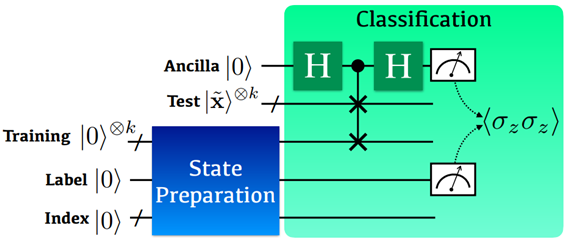 An example of a quantum circuit for quantum kernel-based supervised learning developed by the research team
The research team developed a quantum algorithm system that makes this possible through quantum computing technologies (quantum poking technology and quantum measurement technology). Quantum computing uses qubits instead of bits, the basic unit of computation used by conventional computers. The dimension of the information space increases exponentially with the number of qubits.
The algorithm developed by the research team transfers data existing in a low-dimensional input space into a high-dimensional data feature space represented by qubits, then simultaneously calculates the kernel functions between all quantized training data and test data using quantum superposition, efficiently classifying the test data. The computational complexity of the quantum circuit used increases linearly with the amount of training data but increases very slowly with the number of data features, which is advantageous.
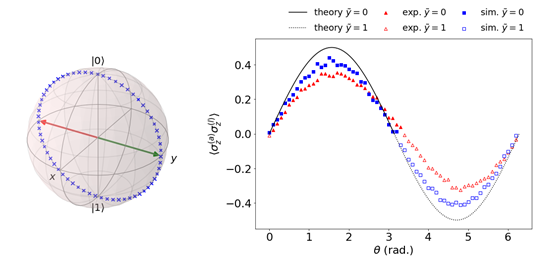
The research team also theoretically proved that various quantum kernels can be implemented through systematic design of quantum circuits. Since the optimal kernel may vary depending on the given input data in kernel-based machine learning, the ability to efficiently implement various quantum kernels is a very important achievement for the practical application of quantum kernel-based machine learning.
The research team experimentally implemented the quantum machine learning algorithm developed in this study on a superconducting quantum computer composed of five qubits provided as a cloud service by IBM, successfully verifying these research results in practice.
Research Professor Kyungdeok Park, who participated in this study, said, "The kernel-based quantum machine learning algorithm developed by the research team is expected to become a technology surpassing classical kernel-based supervised learning in the era of NISQ computing with hundreds of qubits, which is predicted to be commercialized within a few years. It will be actively used as a quantum machine learning algorithm for pattern recognition of complex nonlinear data."
© The Asia Business Daily(www.asiae.co.kr). All rights reserved.
![Clutching a Stolen Dior Bag, Saying "I Hate Being Poor but Real"... The Grotesque Con of a "Human Knockoff" [Slate]](https://cwcontent.asiae.co.kr/asiaresize/183/2026021902243444107_1771435474.jpg)


















