Production Induction Effect of 235.9 Billion KRW, Employment Induction Effect Expected to Create 684 Jobs
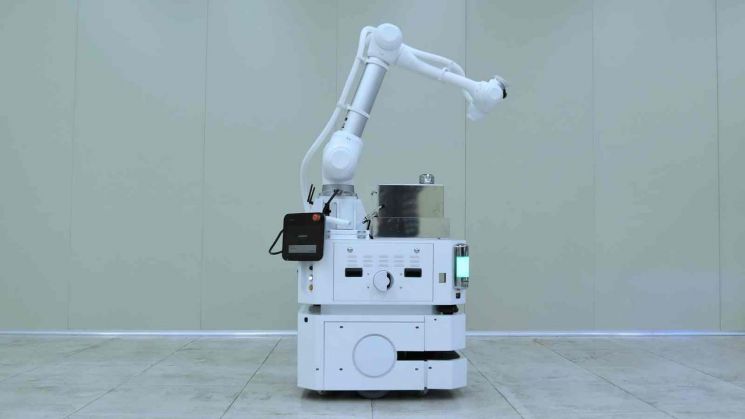
[Asia Economy Yeongnam Reporting Headquarters Reporter Park Dong-wook] The 'Daegu Mobile Collaborative Robot Regulatory Free Zone' was designated as the 3rd Regulatory Free Zone following the final review by the Regulatory Free Zone Committee chaired by Prime Minister Chung Sye-kyun on the 6th.
According to Daegu City, the Mobile Collaborative Robot Regulatory Free Zone is a project where 18 special zone operators, including SL Co., Ltd. electronic factory, Pyeonghwa Precision, Yujin MS, Yuseong Precision Industry, and Ajin X-Tech, can apply special exemptions allowing the operation of 'mobile collaborative robots' while moving, from August 2020 to July 2024, for demonstration purposes.
The demonstration work will be conducted using robots from partner companies such as Hyundai Robotics, Doosan Robotics, and LG Electronics at 14 manufacturing and production sites (8.3㎢), including parts of the Seongseo Industrial Complex, as well as in non-face-to-face service sites.
A 'Mobile Manipulator' refers to a new product combining a collaborative robot mounted on a mobile cart. Currently, robots can only operate while stationary at work sites, so designation as a regulatory free zone is necessary to allow operation while moving.
Currently, countries worldwide are competitively conducting applied research and standardization efforts to capture the mobile collaborative robot market. In Korea, efforts are underway to secure technological and product competitiveness by verifying the safety and efficiency of mobile collaborative robots through demonstrations within the special zone and to prepare safety standards for mobile collaborative robots using demonstration data.
By demonstrating operations such as barcode recognition, inspection, polishing, and posture changes of mobile collaborative robots while moving at manufacturing and production sites (5 locations), it is expected to increase production efficiency by shortening work time and establish flexible production processes.
Applicable manufacturing and production sites include automated manufacturing processes (automobile lamp modules), transfer and loading processes (automobile door latches), large product manufacturing processes (pressure tanks), small-lot multi-product manufacturing processes (parts welding), and production logistics processes (logistics + inspection at electronic parts production sites).
Through the designation of the Mobile Collaborative Robot Regulatory Free Zone, Daegu City expects participating companies to increase sales by 176.7 billion KRW, exports by 19.16 million USD, create 384 new jobs, and attract 7 domestic and international robot companies. In particular, the estimated regional economic ripple effects include a production inducement effect of 235.9 billion KRW, a value-added inducement effect of 64.2 billion KRW, and an employment inducement effect of 684 people.
Daegu City, which has fostered the robot industry as one of the five major future new industries, has grown to be the top non-capital region in the domestic robot industry sector, following Gyeonggi and Seoul. It has also secured the Global Robot Cluster (GRC), involving 5 global robot companies such as Hyundai Robotics and 13 clusters from 11 countries worldwide.
Daegu Mayor Kwon Young-jin stated, "With the expansion of smart factories and the acceleration of non-face-to-face and digitalization due to COVID-19, the Daegu Mobile Collaborative Robot Regulatory Free Zone will be a stepping stone for Daegu, a world-leading ultra-first-class robot city attracting global attention." He emphasized, "We plan to spare no support to ensure the successful promotion of the Mobile Collaborative Robot Regulatory Free Zone project."
© The Asia Business Daily(www.asiae.co.kr). All rights reserved.

















