Start of Hydrogen Vehicle Exports to Switzerland
Plan to Supply 1,600 Units by 2025
Ministry of Industry Provides Technical Support for Parts Development
"New Support of 100 Billion Won Over 5 Years"
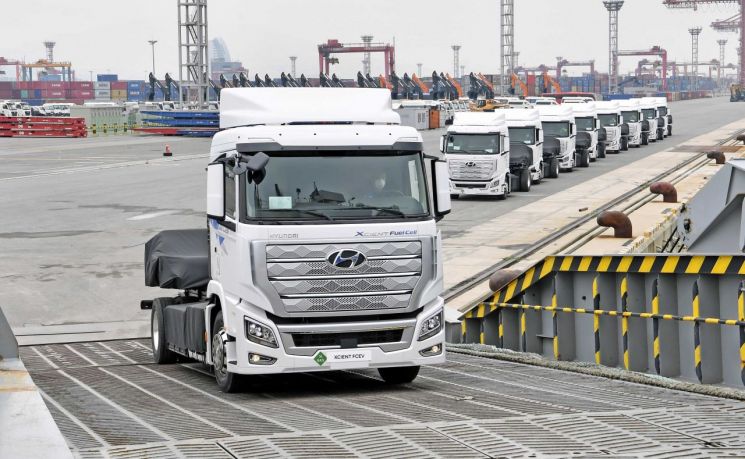
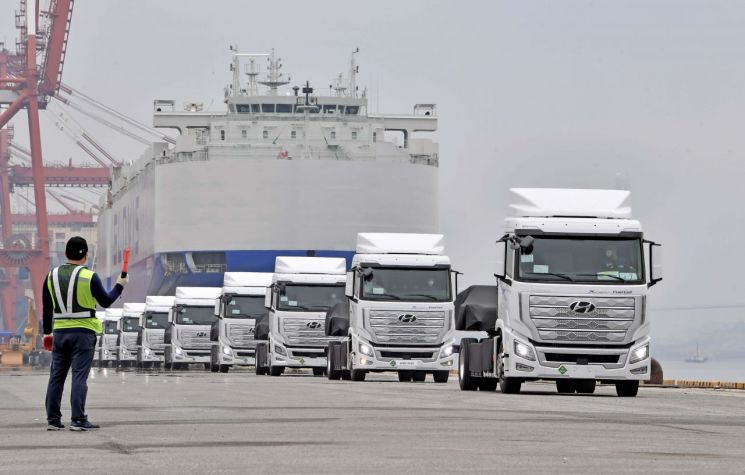
[Asia Economy Reporter Kim Bo-kyung] Hydrogen fuel cell trucks developed through a collaboration between domestic companies and the government are entering the Swiss market for the first time. This marks the opening salvo in targeting the European eco-friendly commercial vehicle market, starting with exports to Switzerland.
The Ministry of Trade, Industry and Energy and Hyundai Motor Company announced on the 6th that they exported 10 large hydrogen fuel cell trucks to Switzerland through Gwangyang Port in Jeollanam-do. The 'XCIENT Fuel Cell' trucks shipped that day are large cargo trucks with a gross vehicle weight of 34 tons, equipped with a 190 kW hydrogen fuel cell system consisting of two hydrogen fuel cells and a 350 kW maximum output drive motor. The driving range per full charge is approximately 400 km, and charging time takes about 8 to 20 minutes depending on the external temperature of the hydrogen tank.
While major automobile manufacturers have previously introduced prototype vehicles for demonstration projects and concept cars for exhibitions aimed at commercializing large trucks, Hyundai is the first to establish a mass production system for sales to general customers. A Hyundai official stated, "This export marks our first entry into the Western European large commercial vehicle market and signifies a foothold to preempt the hydrogen electric commercial vehicle market ahead of major competitors." He added, "Starting with exports to Switzerland, we plan to expand supply regions throughout Europe, including Germany, the Netherlands, Austria, and Norway, and eventually enter the North American commercial vehicle market."
The hydrogen fuel cell trucks shipped that day will be delivered to 'Hyundai Hydrogen Mobility,' a joint venture (JV) between Hyundai Motor Company and Swiss hydrogen solution specialist H2 Energy, officially launched in September last year. They will then be supplied to distribution companies and used as refrigerated vans. Hyundai plans to export an additional 40 units by the end of this year and supply a total of 1,600 units by 2025. This supply is conducted in a pay-per-use model rather than the traditional vehicle sales method. The usage fee includes all costs related to vehicle operation, such as charging fees, repair costs, insurance premiums, and regular maintenance fees.
This export is the result of combined government support and the efforts of our companies. Hydrogen fuel cell trucks require higher durability and output compared to hydrogen passenger cars, making it a challenging field. The Ministry of Trade, Industry and Energy has supported the development and performance improvement of core components such as hydrogen fuel cells. With a total government funding of 90.6 billion KRW, 16 research and development (R&D) projects, including the development of low-cost, high-output fuel cell systems, were supported. The hydrogen fuel cell trucks exported this time incorporate the hydrogen fuel cell cooling system and control technology developed through the ministry’s R&D efforts.
Major European countries such as Norway are pushing to ban the sale of internal combustion engine vehicles from 2025 onwards. The commercial vehicle market, mostly composed of diesel vehicles, urgently needs the introduction and expansion of eco-friendly vehicles such as hydrogen fuel cell trucks. In particular, hydrogen fuel cell trucks have the advantage of emitting no pollutants and are more favorable than battery electric vehicles for long-distance driving and freight transport. Since commercial vehicles like trucks and buses often operate on fixed routes repeatedly, installing hydrogen refueling stations centered around cargo loading/unloading areas or depots poses no significant operational difficulties. The Swiss Hydrogen Mobility Association plans to install a total of seven hydrogen refueling stations by the end of this year and build a network of about 80 hydrogen refueling stations by 2025.
An official from the Ministry of Trade, Industry and Energy said, "To ensure our companies secure a clear advantage in the global hydrogen vehicle market competition, we plan to continuously enhance the performance and durability of core components through new support worth about 100 billion KRW over five years starting this year." He added, "We will also accelerate the domestic hydrogen vehicle supply through various pilot projects."
Lee In-chul, Vice President and Head of Hyundai Motor Company’s Commercial Vehicle Division, said, "By mass-producing and starting sales of the world’s first hydrogen electric large trucks, we have firmly established Hyundai’s global leadership in hydrogen electric commercial vehicles worldwide." He added, "We will lead the paradigm shift in the global eco-friendly commercial vehicle market by expanding not only in Europe but also in North America and China."
Meanwhile, according to a report published by global consulting firm McKinsey in September 2018, it is projected that approximately 3 to 4 million hydrogen fuel cell trucks for transportation will be deployed worldwide by 2030.
© The Asia Business Daily(www.asiae.co.kr). All rights reserved.
![Clutching a Stolen Dior Bag, Saying "I Hate Being Poor but Real"... The Grotesque Con of a "Human Knockoff" [Slate]](https://cwcontent.asiae.co.kr/asiaresize/183/2026021902243444107_1771435474.jpg)

















