Main Cause of Workplace Stress: 'Relationships with Bosses and Colleagues' 25.2%
9 out of 10 Workers Suffer from Burnout Syndrome
Experts Say "Phenomenon Due to Intergenerational Value Conflicts"
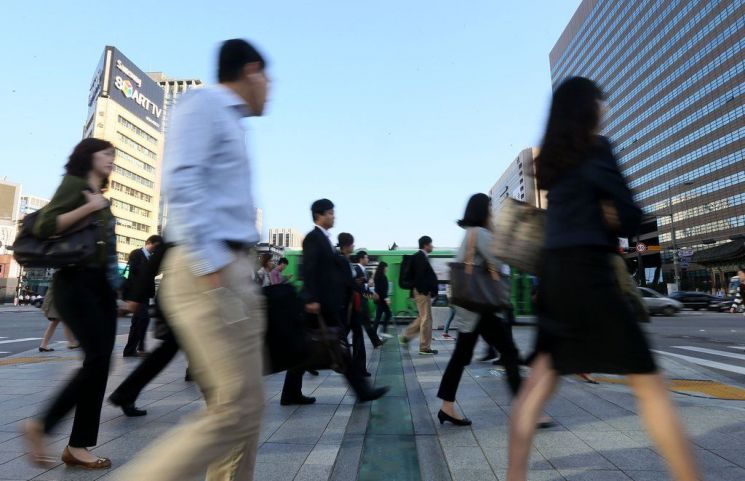 According to a survey, most office workers experience stress while working, and the causes were found to be diverse.
 Photo by Yonhap News
[Asia Economy Reporter Kim Suwan] #A(28), a third-year office worker, is struggling with a deteriorating relationship with their boss. A said, "Recently, I complained about my boss's incessant day-and-night calls and ended up being insulted as a person who lacks basic manners," adding, "Although we haven't maintained a very good relationship normally, this incident has deepened the emotional rift." They continued, "I have no idea how to resolve this. Lately, my boss has been nitpicking about various things, and I'm seriously considering whether I should quit."
Recently, the biggest source of stress for office workers has been found to be interpersonal relationships rather than salary or workload.
Experts analyze this phenomenon as a result of a culture spreading among younger generations that prioritizes the self as the highest value. It is explained that interpersonal relationships are viewed from the perspective of efficiency.
According to a survey, most office workers experience stress during their work life, and the causes are diverse.
On the 2nd, flea market job recruitment conducted a survey of 1,225 office workers about 'Office Workers and Stress,' and 86.7% of all respondents answered that they have experienced stress while working.
The main causes of stress were 'interpersonal relationships with bosses and colleagues' at 25.2%, followed by 'excessive workload' (23.7%), 'low salary' (13.1%), 'power harassment from bosses, customers, or clients' (9.9%), and 'pressure regarding performance' (8.9%).
The problem is that stress from work life is making personalities more sensitive, and even more people are complaining of health problems.
Physical and mental changes due to stress were surveyed as △ 'became more sensitive' (23.3%) △ 'suffer from chronic fatigue' (18.8%) △ 'developed headaches and indigestion' (17.8%) △ 'developed insomnia' (9.8%).
Moreover, if such stress accumulates, it may develop into 'Burnout syndrome,' which requires caution.
Burnout syndrome means 'to burn out' or 'to be exhausted,' referring to a condition where a person who was deeply engaged in work feels drained of energy and falls into lethargy. If these symptoms repeat, the ability to cope with work-related stress is known to weaken. In fact, the World Health Organization (WHO) classifies burnout syndrome as an occupational phenomenon.
As a result, 9 out of 10 office workers are suffering from burnout syndrome. According to a survey conducted by the office worker app Blind in May with 10,091 office workers regarding 'Burnout syndrome,' 89% responded 'yes' to the question 'Have you recently experienced burnout?'
Experts analyze this situation as a phenomenon caused by a value clash between the older and younger generations.
Professor Lee Dong-gwi of Yonsei University's Department of Psychology said, "Older generations often valued dedication to the organization. They emphasized hierarchical relationships because they prioritized organizational efficiency," adding, "In contrast, younger generations no longer believe in the concept of a lifelong job and do not understand loyalty to the organization. They prioritize themselves as the highest value."
Professor Lee advised, "For this reason, people in their 20s and 30s have a resistance to excessive demands from others. They try to avoid unnecessary energy waste such as emotional exhaustion. The values between generations differ in many ways, which means communication is lacking. We must acknowledge these differences and avoid imposing our own views on others. Also, not having unnecessary expectations of each other and finding common ground can be one way to improve the situation."
© The Asia Business Daily(www.asiae.co.kr). All rights reserved.
![Clutching a Stolen Dior Bag, Saying "I Hate Being Poor but Real"... The Grotesque Con of a "Human Knockoff" [Slate]](https://cwcontent.asiae.co.kr/asiaresize/183/2026021902243444107_1771435474.jpg)

















