President Moon Unusually Orders "Supply Expansion" but...
35,000 Housing Units to Start Construction by 2022
Practically Difficult to Find Additional Idle Land for Securing More
"Greenbelt Release Also Difficult"
Blocked Even by Seoul City's Opposition
3rd New Town Expansion Discussed
Experts Say "Even Increasing New Towns Cannot Stop Seoul Housing Price Rise"
[Asia Economy Reporters Yoo In-ho and Lee Chun-hee] "It's true that it's not easy. We have to search thoroughly as much as possible."
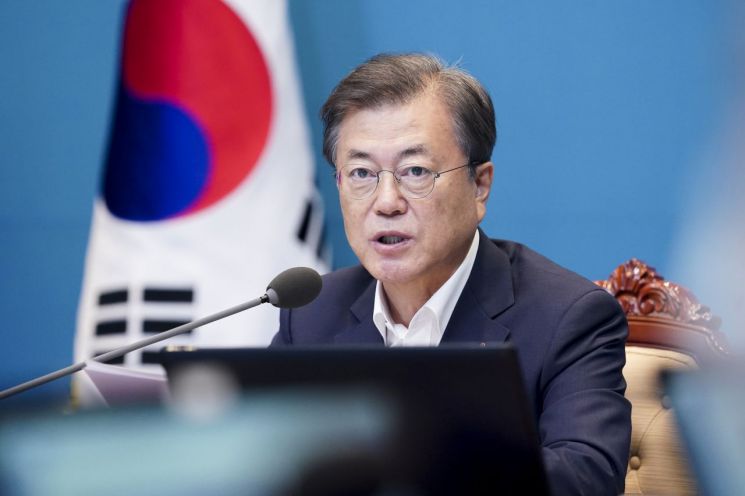
On the 2nd, President Moon Jae-in personally instructed Minister of Land, Infrastructure and Transport Kim Hyun-mi to "increase the housing supply volume even if additional discoveries are made," signaling a sharp shift in the government's real estate policy from a regulation-only approach to a two-track strategy of 'supply expansion' and 'speculative demand suppression.' This somewhat accepts the market's assertion that supply expansion is the only answer.
However, frontline policy officials already feel that it is practically difficult to secure available land necessary for supply expansion. This is because the regulatory barriers to redevelopment and reconstruction projects, which actually account for 70-80% of housing supply in Seoul, remain intact.
According to the Ministry of Land, Infrastructure and Transport (MOLIT) and Seoul City on the 3rd, MOLIT plans to prioritize consultations with Seoul City among the metropolitan local governments including Gyeonggi Province and Incheon City to discover additional Greenbelt or public land.
The public and private idle lands already secured by MOLIT and Seoul City in the city center amount to 63 sites, including Seongdong Detention Center, Geumcheon District Office, and Magok R&D Center, capable of accommodating 40,000 households. Procedures such as project approval and groundbreaking are currently underway.
By type, these include ▲ utilization of national and public land for 19,000 households (34 sites) ▲ utilization of military idle land for 4,500 households (7 sites) ▲ complex development of public facilities for 6,600 households (9 sites) ▲ other types such as private projects and public contributions for 10,000 households (13 sites). So far, only 4,000 households have completed project approval (district designation), and it plans to complete project approval for 16,000 households by the end of this year. It aims to start construction for over 35,000 households by 2022, including 20,000 households next year.

However, it is known that there is virtually no additional idle land that can be secured in downtown Seoul beyond these sites. A MOLIT official said, "It is true that securing land in downtown Seoul for supply expansion is not easy." He added, "Seoul City holds a negative stance on lifting the Greenbelt restrictions, so although we will try to find additional idle land beyond the existing secured sites, it does not seem easy."
In fact, MOLIT and Seoul City are negotiating over lifting the Greenbelt in the city, but have hit a wall. Mayor Park Won-soon of Seoul strongly opposes lifting the Greenbelt within Seoul, saying it should be preserved for future generations. A Seoul City official said, "We agree with the government's supply expansion policy," but added, "Lifting the Greenbelt is not under consideration."
Ultimately, there is no suitable solution other than expanding the 3rd New Towns or developing additional new towns. The industry suggests that Gwangmyeong and Siheung may be announced as additional new towns. These two areas have high accessibility to Seoul and were considered likely candidates for designation as 3rd New Towns but were ultimately excluded. These areas were previously designated as housing promotion districts but faced residents' opposition, resulting in project failure and being designated as special management zones since 2015.
Yang Ji-young, director of R&C Research Institute, said, "3rd New Towns cannot stop the rise in Seoul housing prices," adding, "Even if new towns increase, the current problem is the demand for housing within Seoul, so it is not a fundamental solution." She further noted, "While demand in the outskirts of Gyeonggi Province may be absorbed, it will be difficult to absorb demand within downtown Seoul."
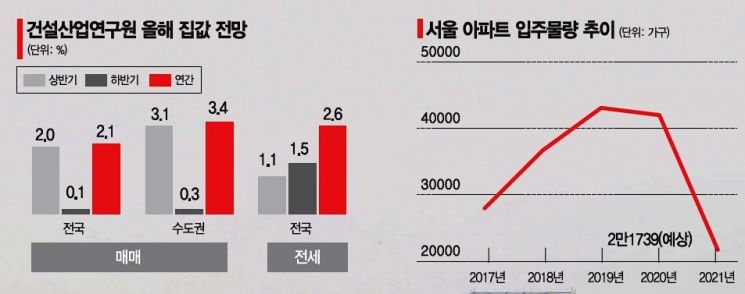
The government's existing mismatch between housing supply and demand is also raised. The public sector's supply is skewed toward rental housing for young people such as youths, while the rise in housing prices stems from a shortage of new apartments mainly demanded by the middle class. In fact, the government is reportedly considering expanding the supply volume of rental housing by about 140,000 households annually or advancing the supply schedule as part of the current supply expansion measures.
In a situation where apartment jeonse (long-term lease) prices are soaring, this acknowledges that there is no sharp supply expansion measure that can immediately solve the problem. An industry official questioned, "Public rental housing mostly consists of small apartments or multi-family houses for low-income groups. Will increasing this volume curb the soaring apartment jeonse prices?"
Therefore, experts insist that there is no way other than easing redevelopment and reconstruction regulations to stabilize housing for the actual demand group, the middle class. Professor Kwon Dae-jung of Myongji University’s Department of Real Estate said, "It is difficult to supply housing in Seoul under redevelopment and reconstruction regulations," adding, "Easing the regulations on maintenance projects is the best method, but since excessive liquidity is flowing in the market, it is difficult to apply immediately unless this is resolved."
Ko Jong-wan, director of the Korea Asset Management Research Institute, advised, "Ultimately, supply policies within Seoul must be introduced," suggesting, "Activating reconstruction and redevelopment, lifting the Greenbelt to build houses, or increasing floor area ratios in the city center can also be considered."
© The Asia Business Daily(www.asiae.co.kr). All rights reserved.
![Clutching a Stolen Dior Bag, Saying "I Hate Being Poor but Real"... The Grotesque Con of a "Human Knockoff" [Slate]](https://cwcontent.asiae.co.kr/asiaresize/183/2026021902243444107_1771435474.jpg)


















