Yangsan Newlywed Hope Town 753 Units Open for Application with 15 Applicants
High Competition in Capital Area vs. Undersubscription in Local Elections
Controversy Over Achievements... "Supply Should Match Demand"
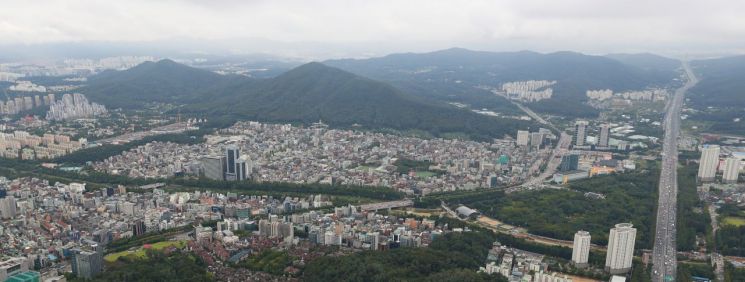
[Asia Economy Reporter Moon Jiwon] Although the government is increasing the supply of public housing to stabilize housing for low-income households, large-scale vacancies are repeatedly occurring in local areas. There are calls to focus on supplying housing that meets the demands of residents, such as proximity to workplaces, rather than simply increasing the supply volume.
According to the Ministry of Land, Infrastructure and Transport and Korea Land and Housing Corporation (LH) on the 3rd, only 15 applications were received for the additional recruitment of residents for the newlywed hope town in Yangsan Sasong A-1 Block, Gyeongnam, out of 753 households at the beginning of last month. Previously, in the initial recruitment at the end of December last year, only 39 contracts were signed out of 792 households in this apartment complex.
The newlywed hope town in Busan Gijang A2 Block also experienced a shortage again, with only 101 contracts signed out of 486 households during the initial supply in November last year, and recently only 44 applications for the remaining 385 households. Additionally, public sale housing in Daegu Yeonggyeong S-1 Block and public sale housing in Munae, Yeongcheon, Gyeongbuk are currently recruiting additional residents for remaining units.
Public housing shortages are also occurring in some areas of the metropolitan area. In the case of Hwaseong Dongtan 2 A104 Block newlywed hope town in Gyeonggi, 454 people applied for 282 households of 55㎡ units in the additional recruitment in May, resulting in a complete sell-out, but only 11 applied for 65 households of 46㎡ units, failing to complete the sale.
This contrasts with the high competition rates recorded for metropolitan area public housing. According to the Ministry of Land, the newlywed hope town in Hanam Wirye, Gyeonggi, previously supplied, had a subscription rate of 53 to 1 per complex. The newlywed hope towns supplied in Yangwon, Seoul, and Godeok, Pyeongtaek recorded competition rates of 21 to 1 and 1.6 to 1, respectively. This clearly shows the gap in competition rates between metropolitan and local public housing.
The reason for the repeated shortage in local public housing is that demand is relatively weak compared to the metropolitan area.
A Ministry of Land official explained, "The reason for many remaining units in local areas seems to be largely due to locational factors." The Ministry of Land and LH are making efforts such as relaxing resident conditions or strengthening publicity to resolve the repeated shortage issues, but it is analyzed to be difficult.
There are also voices suggesting that the government, focusing only on building achievements by increasing the supply of public housing, may have failed to properly analyze demand. While the supply of public housing itself helps stabilize housing for low-income households, many are actually being overlooked in the market, so the policy function is not properly fulfilled. The government plans to recruit residents for a total of 18,364 households in 68 local areas in the second half of this year.
Professor Seo Jin-hyung of Gyeongin Women's University (President of the Korean Real Estate Society) explained, "When the government establishes housing supply plans, it should supply where there is demand," adding, "A large number of public housing units suitable for proximity to workplaces should be supplied, but because supply is made without reviewing specific plans and locations, the phenomenon of increasing remaining units is occurring."
© The Asia Business Daily(www.asiae.co.kr). All rights reserved.
![Clutching a Stolen Dior Bag, Saying "I Hate Being Poor but Real"... The Grotesque Con of a "Human Knockoff" [Slate]](https://cwcontent.asiae.co.kr/asiaresize/183/2026021902243444107_1771435474.jpg)










