This Month's Delinquency Rate Soars to 16.91%
Some Companies 'Circularly Fund'... Funding Consumers Suffer Consecutive Losses
Following Private Equity, Financial Authorities Launch Intensive Inspections Amid Concerns of New Risks
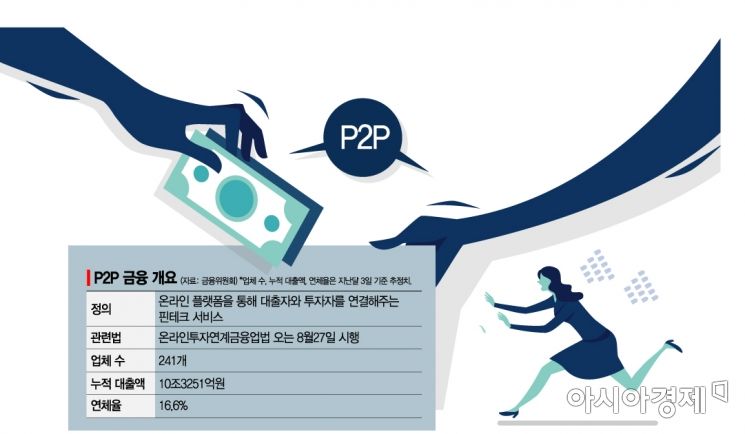
[Asia Economy Reporter Kim Min-young] The delinquency rate in peer-to-peer (P2P) finance is soaring. With the related law set to be enforced next month, bringing the industry into the regulatory framework, even the top-tier companies are experiencing rising delinquency rates, raising alarms across the sector.
According to financial authorities and industry sources on the 3rd, the P2P finance delinquency rate surged from 5.5% in 2017 to 10.9% in 2018, 11.4% at the end of last year, and 16.6% last month. This month, it has risen further to 16.91%.

Even ‘Terra Funding,’ the industry leader by cumulative loan amount, recorded a delinquency rate of 20.18% last month. This marks an increase of 7.21 percentage points in just half a year, causing concern within the industry.
Terra Funding operates a real estate P2P finance business model that connects construction contractors with individual investors. Since the loan size per case reaches the 10 billion KRW range, any problem with a specific product can lead to significant losses. The company’s cumulative loan amount has reached 1.1292 trillion KRW.
Terra Funding explained that the delinquency rate rose due to defaults occurring in 15 project financing (PF) loans for construction funds. A company representative said, “The real estate market has deteriorated, and in order to minimize investor losses, we have made it a principle to avoid selling bonds as much as possible and to conduct internal collections, which has contributed to the higher delinquency rate.”
They added, “We are putting all efforts into debt management by increasing external managers in the credit management team,” and “We are also strengthening capabilities to reduce the frequency of delinquencies by recruiting appraisers and sales experts.” (Online comprehensive)
P2P finance is a fintech (finance + technology) service that connects borrowers and investors through an online platform without going through financial companies. It was introduced in Korea in 2015 and has grown rapidly since then.
However, recently, with the sharp rise in delinquency rates and some companies’ unsound business practices, financial consumer damages have occurred repeatedly. ‘Pop Funding’ is a representative case. Pop Funding has handled movable collateral loans, lending funds collected from investors secured by inventory assets of small and medium-sized enterprises such as home shopping or open market sellers. Due to delays in principal repayments by borrowers, 35.5 billion KRW worth of private equity funds linked to this product have suspended redemptions. Pop Funding was once cited by the Financial Services Commission as a model case of innovative finance. Currently, it is under prosecution investigation for allegations including ‘circular financing.’
Because of the nature of P2P finance transactions, if the borrower fails to repay on time, losses inevitably fall entirely on investors, raising concerns that it could become another financial instability trigger following private equity funds.
Ultimately, financial authorities have taken action. The day before, they announced that along with a full investigation of private equity funds, they will conduct intensive inspections of all P2P companies around the enforcement date of the Online Investment-Linked Finance Business Act on the 27th of next month.
Earlier last month, financial authorities issued a P2P investment advisory warning, citing companies that guarantee principal, lure investors with excessive rewards and high returns, or excessively lend to specific borrowers. This is the second warning this year. The authorities stated, “We will analyze audit reports from accounting firms on P2P companies’ loan receivables and conduct registration reviews only for qualified companies, while guiding unqualified companies to convert to loan businesses or to close down.”
Some expect that with the enforcement of the Online Investment-Linked Finance Business Act next month, as P2P enters the regulatory framework, the exposure of insolvent companies will accelerate the sorting of good and bad players. The enforcement decree specifies that P2P companies’ real estate-related loan limits are ‘within 7% of total loan assets’ or ‘70 billion KRW or less.’ Meanwhile, there are currently 241 P2P companies operating domestically, with cumulative loans reaching 10.3251 trillion KRW as of last month.
© The Asia Business Daily(www.asiae.co.kr). All rights reserved.
![Clutching a Stolen Dior Bag, Saying "I Hate Being Poor but Real"... The Grotesque Con of a "Human Knockoff" [Slate]](https://cwcontent.asiae.co.kr/asiaresize/183/2026021902243444107_1771435474.jpg)













