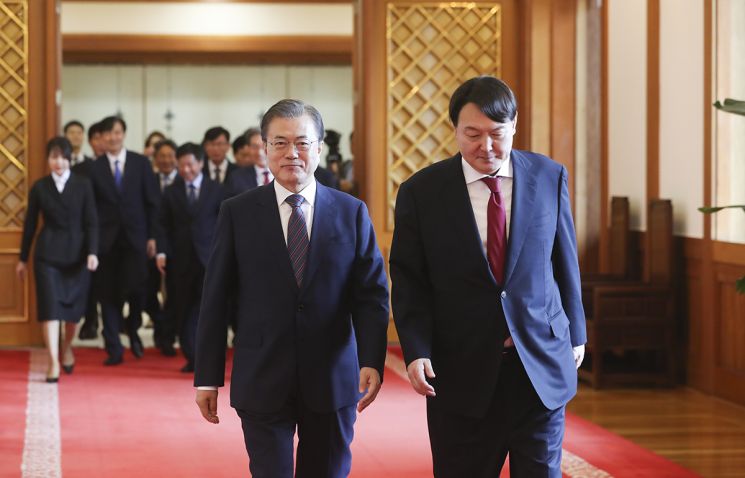
 On July 25 last year, President Moon Jae-in and Prosecutor General Yoon Seok-youl are moving together to the reception room after the appointment certificate ceremony at the Blue House. At the time, President Moon handed the appointment certificate to Prosecutor General Yoon and urged him, "Do not be swayed by power." (Photo by Blue House)
[Asia Economy Reporter Son Sun-hee] "I could not understand his conduct. Even now, I do not fully understand it."
This is President Moon Jae-in's reflection on Kim Jong-bin, then Prosecutor General, who resigned voluntarily when the first-ever investigative directive by the Minister of Justice in constitutional history was issued in October 2005. President Moon describes the situation in detail in his book 'Destiny.' During the participatory government era, when the prosecution sought to request an arrest warrant against Kang Jeong-gu, a professor at Dongguk University, for violating the National Security Act, then Minister of Justice Cheon Jeong-bae exercised the investigative directive to order a non-custodial investigation.
President Moon viewed this as a principled act based on the Prosecutors' Office Act. Unlike the past, when unofficial interference in investigations through phone calls and other indirect means was rampant, the activation of the official investigative directive was rather an opportunity to reaffirm the prosecution's political neutrality.
Nevertheless, when the Prosecutor General submitted his resignation, President Moon pointed out, "The Prosecutor General must follow the Minister of Justice's instructions even if it goes against his own convictions, as that is the procedure," and added, "Due to Prosecutor General Kim's opposition, we reverted to undesirable past practices." This clearly expressed his opposition to the Prosecutor General's voluntary resignation in response to the investigative directive.
President Moon further stated, "The important system established to ensure the prosecution's political neutrality is the fixed term of the Prosecutor General," emphasizing, "Adhering to the term itself is very important." He repeatedly criticized, "It is still difficult to understand why the Prosecutor General gave up his term over such an issue."
Fifteen years later, Minister of Justice Chu Mi-ae has exercised the investigative directive for the second time in history. This is interpreted as an overt pressure for voluntary resignation against Prosecutor General Yoon Seok-youl. Moreover, Yoon Hojung, chairman of the National Assembly's Legislation and Judiciary Committee, which oversees the prosecution and a member of the Democratic Party, openly demanded resignation, saying, "Make a decision for the organization." Conversely, the United Future Party has called for Minister Chu's dismissal and impeachment. The conflict between the Ministry of Justice and the prosecution is escalating into the political arena, creating a confrontational situation.
Attention is focused on the Blue House. President Moon has never clearly addressed the conflict between the Ministry of Justice and the prosecution in public. The last mention was at the 6th Anti-Corruption Policy Council on the 22nd of last month, attended by both Minister Chu and Prosecutor General Yoon, where he said, "Cooperate with each other and devise bold reform measures." However, this statement has been interpreted differently by both camps, and the level of conflict has not subsided.
A Blue House official said, "As far as we know, President Moon has not made any remarks about the recent exercise of the investigative directive," adding, "He is well aware of the potential effects his statements could provoke."
© The Asia Business Daily(www.asiae.co.kr). All rights reserved.

















