Continuous Increase for Over 2 Quarters for the First Time in 9 Years
It Takes 24 Years to Buy a House in Seoul
Time Required to Buy a House Compared to Income Increasing Significantly
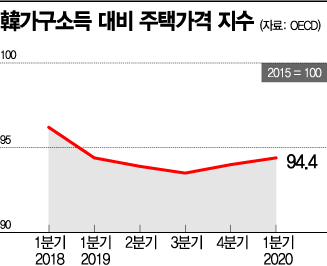
[Asia Economy Reporter Kim Eun-byeol] Despite the government's stringent regulations, housing prices continue to rise daily, and the house price-to-income ratio in Korea, as compiled by the Organisation for Economic Co-operation and Development (OECD), has increased for two consecutive quarters. This indicates that the burden on citizens is growing as housing prices rise relative to disposable income in Korea.
According to OECD statistics on the 3rd, the house price-to-income ratio for the first quarter of this year was 94.4, up 0.4 points from 94.0 in the fourth quarter of last year. This marks a consecutive increase for two quarters following the fourth quarter of last year. In the fourth quarter of last year, the ratio also turned upward by 0.5 points compared to the previous quarter.
The OECD calculates this index based on nationwide housing prices and income statistics. Therefore, Korea's index had generally been on a downward trend. As the economy grows, incomes have been steadily increasing, and since real estate prices in Korea have risen mainly centered on apartment prices in Seoul, the overall increase nationwide was not significant.
Nonetheless, the fact that the upward trend in the house price-to-income ratio has continued for two consecutive quarters recently is noteworthy. Park Cheon-gyu, head of the Real Estate Market Research Center at the Korea Research Institute for Human Settlements, stated, "Since the OECD statistics index the house price-to-income ratio based on 2015, it is difficult to say exactly how many years of earnings are needed to buy a house," but added, "It is meaningful to observe changes over time through a time series." Compared to other OECD countries, Korea's absolute house price-to-income ratio level is relatively low.
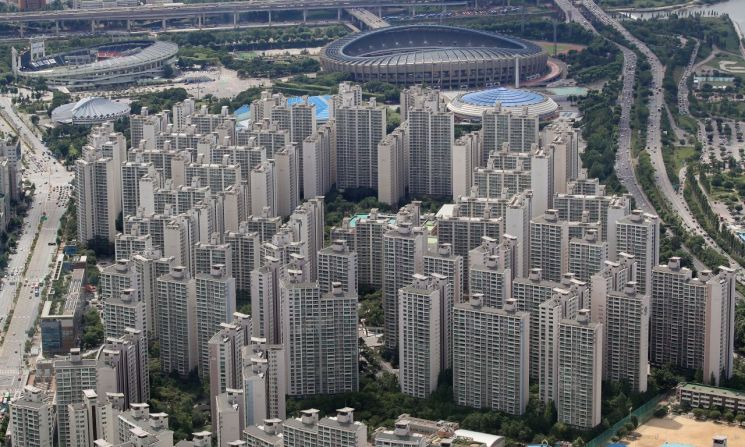
Looking specifically at Seoul, where housing prices have risen particularly rapidly, it is becoming increasingly difficult to buy a house with earned income. According to the global statistics comparison site Numbeo, Seoul's Price to Income Ratio (PIR) as of this year is 24.01. This means it would take over 24 years of combined household income to purchase one home. This ranks 23rd among 441 major cities worldwide, higher than famously expensive cities such as New York (10.76, 168th), Tokyo (13.97, 84th), and London (21.21).
Numbeo's PIR calculation criteria differ from those used by Korean institutions, so there is some exaggeration. The PIR calculated by Korean agencies is approximately 11 years. However, the sharp rise in PIR calculated by the same criteria is noteworthy. Considering that Numbeo's PIR for Seoul was 14.17 in 2015, the time required to purchase a home has increased by nearly 10 years over the past five years.
The problem is that many expect housing prices in Korea to continue rising, and the low-interest-rate environment is also expected to persist. According to the Bank of Korea, the Consumer Sentiment Index (CSI) for housing price outlook recorded 112 last month, rising 16 points from the previous month. This is the largest increase in 21 months since September 2018 (+19 points). The turnaround in apartment sale prices in Seoul and the continued rise in apartment sale prices nationwide, especially in the metropolitan area and other non-regulated regions, influenced this increase.
© The Asia Business Daily(www.asiae.co.kr). All rights reserved.
!["The Woman Who Threw Herself into the Water Clutching a Stolen Dior Bag"...A Grotesque Success Story That Shakes the Korean Psyche [Slate]](https://cwcontent.asiae.co.kr/asiaresize/183/2026021902243444107_1771435474.jpg)

















