Average Nationwide Temperature in June 22.8°C
Highest Since 1973
1.6°C Above Normal
Yeongwol Reaches 36.8°C, Chuncheon 36.4°C
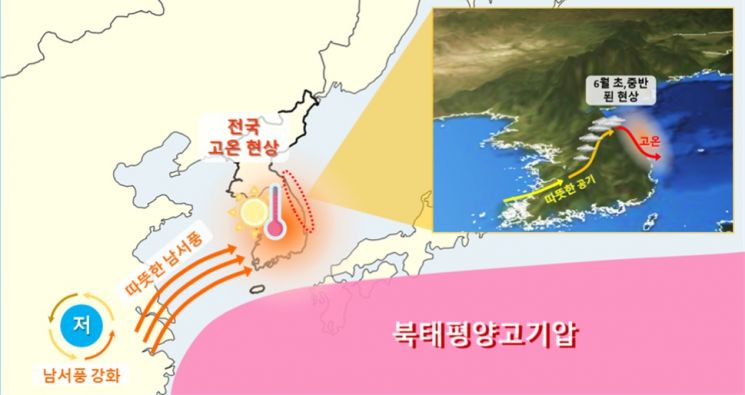 Schematic Diagram of Pressure Systems Around Korea in June (Provided by Korea Meteorological Administration)
[Asia Economy Reporter Hyunju Lee] June this year was recorded as the hottest month ever. The higher-than-average temperatures are expected to continue through July and August.
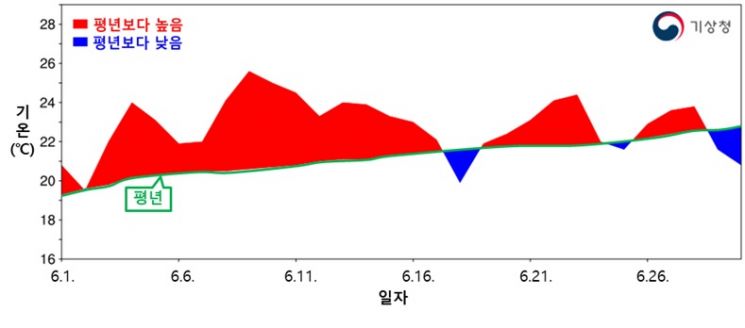
According to the Korea Meteorological Administration on the 3rd, the nationwide average temperature in June was 22.8°C, the highest since the nationwide meteorological observation network was expanded in 1973. This is 1.6°C higher than the average. The nationwide average maximum temperature in June was recorded at 28.0°C (1.5°C above average), setting a new record. The number of heatwave days was also the highest on record at 2.0 days, compared to the average of 1.4 days.
The early heatwave was caused by the influence of the North Pacific High with high temperature and humidity, and warm southwesterly winds flowing in from a low-pressure system approaching from the west. Additionally, strong solar radiation contributed to the continued hot weather. Especially in early and mid-June, the southwesterly winds crossing over the Taebaek Mountains became even hotter and drier, causing the daily maximum temperature in Yeongdong, Gangwon Province, to rise above 35°C. On the 23rd of last month, the daily maximum temperature in Yeongwol was 36.8°C, and on the 22nd, Chuncheon recorded 36.4°C.
The hot weather is expected to continue. According to the three-month weather forecast released by the Korea Meteorological Administration, the average temperature from July to September is expected to be 1 to 1.5°C higher than the average (23.4°C) and about 0.5°C higher than last year (24.3°C).
The sharp rise in summer temperatures is a global phenomenon, not just in Korea. In Siberia, Russia, which is part of the Arctic Circle, temperatures exceeding 40°C have been observed. The temperature in Siberia in May was 10°C higher than average. Korea also recorded the highest average temperature from January to June at 11°C, with the average temperature for the period being 9.4°C. A Korea Meteorological Administration official said, "There is a possibility that this year will rank first in the world for average annual temperature."
The monsoon rain that started in Jeju Island on the 10th of last month fell in the central and southern regions on the 24th. The start of the monsoon in Jeju was 9 to 10 days earlier than usual. The southern region started one day later, and the central region started one day earlier than usual. The rain fell mainly in the southern region, resulting in a large regional difference in precipitation between the central and southern regions, excluding Yeongdong, Gangwon Province. The central region recorded 142.4 mm, and the southern region recorded 215.5 mm, with the central region at about 66% of the southern region's precipitation.
© The Asia Business Daily(www.asiae.co.kr). All rights reserved.


















