National Security Office Agents Granted Extrajudicial Powers
Judges Find It Harder to Allow Bail
Concerns Arise Over Potential Violation of Right to Remain Silent
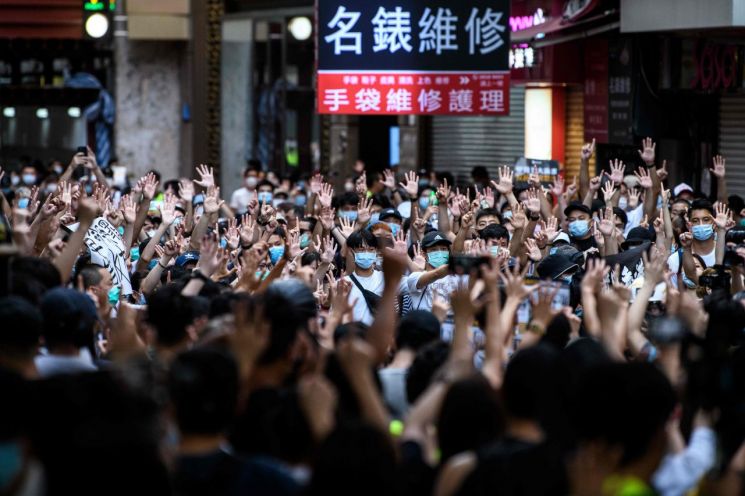
[Asia Economy Reporter Onyu Lim] The "Hong Kong National Security Law" (Hong Kong Security Law), which came into full effect on the 1st, is drawing criticism for potentially undermining judicial independence and infringing on the human rights of suspects. The core of the Hong Kong Security Law is to prohibit and punish collusion with foreign forces, acts of secession, subversion of state power, terrorism, and to establish institutions within Hong Kong to enforce these provisions.
According to the South China Morning Post (SCMP) and others on the 2nd, Hong Kong's legal community pointed out that the Hong Kong Security Law contains several provisions that could undermine the foundation of the rule of law and violate human rights.
First, agents of the "Office for Safeguarding National Security," established by the Chinese central government and effectively overseeing national security matters in Hong Kong, are not subject to Hong Kong law in relation to their duties, and the Hong Kong government must not interfere with their work. In response, the Hong Kong Bar Association issued a statement expressing concern that these agents could possess extralegal powers.
Article 59 of the Hong Kong Security Law stipulates that anyone aware of circumstances related to violations of this law "must testify truthfully," raising concerns that the right to remain silent could be revoked.
There is also speculation that judges may find it more difficult to grant bail. Under Hong Kong law, all suspects except those accused of murder can apply for bail, and the prosecution must prove reasons such as flight risk, reoffending, or witness tampering to deny bail. However, the Hong Kong Security Law allows judges to grant bail only if there are reasonable grounds to believe the suspect will not commit other offenses under this law, effectively significantly reducing the possibility of bail.
The right to a public trial by jury may also be restricted. Hong Kong law applies public jury trials for serious crimes, but the Hong Kong Security Law grants the Secretary for Justice the authority to conduct closed trials without juries for sensitive cases. Acts such as spreading rumors on social media can also be punishable.
The pro-democracy camp in Hong Kong is concerned not only about disqualification from running in the Legislative Council elections scheduled for September but also about the possibility of permanent disqualification from candidacy. Article 35 of the Hong Kong Security Law prohibits individuals convicted of violating this law from running in elections and mandates immediate removal from public office for legislators or civil servants who are convicted. Teresa Cheng, Hong Kong's Secretary for Justice, avoided giving a definitive answer when asked by reporters whether the right to stand for election could be permanently revoked for violators of the Hong Kong Security Law, neither denying nor confirming the possibility, which has heightened concerns within the pro-democracy camp.
© The Asia Business Daily(www.asiae.co.kr). All rights reserved.

















