Woori Financial Management Research Institute Analyzes 621 Companies
Total Sales 7 Trillion KRW · Operating Profit 2.4 Billion KRW
189 Companies in Deficit for 2 Consecutive Years, Insolvent Firms
Automobile, Steel, Machinery Sectors Shaken by COVID-19
[Asia Economy Reporter Kim Min-young] Company A, an auto parts manufacturer in Incheon and a supplier to GM Daewoo, has been partially closed for over three months. This company, which relies on overseas markets for 70% of its sales, saw its operating rate drop to around 30% as the COVID-19 pandemic prolonged. Although it was a sound company, the ongoing shortage of orders in the first half of this year has forced it to wait for bank loan approvals. A company official lamented, “There are frequent government support measures, but it is uncertain how positively they impact companies. The credit evaluations related to loans have not improved, and the practical effects are minimal, putting second- and third-tier vendors at risk of collapse.”
Company B, which produces and sells seasonal home appliances such as heating equipment, is facing its biggest crisis in over 40 years since its founding, continuing from last year. It had grown to achieve sales of 48 billion KRW and an operating profit of 1.8 billion KRW in 2018, but last year sales dropped by about 20 billion KRW, and it recorded an operating loss close to 5 billion KRW. Due to the nature of seasonal appliances, forecasting failures were particularly fatal. A company representative said, “The onslaught of low-priced Chinese products eased somewhat due to COVID-19, and because last year’s performance was so poor, a recovery is expected in the first half of this year,” but added, “Due to the overall economic downturn and decreased demand, it will be difficult to escape operating losses in the first half of this year.”
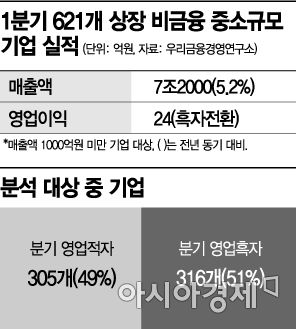
It was found that half of the non-financial listed small and medium-sized enterprises (SMEs) with sales under 100 billion KRW recorded losses in the first quarter. As SMEs hit hard by COVID-19 surged, the number of companies struggling with deficits increased significantly compared to last year. With the prolonged pandemic worsening performance indicators, the number of loss-making companies is expected to rise further in the second quarter.
On the 2nd, Woori Financial Management Research Institute analyzed the first-quarter performance of 621 companies with sales under 100 billion KRW. The combined sales of these companies amounted to 7.2 trillion KRW, with operating profits totaling only 2.4 billion KRW.
The average sales per company were 11.5 billion KRW, and operating profits were about 4 million KRW. Notably, 305 companies, accounting for 49% of the analyzed firms, recorded operating losses. This is a slight increase from 285 companies in the same period last year and the highest level since 2018. Among them, 189 companies (30.4%) were classified as distressed firms with losses for two consecutive years, and their operating loss ratio relative to sales reached 14%.
By industry, heavy and chemical industries such as automotive, steel, and machinery were significantly impacted by COVID-19. Auto parts companies shifted to negative growth in the first quarter due to reduced finished vehicle production. Operating profit margins worsened from -0.5% in the same period last year to -2.5%. Due to decreased operating rates, 15 out of 22 companies were operating at a loss in the first quarter, and operating losses persisted in all quarters except the second quarter of 2018 since the fourth quarter of 2017.
Steel demand sharply declined in the first quarter, with sales dropping 7.2% compared to the same period last year. Although sales had been relatively stable with less than 1% decline from the second to fourth quarters of last year, the sector failed to rebound due to COVID-19 and collapsed. While raw material prices fell, product prices dropped even more, deteriorating profitability.
Machinery companies, which hold the largest share among industrial goods, were also directly hit by COVID-19. Sales have been declining since the second quarter of last year, and operating profit margins fell from 2.4% in the same period last year to 0.5% in the first quarter of this year. This negative growth is expected to worsen further in the second quarter of this year.
Kim Su-jin, senior researcher at Woori Financial Management Research Institute, analyzed, “Although sales of auto parts and steel have been increasing since April, the low point, they remain more than 30% below the same month last year. Due to concerns about the resurgence of the pandemic, it will be difficult for economic activities to fully normalize by the end of the year, limiting demand recovery.”
The outlook remains negative. Han Kwang-yeol, a researcher at NH Investment & Securities, stated, “From the second quarter onward, the deterioration of corporate performance indicators due to COVID-19 will become more visible. If recovery is slow, corporate credit ratings will continue to decline.”
There are also opinions that financial institutions’ support measures should accompany these efforts. Researcher Kim said, “Financial institutions need to be cautious about the expanding liquidity risks of small- and medium-sized companies while considering active support for industries with high growth potential and companies enhancing their global competitiveness.”
© The Asia Business Daily(www.asiae.co.kr). All rights reserved.

![Clutching a Stolen Dior Bag, Saying "I Hate Being Poor but Real"... The Grotesque Con of a "Human Knockoff" [Slate]](https://cwcontent.asiae.co.kr/asiaresize/183/2026021902243444107_1771435474.jpg)














