Seosangmok "Not Watching Blue House, Opposition Lawmakers Also Find It Fun" Encouragement Included
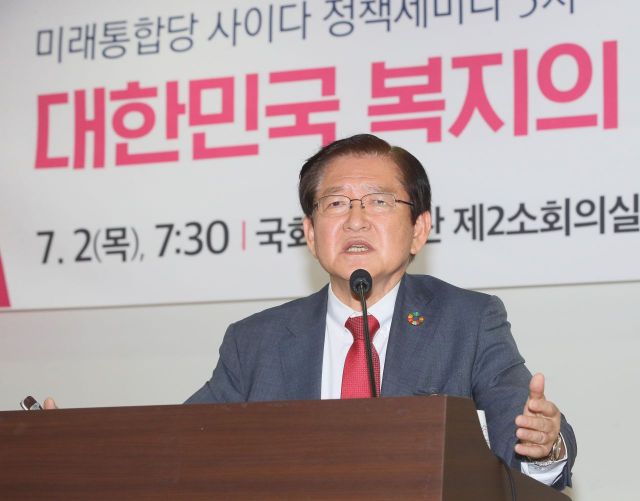
[Asia Economy Reporter Lee Ji-eun] On the morning of the 2nd, the United Future Party held the 5th 'Cider' policy seminar on welfare policy at the National Assembly. Seo Sang-mok, former Minister of Health and Welfare (Chairman of the Korea National Council on Social Welfare), who gave the lecture, said at the event, "Former Presidents Park Chung-hee and Chun Doo-hwan were also interested in the welfare state," urging the United Future Party to lead the welfare agenda.
At the seminar titled "The Current Status and Future Direction of Welfare in the Republic of Korea," held in the National Assembly Members' Office Building Conference Room 2, Chairman Seo said, "Welfare has always been considered a progressive agenda, and conservatives showed little interest, but since you invited me, it seems conservatives have become more interested."
He emphasized that welfare systems have developed according to stages of economic development, and past conservative leaders also set a welfare society as one of their main goals. Chairman Seo recalled, "Many said former President Park had no interest in welfare, but he rather promoted a welfare society, and one of the three major national policy goals of the Chun Doo-hwan administration was 'building a welfare state.' The first task assigned to the Korea Development Institute (KDI) during the Chun Doo-hwan regime was also measures for the underprivileged."
Regarding the basic income system, he suggested it should be implemented alongside the reform of existing welfare systems. He explained, "The biggest problem with public assistance is the decline in work motivation. Beneficiaries of basic livelihood security are nicknamed 'quasi-civil servants' because the benefits are so generous, and if their earned income exceeds a certain level, the benefits disappear, so there is no incentive to work. On the other hand, basic income does not cause a decline in work motivation but requires a lot of money."
Chairman Seo added, "I am not saying we should unconditionally adopt the basic income system, but if we implement it while reforming the system, it could be ideal. The goal is to increase the efficiency of the welfare system, which is not a matter of conservative or progressive politics."
Regarding the National Pension, he advised eliminating the flat-rate portion and raising the insurance contribution rate. He said, "The proportional part corresponds to what you pay, and the flat-rate part has an income redistribution effect. Eliminating the flat-rate part and raising the insurance rate by about 15 percentage points is necessary to prevent long-term collapse. People worry that the pension fund will be depleted in 40 years, but as we reach a mature stage, we need to operate by changing from a funded system to a pay-as-you-go system like advanced countries."
Having served three terms from the 13th to the 15th National Assembly, he also offered words of comfort to United Future Party lawmakers facing consecutive election defeats. He said, "Although we are the opposition, the opposition can do more. I served 10 years as the ruling party and 2 years as the opposition during my 12-year term as a lawmaker, and the opposition is also interesting," adding, "The ruling party cannot act properly because they have to consider the Blue House, but the opposition can act as they see fit. The opposition can lead the agenda regardless of numbers."
Floor Leader Joo Ho-young emphasized, "Welfare systems have become more diverse and numerous compared to 10 or 20 years ago, but there are many issues such as sustainability, stability, and equity," adding, "In the upcoming presidential and general elections, the design and pledges of welfare systems are likely to be important factors for victory or defeat, but the key challenge is whether they can be implemented."
© The Asia Business Daily(www.asiae.co.kr). All rights reserved.

















