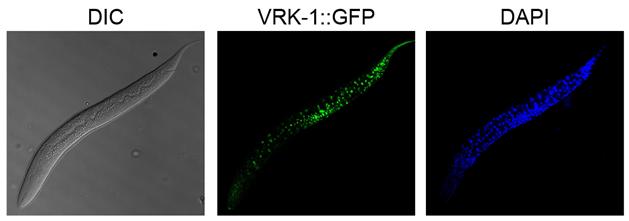
 VRK-1 protein labeled with green fluorescence (GFP) in Caenorhabditis elegans (center). Blue fluorescence (DAPI) labels the cell nuclei (right). VRK-1 protein is expressed in various tissues of Caenorhabditis elegans.
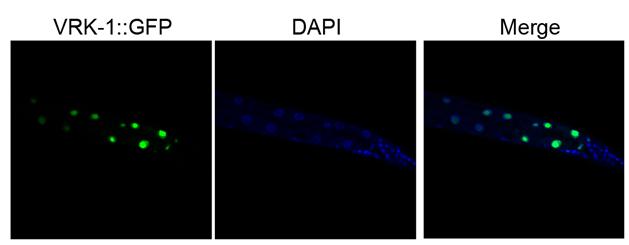 The VRK-1 of the Caenorhabditis elegans was labeled with green fluorescent protein (GFP) to indicate its location within the intestinal cells. VRK-1 in the intestinal cells appears to be located inside the nucleus, as it is observed at the same position as the nucleus stained by DNA staining (DAPI staining).
[Asia Economy Reporter Junho Hwang] Domestic researchers have discovered a protein that can delay aging or alleviate metabolic disorders through a tiny worm smaller than a fingernail.
The National Research Foundation of Korea announced that a research team led by Professor Seungjae Lee of the Korea Advanced Institute of Science and Technology and Professor Kyungtae Kim of Pohang University of Science and Technology identified the mechanism of a new longevity-inducing protein, VRK-1, which helps extend lifespan by activating the cell’s energy sensor (AMPK enzyme) through the Caenorhabditis elegans worm.
Our cells continuously monitor energy levels to maintain a constant energy state despite fasting or exercise. This role is performed by AMPK. However, the upstream regulator that stimulates AMPK had not been known.
The research team found that when VRK-1 is activated in the 1mm-sized soil-dwelling Caenorhabditis elegans, the protein expression pattern among approximately 20,000 worm genes is similar to that observed when AMPK is activated. They discovered that VRK-1 directly phosphorylates AMPK, and the phosphorylated AMPK mediates inhibition of the mitochondrial electron transport chain, resulting in lifespan extension.
The team also reported that mutants of Caenorhabditis elegans with reduced mitochondrial electron transport chain function, which showed extended lifespan, activated VRK-1, whereas AMPK mutant worms unresponsive to VRK-1 stimulation did not exhibit this lifespan extension effect.
The researchers newly identified the role of VRK-1, a well-conserved upstream factor inducing AMPK’s longevity regulation effect across multiple species, and expect VRK-1 to be added as a drug discovery target for metabolic diseases caused by AMPK abnormalities and anti-aging therapies.
The results of this study are scheduled to be published in the international journal Science Advances.

© The Asia Business Daily(www.asiae.co.kr). All rights reserved.



















