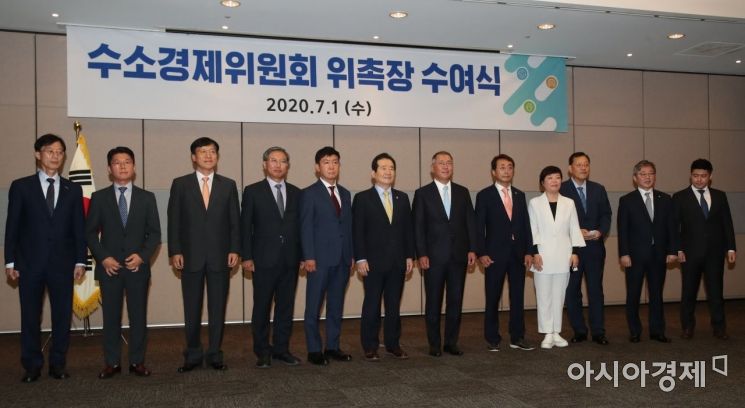
 Prime Minister Chung Sye-kyun attended the appointment ceremony for the Hydrogen Economy Committee members held at KINTEX in Ilsan, Gyeonggi-do on the 1st, and took a commemorative photo with committee members including Chung Eui-sun, Executive Vice Chairman of Hyundai Motor Company. Photo by Kim Hyun-min, Goyang kimhyun81@
[Asia Economy Reporter Junho Hwang] The government plans to expand the number of hydrogen vehicles to 850,000 and hydrogen charging stations to 660 by 2030. By 2040, it aims to increase hydrogen-specialized companies to 1,000 and develop 2 out of 5 new towns in the 3rd phase as hydrogen cities. Hydrogen charging stations and buses will operate in these hydrogen cities.
On the 1st, the government held the 1st Hydrogen Economy Committee meeting chaired by Prime Minister Jeong Seyeon and approved these agendas. The committee included private experts from industry, academia, and civic groups. Private members include Chung Euisun, Vice Chairman of Hyundai Motor Company, Professor Moon Il of Yonsei University, and Lee Mikyung, Executive Director of the Environmental Foundation, among 11 members. Government participants included the Ministry of Land, Infrastructure and Transport, Ministry of Trade, Industry and Energy, Ministry of Science and ICT, and Ministry of Environment.
The first step in the hydrogen economy is creating an industrial ecosystem. The government plans to nurture 500 hydrogen-specialized companies by 2030 and increase that number to 1,000 within 10 years. It will promote the 'Hydrogen Materials, Parts, and Equipment Project' in five major fields: hydrogen mobility, fuel cells, liquefied hydrogen, hydrogen charging stations, and water electrolysis. For excellent technologies and products, the public sector will actively purchase them through an innovative procurement system. Additionally, a hydrogen economy fund worth 34 billion KRW will be established to facilitate new companies' entry into the hydrogen market.
Medium-scale production bases will be established in four regions: Gyeongnam, Honam, Jungbu, and Gangwon. By 2025, 40 small-scale production bases will also be built to establish a stable hydrogen supply infrastructure. Plans have been made to create regional ecosystems by linking hydrogen clusters, regulatory special zones, and hydrogen cities.
Various demonstration projects will also be promoted in connection with renewable energy such as Jeju Island's wind energy and Saemangeum's solar energy. Based on this, a 100MW-class green hydrogen mass production system will be established by 2030. To create demand, green hydrogen certification systems and mandatory usage systems are being considered.
The goal is also set to reduce the hydrogen price to the 3,000 KRW per kilogram level by 2040. To develop technologies in supply areas such as hydrogen production, storage, transportation, and charging?where technological capabilities are weak compared to advanced countries?the government plans to consolidate the capabilities of related ministries. Hydrogen supply infrastructure construction projects currently promoted by each ministry will be pursued as cross-ministerial projects. These cross-ministerial projects will undergo public opinion gathering this month, and a preliminary feasibility study request will be submitted next month.
Hydrogen vehicles and hydrogen charging stations will also be further expanded. The government plans to supply 850,000 hydrogen vehicles by 2030 by expanding vehicle models. Leveraging hydrogen vehicles' advantages such as longer driving range and shorter charging time compared to electric vehicles, the government will expand the supply of large freight vehicles and medium- to long-distance buses. Financial support such as purchase subsidies will be strengthened, and fuel subsidies for large hydrogen vehicles like freight trucks will be introduced starting next year. From 2023, large complex charging facilities will be built at transportation hubs.
Hydrogen charging stations will be increased by 660. As of last year, there were 34 hydrogen charging stations in Korea. Along with this, hydrogen cities will also be expanded. In addition to the already selected Ulsan, Ansan, Jeonju, Wanju, and Samcheok, two of the three new towns currently under development will be created as hydrogen cities. Hydrogen cities will be supplied with apartment fuel cell power generation, hydrogen charging stations, and hydrogen buses.
Before the Hydrogen Economy Act takes effect in February next year, the committee also designated dedicated institutions for the hydrogen economy. The Hydrogen Convergence Alliance Promotion Group will be responsible for hydrogen industry promotion. Korea Gas Corporation is designated for distribution-related matters, and Korea Gas Safety Corporation for safety.
© The Asia Business Daily(www.asiae.co.kr). All rights reserved.

















