Irregular and subcontracted workers
oppose exclusion of dismissal ban clause
at KCTU Central Executive Committee meeting
unable to approve tripartite agreement
government expresses intent to re-pursue
agreement formed through dozens of working-level talks
and concessions not easily rewritten, uncertain outcome
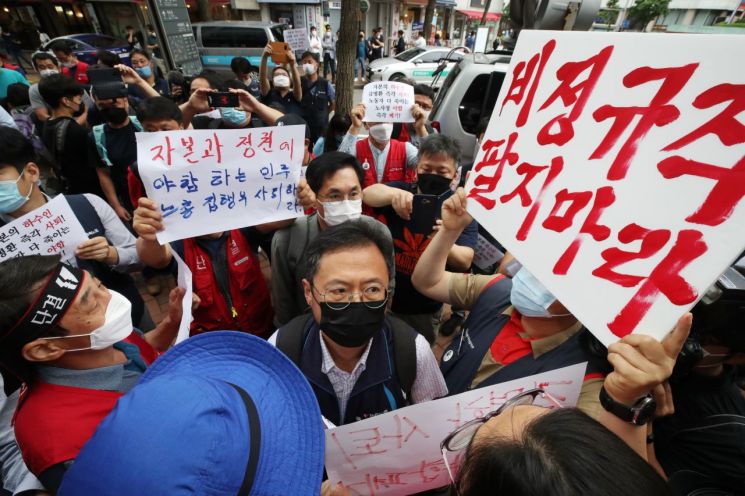
[Asia Economy Reporters Joo Sang-don, Jang Se-hee, Lee Kwan-joo] The government is struggling to hide its embarrassment after the signing of the "Tripartite Representatives Meeting for Overcoming the COVID-19 Crisis" agreement, scheduled for the 1st, fell through due to the Korea Confederation of Trade Unions (KCTU) notifying its absence.
The Prime Minister's Office, which promoted the tripartite dialogue, had high hopes for the signing as of that morning. This was because Kim Myung-hwan, chairman of the KCTU, showed willingness to attend the signing ceremony despite opposition from hardliners. However, when Kim was blocked by hardliners at the KCTU Central Executive Committee meeting held that morning and could not attend the signing, the signing ceremony was ultimately canceled.
The government has expressed its intention to reschedule, but whether the tripartite agreement can be pursued again remains uncertain. This is because it is not easy to renegotiate the agreement, which was created through dozens of working-level consultations and deputy representative-level meetings with mutual concessions.
Moreover, Kim’s leadership, which proposed and succeeded in a one-point tripartite agreement outside the Economic, Social and Labor Council (ESLC), has inevitably been damaged. Demands for social responsibility from the KCTU, which overtook the Federation of Korean Trade Unions (FKTU) as the largest union, are expected to increase. If the tripartite social agreement ultimately fails, the gap in labor-management conflicts is expected to deepen further.
◆ 'Ban on Dismissals' Omitted... KCTU Overturns the Table = The KCTU held a two-day Central Executive Committee meeting from the 29th of last month but failed to ratify the tripartite agreement until just before the signing ceremony. Hardliners from KCTU-affiliated unions such as the Metal Workers' Union, Public Transport Workers' Union, and Construction Workers' Union reportedly opposed the agreement at the Central Executive Committee, claiming the entire agreement process proceeded without internal consent.
In particular, within the KCTU, there is strong opposition to the omission of a dismissal ban clause in the agreement, despite the worsening employment instability of non-regular and subcontracted workers due to the spread of COVID-19.
The KCTU had previously insisted on concrete policies for employment retention, including ▲ a temporary ban on subcontract and outsourcing contract termination during disasters ▲ mandatory inclusion of indirect workers when the primary contractor applies for employment retention subsidies ▲ introduction of a worker application system to minimize employers’ evasion of applying for employment retention subsidies.
However, the inclusion in the agreement of phrases such as "the labor sector will actively cooperate when companies facing management crises take necessary measures such as reducing working hours or temporary closures to maintain employment" was seen by internal hardliners as far from the consistently demanded dismissal ban, leading to increased opposition.
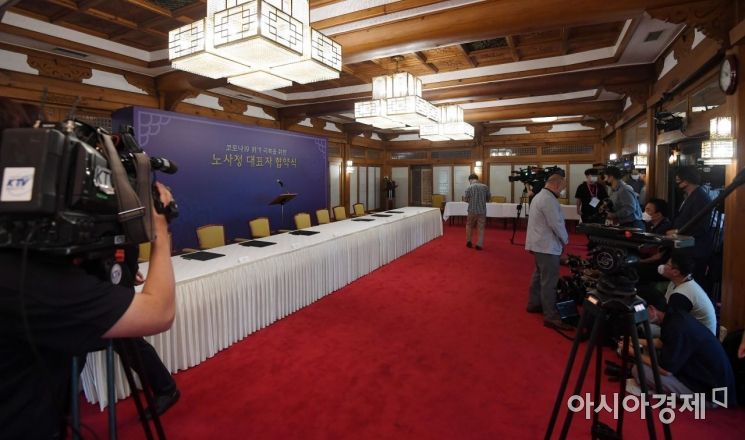 The 'Tripartite Agreement Ceremony for Overcoming the COVID-19 Crisis,' which was scheduled to be held on the 1st at the Prime Minister's Official Residence in Jongno-gu, Seoul, was canceled due to the last-minute absence of the Korean Confederation of Trade Unions (KCTU). The tripartite parties had originally planned to sign an agreement that included strengthening employment retention and introducing nationwide employment insurance. The KCTU held a Central Executive Committee meeting from the morning to discuss whether to sign the agreement but ultimately decided not to attend the ceremony. The photo shows the venue of the canceled agreement ceremony on that day. Photo by Kim Hyun-min kimhyun81@
Additionally, within the KCTU, there is criticism that the agreement clause stating "the government will promote legislation for employment insurance enrollment of special-type workers, considering their characteristics and consulting labor, management, and stakeholders" deviates from the purpose of universal employment insurance and fails to protect all special-type workers.
◆ Government Embarrassed: "We Will Reschedule" = The government is embarrassed by the cancellation of the scheduled "Tripartite Representatives Agreement Ceremony." A government official from a related ministry who came to Seoul to attend the ceremony said, "We did not expect the KCTU to be absent on the day."
Accordingly, the Prime Minister's Office, which organized the event, stated its intention to reschedule the tripartite agreement. A Prime Minister's Office official said, "Although today's agreement ceremony was canceled, discussions on future directions will continue," and "We will pursue the tripartite agreement again."
The Ministry of Employment and Labor, which established the framework for the Employment Retention Subsidy system, stated that urgent matters will be handled first regardless of the tripartite agreement. A government official said, "Since the employment retention subsidy is urgent, it will be promoted separately from the tripartite agreement ceremony." However, without a tripartite agreement, increasing the project budget in the National Assembly’s Budget and Accounts Committee may face difficulties.
◆ What Was Included in the Tripartite Agreement? = The main points of the tripartite agreement, which was to be announced that day, were that the government would expand the employment retention subsidy system by extending the period of 90% subsidy support until the end of September, the business sector would make efforts to improve management and maintain employment, and the labor sector would actively cooperate with measures such as reducing working hours.
First, the government planned to extend the period of 90% employment retention subsidy support for companies maintaining employment through paid leave or furlough instead of reducing jobs until the end of September, a three-month extension. It also included a temporary extension of the subsidy payment period until the end of the year for specially designated employment support industries. The government promised to actively consider extending and additionally designating special employment support industries. To eliminate blind spots in employment insurance, the government planned to establish a "Roadmap to Eliminate Employment Insurance Blind Spots" by the end of this year and legislate for the enrollment of special-type workers in employment insurance.
Accordingly, the business sector agreed to first make management improvement efforts to overcome the COVID-19 crisis and strive to maintain employment as much as possible. The labor sector promised to actively cooperate when companies facing management crises due to COVID-19, such as sharp sales declines, take necessary measures such as reducing working hours and temporary closures to maintain employment, as stated in the agreement.
© The Asia Business Daily(www.asiae.co.kr). All rights reserved.



















