Hong "Will Devise Measures to Minimize Damage"
Discussion on Easing Balance Loan for Sale Contracts
May Exclude Some Regulatory Areas
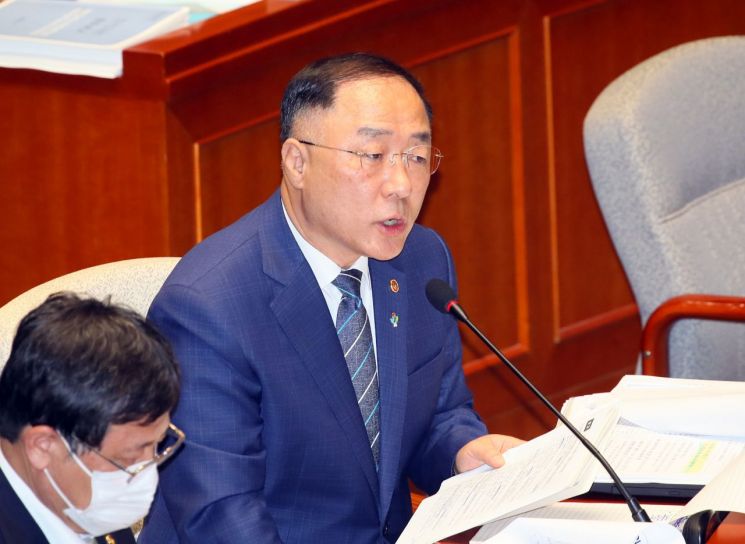 Hong Nam-ki, Deputy Prime Minister for Economy, is responding to lawmakers' questions regarding the third supplementary budget proposal at the plenary session of the Special Committee on Budget and Accounts held at the National Assembly on the 30th of last month. (Photo by Yonhap News)
[Asia Economy Reporter Lee Chun-hee] As criticism grows over the comprehensive and stringent 6.17 real estate measures, supplementary plans are expected to be prepared to minimize damage to actual homebuyers. Various supplementary measures are being proposed, including calls from opposition parties to repeal the increased capital gains tax to provide an exit for multi-homeowners.
On the 29th of last month, Jeong Il-young, a member of the Democratic Party of Korea, emphasized at the National Assembly's Planning and Finance Committee plenary session that "there is significant dissatisfaction among actual homebuyers in their 30s and 40s who have been harmed by the 6.17 measures," and stressed the urgent need to address the side effects of the 6.17 measures. Even within the ruling party, criticism arose that the measures were excessive. Jeong’s constituency, Yeonsu-eul in Incheon, saw regulations tighten rapidly from a non-regulated area to a speculative overheating zone due to this measure.
Jeong stated, "The expansion of speculative overheating zones, which limit the loan-to-value ratio (LTV), has been applied retroactively, restricting balance payment loans even for those who had signed pre-sale contracts before the announcement," and urged, "Since actual homebuyers are now unable to move in, please promptly prepare supplementary measures to address this."
He continued, pointing out that real estate policies are repeating the same approach and questioning their effectiveness, saying, "Please prepare groundbreaking real estate policies, including supply expansion in areas desired by actual homebuyers."
At the Planning and Finance Committee meeting that day, Hong Nam-ki, Deputy Prime Minister and Minister of Economy and Finance, responded to these inquiries by stating, "Protecting actual homebuyers is a fundamental principle of the government," and added, "We will devise measures to protect actual homebuyers as much as possible." This suggests that the next measures are likely to shift direction from purely regulatory policies to include supplementary measures.
For now, inside and outside the government, there is talk of easing the LTV from 40% to 60% for balance payment loans for those who signed pre-sale contracts in regulated areas such as adjusted target areas. Additionally, some suggest subdividing certain outer metropolitan areas where housing price increases are minimal and possibly removing them from the adjusted target areas again.
Even the conservative opposition party, which is currently boycotting the National Assembly schedule, is proposing legislation to introduce supplementary measures. Yoo Kyung-joon, a member of the United Future Party representing Gangnam-byeong, has proposed the 'Partial Amendment to the Comprehensive Real Estate Tax Act' and the 'Partial Amendment to the Income Tax Act.' Through these two bills, Yoo proposes ▲ legally specifying the fair market value ratio at 70%, ▲ raising the comprehensive real estate tax thresholds (single-homeowners from 900 million KRW to 1.2 billion KRW, multi-homeowners from 600 million KRW to 900 million KRW), and ▲ abolishing the capital gains tax surcharge system as alternatives.
Yoo explained the rationale by saying that multi-homeowners "need to be given an exit." He stated, "The current government's real estate policy only imposes regulations without providing an exit for multi-homeowners, ultimately causing harm to ordinary citizens." He added, "The rapid rise in housing prices is ultimately due to a supply shortage, and to curb the surge, multi-homeowners must be given an exit to put their houses on the market."
Regarding raising the comprehensive real estate tax thresholds, Yoo explained, "Given that the median price of apartments in Seoul has exceeded 900 million KRW, it is only natural to update the tax standards set over ten years ago to reduce the tax burden." According to KB Kookmin Bank, the median price of apartments in Seoul was surveyed at 918.12 million KRW as of last month.
© The Asia Business Daily(www.asiae.co.kr). All rights reserved.
![User Who Sold Erroneously Deposited Bitcoins to Repay Debt and Fund Entertainment... What Did the Supreme Court Decide in 2021? [Legal Issue Check]](https://cwcontent.asiae.co.kr/asiaresize/183/2026020910431234020_1770601391.png)
















