-Unanimous Passage of the Hong Kong National Security Law's 66 Articles
-Unrestricted Authority Manipulating Hong Kong
-Hong Kong National Security Law Takes Precedence Over Local Laws in Case of Conflict
[Asia Economy Beijing=Special Correspondent Park Sun-mi] On the 23rd anniversary of Hong Kong's handover, June 1, the Chinese government abruptly enforced the Hong Kong National Security Law and released the full text of the law, heightening concerns. The law allows for sentences up to life imprisonment for serious offenses and applies punishments not only to Hong Kong residents but also to foreigners and foreign companies for illegal activities. Notably, the supplementary provisions state that when local laws of the Hong Kong Special Administrative Region conflict with the Hong Kong National Security Law, the latter shall prevail, indicating its status as a superior law. This move is seen as the Chinese central government increasing its control over Hong Kong, effectively moving one step closer to a 'one country, one system' regime. Joshua Wong, secretary of the Demosist? Party, which has led pro-democracy movements, posted on Twitter immediately after the law took effect, calling it "the end of Hong Kong, the beginning of terror rule."
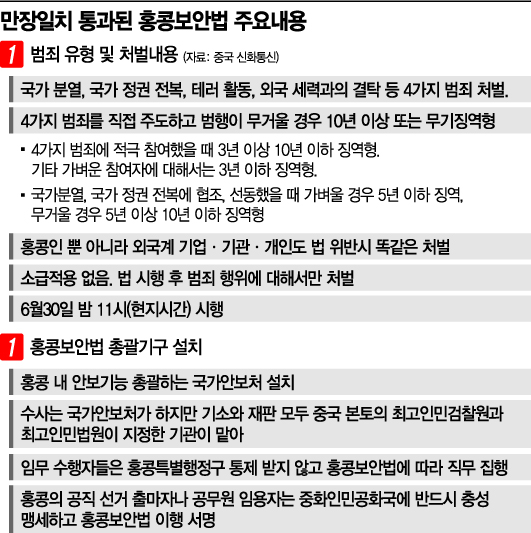
The Hong Kong National Security Law, disclosed through China's Xinhua News Agency on June 1, consists of six chapters and 66 articles. The punishable offenses under the law are broadly categorized into four types: ▲secession, ▲subversion of state power, ▲terrorist activities, and ▲collusion with foreign forces. Acts such as attempting to separate or declare independence of Hong Kong from China, attacking, destroying, or disrupting state institutions, causing serious harm to society through explosions or arson, leaking state security-related confidential information, or colluding with foreign forces to request control over Hong Kong and China are all subject to punishment. The minimum sentence for all four offenses is imprisonment of up to three years. For serious cases, sentences can exceed ten years or even reach life imprisonment. Compared to Macau’s National Security Law, enacted in 2009, which sets the maximum penalty at 30 years, this law imposes much harsher punishments. Some foreign media added expert opinions that even peaceful protests could result in up to ten years in prison if foreign forces are involved under the current law.
The law’s scope of punishment is not limited to Hong Kong residents. It explicitly states that foreign companies, institutions, and individuals will receive the same penalties if they violate the law. However, the Hong Kong National Security Law applies only to acts committed after its enforcement, thus excluding retroactive application to crimes committed during previous Hong Kong protests.
Investigations into violations of the law are conducted by Hong Kong authorities, but the Chinese central government has comprehensive jurisdiction and can intervene. This is why the law is described as 'one country, one system.' The central government has mandated the establishment of a national security office in Hong Kong to oversee security functions. In cases involving foreign interference, situations where the Hong Kong government cannot effectively enforce the law, or serious threats to national security, the national security office will take charge of investigating violations of the Hong Kong National Security Law. While investigations are conducted by the national security office, prosecutions and trials are handled by institutions designated by the Supreme People's Procuratorate and the Supreme People's Court in mainland China, not Hong Kong. For cases under the Hong Kong National Security Law, the entire process of investigation, prosecution, trial, and sentence execution may be subject to the provisions of China’s criminal procedure law. This means suspects can be extradited to mainland China for trial. Trial results are announced, but proceedings may be conducted confidentially.
Information regarding the operation of the national security office is also confidential, and decisions made there are not subject to any judicial review. Furthermore, personnel performing duties at the national security office execute their tasks under the Hong Kong National Security Law and are not subject to the jurisdiction of the Hong Kong Special Administrative Region. The authority to interpret the Hong Kong National Security Law rests with the Standing Committee of the National People's Congress of China.
The law also includes provisions requiring candidates for public office and public officials in Hong Kong to pledge allegiance to the People's Republic of China. Hong Kong citizens must sign this law upon assuming public office.
The unexpectedly stringent Hong Kong National Security Law has deeply shaken the pro-democracy camp in Hong Kong. Joshua Wong announced his intention to resign from his party immediately after the law’s passage, and the Demosist? Party declared its immediate disbandment. The Hong Kong National Front, a group advocating Hong Kong independence, also announced the dissolution of its Hong Kong headquarters and the disbandment of all its members. The student protest group Student Mobilization decided to disband its Hong Kong headquarters as well. Foreign organizations are hastily severing ties with Hong Kong protesters. The U.S. organization Global Media Agency (USAGM) froze $2 million in funds that had been intended to support Hong Kong protesters.
© The Asia Business Daily(www.asiae.co.kr). All rights reserved.

















