Choi Im-wi User Committee Members "Propose 2.1% Reduction Compared to This Year"
"Considering Economic Contraction Forecast Due to COVID-19 Impact"
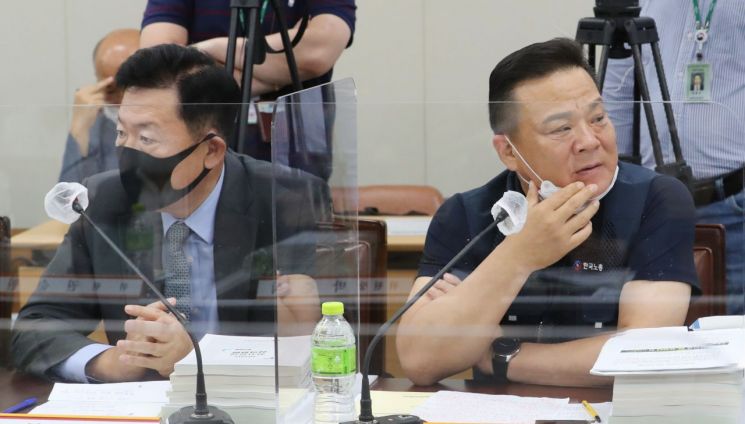
[Asia Economy Reporter Kim Ji-hee] On the 1st, the employer members of the Minimum Wage Commission proposed an initial employer-side minimum wage of 8,410 KRW per hour for next year at the 4th plenary session of the Minimum Wage Commission held on the same day. They presented a reduction plan citing the significant economic shock caused by the novel coronavirus infection (COVID-19).
According to the Korea Employers Federation (KEF) on the 1st, the employer members proposed an initial minimum wage for next year of 8,410 KRW, a decrease of 180 KRW (-2.1%) compared to 2020. The reasons for proposing the reduction plan included ▲the economic recession caused by COVID-19 becoming visible this year ▲the rapid pace and relatively high level of minimum wage increases ▲the worsening business conditions and employment situation for small and medium-sized enterprises (SMEs) and small business owners due to the minimum wage increase and COVID-19 shock.
The employer members stated, "Due to the force majeure external shock caused by the COVID-19 pandemic, the global economy is experiencing the worst recession in over 100 years, and our export-dependent economy is suffering enormous damage such as a sharp decline in exports, contraction of domestic demand, and decreased corporate operating profits." They added, "This year, major overseas institutions have forecast negative growth for the first time in 22 years, indicating a deepening crisis in the real economy and employment."
They also pointed out that among OECD countries with similar industrial competitors, the relative level and pace of minimum wage increases in Korea are virtually the highest. The employer members emphasized, "Korea's minimum wage in 2020 is estimated at 62.4~62.8% of the median wage (KEF estimate), which is 20~30 percentage points higher than that of the United States, Japan, and Germany, countries with direct industrial competition with Korea." They added, "The cumulative increase rate over the past three years is 2 to 8.2 times higher than those countries."
They further claimed, "The rate of increase in Korea's minimum wage has risen much faster than inflation, wages, and productivity growth." Over the past 20 years, Korea's minimum wage has increased by an average of 8.8% annually, which is 3.8 times the inflation rate (2.3%) and 1.9 times the nominal wage increase rate (4.7%, 2001?2019).
The combination of the minimum wage increase and the COVID-19 shock has worsened the business conditions and employment situation for SMEs and small business owners, which is also a concern. The employer members said, "Small and micro enterprises and small business owners, already struggling due to minimum wage increases, have suffered severe damage from the COVID-19 shock. From 2021, additional burdens are expected due to the introduction of paid holidays on public holidays." They added, "54.2% of small business owners have annual operating profits of less than 30 million KRW, raising concerns about further difficulties."
They continued, "Due to the impact of minimum wage increases, ultra-short-time jobs have surged, and self-employed persons with employees have decreased, resulting in overall qualitative deterioration of jobs. The employment situation has worsened, with the number of employed persons in the service sector declining for three consecutive months since March due to the COVID-19 aftermath." They added, "These phenomena are clearly observed in industries with many minimum wage workers and small-scale businesses."
© The Asia Business Daily(www.asiae.co.kr). All rights reserved.
![User Who Sold Erroneously Deposited Bitcoins to Repay Debt and Fund Entertainment... What Did the Supreme Court Decide in 2021? [Legal Issue Check]](https://cwcontent.asiae.co.kr/asiaresize/183/2026020910431234020_1770601391.png)
















