In the 1960s, when the electronics industry was emerging, the late founder Lee Byung-chul led the establishment of Samsung SDI's predecessor
"Beyond finished products, localization of materials and components technology must be prioritized" Philosophy drove contrarian investments during economic crises
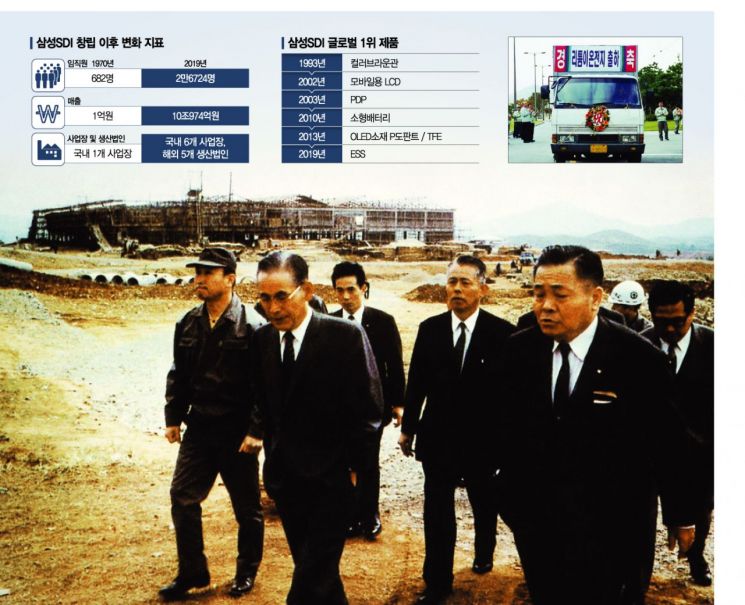
Since Samsung SDI's founding, sales grew from 100 million KRW to 10 trillion KRW, and employees increased from 682 to 26,724
[Asia Economy Reporter Kim Hyewon] "We will achieve complete localization from materials to components and finished products and grow into a comprehensive electronics company."
In the mid-1960s, when South Korea's electronics industry was just beginning, the late Lee Byung-chul, founder of Samsung Group, led the establishment of 'Samsung-NEC,' the predecessor of Samsung SDI, with this vision while preparing to enter the electronics industry. His philosophy was that to produce a single finished TV product, the technology for materials and components such as displays must precede. He foresaw the importance of the materials, components, and equipment (SoBuJang) industry 50 years earlier, which later became a wake-up call due to Japan's export restrictions. Lee's foresight continued through three generations of the owner family, including Lee Kun-hee, chairman of Samsung Electronics, and Vice Chairman Lee Jae-yong, with pioneering spirit and bold investments, bearing fruit today as Samsung SDI.
Marking its 50th anniversary on the 1st, Samsung SDI's 50-year history is a record of challenges and innovations that went beyond technological independence in materials and components, achieving 'global number one in seven products' and advancing to the world’s top. It is also a journey of transformation that created something from nothing by shifting industries from cathode ray tubes to displays, and then again to batteries. Breaking down barriers between industries and dedicating itself to creating the first and best products, the company's sales have grown approximately 100,000 times from 100 million won to 10 trillion won since its founding in 1970, and the number of employees has increased about 40 times from 682 to around 27,000.
The first global number one achievement in the global market was the color cathode ray tube product in 1993. While competitors hesitated to invest due to the second oil shock, under Lee Byung-chul’s direction, Samsung SDI established an annual production system of 10 million units, accounting for 10% of the global CRT market, and achieved world number one in just nine years. This was the result of a bold investment at the optimal time. Since then, Samsung SDI expanded its business to next-generation flat panel displays such as PDP, LCD, and OLED, dominating the world number one position in mobile LCD and PDP fields as well.
However, Samsung SDI could not rest on its position as the 'display powerhouse.' Under the leadership of Chairman Lee Kun-hee, the company took another step forward with the battery business. The battery business was considered a 'reckless challenge' with many voices fearing failure because its relevance to displays was close to 'zero.' Samsung SDI started battery development in 1997, facing the IMF bailout crisis just before large-scale facility investments, but the owner management poured funds with strong determination. Ten years after fully launching the battery business, Samsung SDI secured the number one market share in the small battery market in 2010.
Building on its competitiveness in the small battery business, Samsung SDI has also entered the electric vehicle battery market, writing a new history. Especially, Vice Chairman Lee sees the importance of batteries increasing further in the autonomous driving era and is personally overseeing the business while paying close attention to the next-generation batteries Samsung SDI is developing. It is reported that Vice Chairman Lee supports orders through close networks with automotive company executives. Recently, when Chung Eui-sun, Executive Vice Chairman of Hyundai Motor Group, visited Samsung SDI’s Cheonan plant, Vice Chairman Lee personally explained the development trends of solid-state battery technology, reflecting this context. Empowered by Vice Chairman Lee’s investment will, Samsung SDI plans to secure leadership in the growing market through the development of next-generation products such as solid-state batteries beyond lithium-ion batteries. Ultimately, based on battery and electronic materials competitiveness, the company aims to become a leading enterprise in the future society of BoT (Battery of Things), where batteries are the driving force and connecting link of all things.
© The Asia Business Daily(www.asiae.co.kr). All rights reserved.
![User Who Sold Erroneously Deposited Bitcoins to Repay Debt and Fund Entertainment... What Did the Supreme Court Decide in 2021? [Legal Issue Check]](https://cwcontent.asiae.co.kr/asiaresize/183/2026020910431234020_1770601391.png)
















