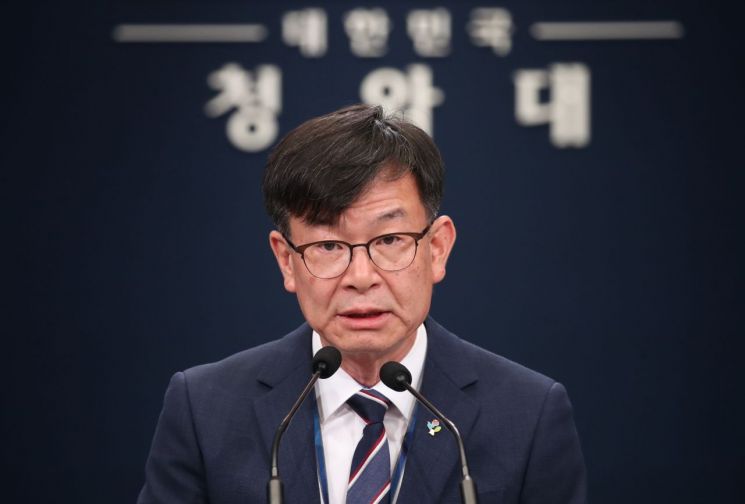
[Asia Economy Reporter Son Sun-hee] Kim Sang-jo, Chief Presidential Secretary for Policy, expressed regret on the 1st regarding some Blue House aides still owning multiple homes, saying, "At that time, Secretary No Young-min's remark was directed at those owning multiple homes in the 'Seoul metropolitan area regulated zones,'" but added, "I don't think explaining this would be convincing to the public."
On the same day, Kim appeared on MBC Radio's program 'Kim Jong-bae's Focus' in the morning. When the host asked, "Why aren't Blue House aides selling their houses?" Kim responded, "I believe the most appealing approach to the public is for the government to consistently implement real estate policies to stabilize the market so that people can emotionally accept it," expressing his view.
Despite the government declaring a 'war on real estate speculation' and implementing policies to reduce multiple homeowners, Blue House aides remain multiple homeowners. Regarding concerns that this could send the wrong signal to the real estate market, Kim admitted, "Real estate policy is truly difficult," and indirectly answered, "There are issues with liquidity such as loan regulations, and four key factors?taxes, transaction structures including jeonse and monthly rent, and supply?must be optimally combined and consistently executed to stabilize the market." He emphasized, "If criticism focuses on just one aspect, it could be very embarrassing for the government, but nonetheless, the Moon Jae-in administration's determination to stabilize the real estate market remains unwavering."
Kim, who joined the Blue House in June last year, recently marked his first anniversary in office. Right after his appointment, the export restrictions by Japan occurred, and he has been responding on the front lines for the past year. Kim reflected, "In an era of US-China hegemonic competition, retreating free trade, and shaken global supply chains, events that could destabilize economic relations between Korea and Japan unfolded," adding, "I have had a strong opinion to turn this incident into an opportunity to change the future." He continued, "The localization of materials, parts, and equipment (SoBuJang) is not a new topic. It has been pursued for over 20 years but failed," and added, "Since Japan attacked our weak link, we decided that there must be a whole-of-government and society effort to stabilize our SoBuJang industry's supply chain and enhance international competitiveness."
Kim stated, "We can say significant achievements have been made over the past year, but we must not stop here," explaining, "This is not simply a Korea-Japan issue; in the era of US-China hegemonic competition, global supply chains are shaken, so we are preparing various measures to stabilize more SoBuJang supply chains and will soon have an opportunity to share this with the public."
Regarding Yoo Myung-hee, Director-General for Trade at the Ministry of Trade, Industry and Energy, running for the World Trade Organization (WTO) Director-General position, Kim said, "This has very important international significance," expressing confidence, "I think there is a good chance of winning." Kim added, "Since our country is highly dependent on exports and imports, we face great difficulties due to the rise of nationalist trade policies," and said, "If a Korean takes the Director-General position, it will play a very important role in leading international organizations based on the principles of multilateral cooperation, which will greatly benefit our national interests."
Regarding Japan's overt opposition to this move, Kim analyzed, "It reflects concerns that Japan might lose leadership in Asia," and said, "It is only natural that Japan is displeased with a Korean candidate becoming WTO Director-General."
© The Asia Business Daily(www.asiae.co.kr). All rights reserved.

















