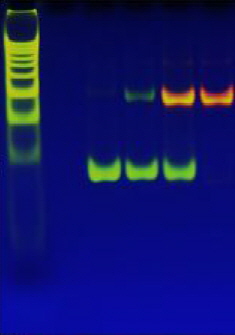
 This is an image of a silver nanocluster sensor that emits orange fluorescence when bound to DNA. The research team has uncovered the reason why silver emits light upon interacting with DNA.
[Asia Economy Reporter Junho Hwang] The reason why clusters of silver particles, measuring one ten-billionth of a meter (nanometer) in size, exhibit an orange color when they come into contact with DNA in our bodies has been revealed by domestic researchers. The research team expects this achievement to contribute to the advancement of biosensor materials for detecting various substances in the future.
A joint research team led by Dr. Ilrae Jeong of the Environmental Safety Evaluation Research Department at the Korea Atomic Energy Research Institute announced on the 1st that they have elucidated the mechanism of action of the promising biosensor material 'DNA silver nanocluster' sensor by utilizing the institute's nuclear technology.
Through five years of research, the joint team discovered that when two hairpin-looped DNA strands face each other and form a binding structure, the bound silver nanosensor exhibits a strong orange color.
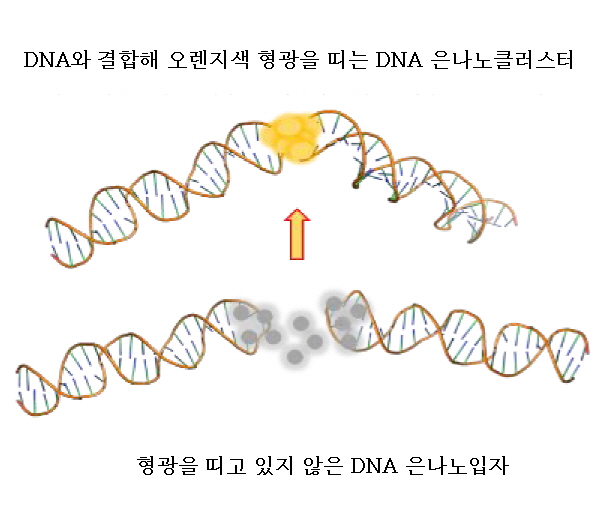
DNA generally does not display color, but when combined with silver nanoclusters, it exhibits unique fluorescent red, blue, and orange colors. This fluorescence is used to detect various biomaterials or diagnose diseases, but the mechanism behind the fluorescence had not been clarified.
The research team used the scattering facility within the institute to observe the binding structure between DNA and silver nanoclusters and was able to identify the correlation between this structure and the anti-photobleaching emission pattern. The scattering technique involves quantum beams such as neutrons or X-rays passing through a material and interacting with atomic nuclei or electrons inside, causing trajectory changes; it measures very small regions to observe nanoparticles at the nanoscale.
The DNA silver nanocluster sensor is utilized as a biosensor material to detect biomaterials such as DNA and RNA within patients' bodies, aiding in the diagnosis of intractable diseases like cancer and dementia. The research team expects that the results of this study will contribute to the development of biosensor materials for detecting various substances in the future.
Dr. Ilrae Jeong stated, "It is meaningful that we elucidated the structure and mechanism of action of biosensor materials by utilizing the institute's nuclear technology," adding, "If the application of nuclear technology expands in the bio field, significant progress in biological structural analysis research is expected."
Meanwhile, this research involved not only the institute but also Jeonbuk National University, Yonsei University, Seorin Bioscience Co., Ltd., and the Oak Ridge National Laboratory in the United States. The research results were published in ACS NANO, an academic journal in the fields of nanoscience and materials science.
© The Asia Business Daily(www.asiae.co.kr). All rights reserved.
![User Who Sold Erroneously Deposited Bitcoins to Repay Debt and Fund Entertainment... What Did the Supreme Court Decide in 2021? [Legal Issue Check]](https://cwcontent.asiae.co.kr/asiaresize/183/2026020910431234020_1770601391.png)