Zigbang Second Half Housing Market Outlook Survey
Little Difference in Responses Before and After June 17
Low Interest Rate Trend Has Major Impact... Seoul Faces Supply Reduction Concerns
56% Expect Jeonse Prices to Rise Overall
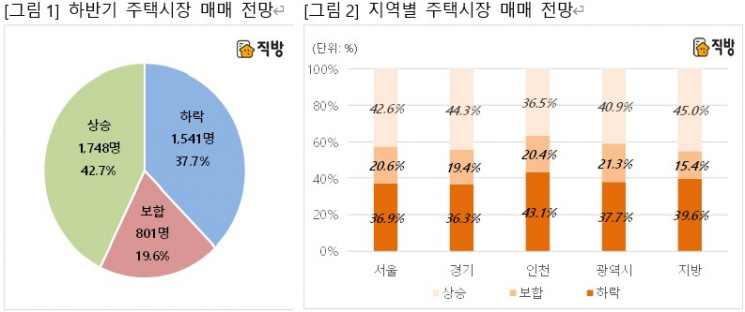
[Asia Economy Reporter Lim Onyu] Public opinion predominantly expects housing prices to rise in the second half of this year. According to a survey conducted by Zigbang with 4,090 users, 42.7% (1,748 respondents) answered that the housing sales market in their residential area would rise in the second half of the year. Meanwhile, 37.7% (1,541 respondents) expected a decline, and 19.6% (801 respondents) anticipated stability.
By region, 42.6% of Seoul residents predicted a rise, 36.9% expected a decline, and 20.6% foresaw stability. The Gyeonggi region showed similar results, with 44.3% expecting an increase and 36.3% a decrease. In contrast, 43.1% of respondents in Incheon anticipated a decline, outnumbering those who expected a rise (36.5%).
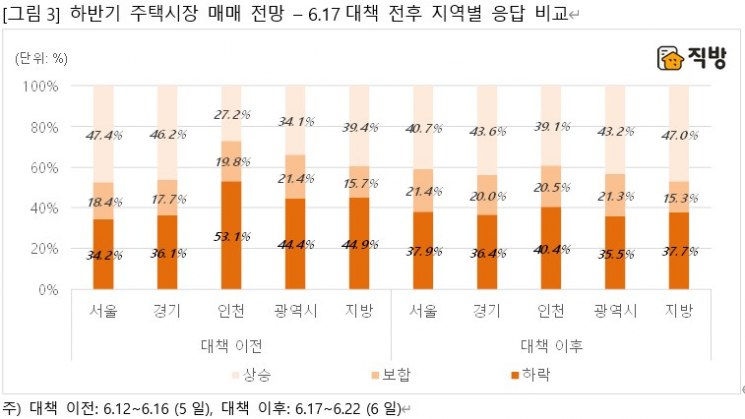
During the survey period, the government announced the June 17th measures to strengthen regulations in the metropolitan area. Zigbang explained, "There was no difference in responses before and after the announcement overall, but regional differences in responses appeared." In Seoul and Gyeonggi, the proportion of respondents expecting housing prices to rise in the second half decreased after the announcement, whereas in Incheon, metropolitan cities, and provinces, the proportion expecting a rise increased. Ham Youngjik, head of Zigbang Big Data Lab, analyzed, "Even after the announcement, it seems that regions with relatively fewer regulations showed higher expectations for price increases."
Perspectives on housing prices in the second half also differed depending on homeownership status. Among homeowners, 49.7% expected prices to rise and 29.8% expected a decline, while among non-homeowners, 49.1% anticipated a decline and 32.6% expected a rise.
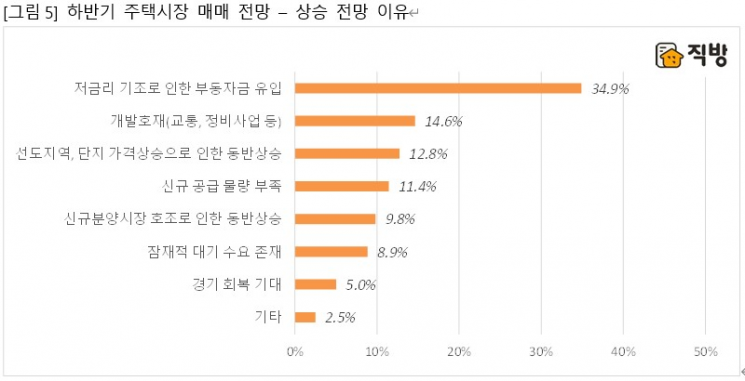
The main reason respondents expected housing prices to rise in the second half was 'inflow of idle funds due to low interest rates,' cited by 34.9%. This was followed by △development benefits such as transportation and maintenance projects (14.6%) △price increases in leading areas and complexes causing simultaneous rises (12.8%) △shortage of new supply (11.4%), among others.
By region, the top reason was the same across all areas, but the second most cited reason varied. In Seoul, it was △shortage of new supply (18.5%), in Gyeonggi △development benefits (21%), and in Incheon and metropolitan cities, △development benefits were also the second most cited. In provinces, △simultaneous rises due to price increases in leading areas and complexes (14.9%) ranked second.
Ham explained, "Due to Seoul's characteristics, demand is higher than in other regions, but new complex supply and listings are insufficient, which was chosen as a reason for the rise. In Gyeonggi, Incheon, and metropolitan cities, regional development benefits such as GTX and maintenance projects appeared as reasons for the rise, showing regional differences."
The main reason for expecting a decline in housing prices in the second half was 'economic instability due to COVID-19,' cited by 35%. This was followed by △real estate loan regulations (27.4%) △perception that current prices are high (13.7%), among others.
◆56% of respondents expect Jeonse prices to rise in the second half... following sales prices
More than half of respondents expected the Jeonse market to rise in the second half. Among all respondents, 56% (2,289 people) forecasted an increase, 22.6% expected a decline, and 21.5% anticipated stability. By region, a majority in all areas expected Jeonse prices to rise, with Seoul showing a slightly higher proportion at 59.5%.
Homeowners were more likely than non-homeowners to expect Jeonse prices to rise. Among homeowners, 60.7% expected an increase, while 49.1% of non-homeowners anticipated a rise.
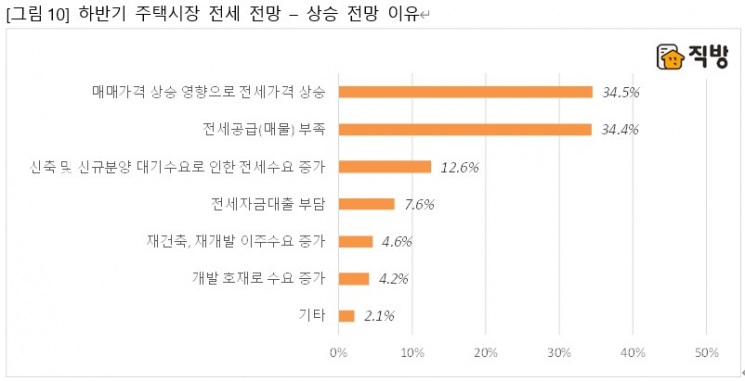
The main reason for Jeonse price increases was 'rising Jeonse prices influenced by sales price increases' (34.5%), closely followed by △shortage of Jeonse supply (listings) (34.4%) △increased Jeonse demand due to new construction and pre-sale waiting demand (12.6%), among others.
◆54.4% of respondents say "Subscription is the most popular market in the second half"
The real estate market expected to be most popular in the second half was 'new apartment subscription,' chosen by 54.4%. This was followed by △existing apartments (15.3%) △apartment pre-sale rights and move-in rights (13.5%) △reconstruction and redevelopment maintenance districts (8.2%).
However, among people in their 20s with low subscription scores, the rate choosing new apartment subscriptions was only in the 40% range. In their 20s, the proportion selecting officetels, row houses, villas, and multi-family houses?which have relatively lower cost burdens?was higher compared to other age groups.
In the second half, many policy changes will occur, including the implementation of the private land price ceiling system and the end of the temporary capital gains tax relief for multi-homeowners. Amid these, the low interest rate trend is expected to continue, bringing ongoing inflows of surplus funds. Ham said, "Since the June 17th measures were announced recently and the government has indicated additional real estate measures if signs of housing market instability appear, the direction of the housing market in the second half is expected to be fluid."
© The Asia Business Daily(www.asiae.co.kr). All rights reserved.
![User Who Sold Erroneously Deposited Bitcoins to Repay Debt and Fund Entertainment... What Did the Supreme Court Decide in 2021? [Legal Issue Check]](https://cwcontent.asiae.co.kr/asiaresize/183/2026020910431234020_1770601391.png)


















