The Foundation of the Franchise Industry is Consistent Service
Revised Bill 'Likely to Trigger Service Quality Decline'
Conflicts and Disputes May Arise, Brand Management Also Challenging
[Asia Economy Reporter Lee Seon-ae] The industry has strongly opposed the Fair Trade Commission's re-amendment of the standard franchise contracts for four sectors: chicken, pizza, coffee, and other dining services, calling it a "model of desk-bound administration."
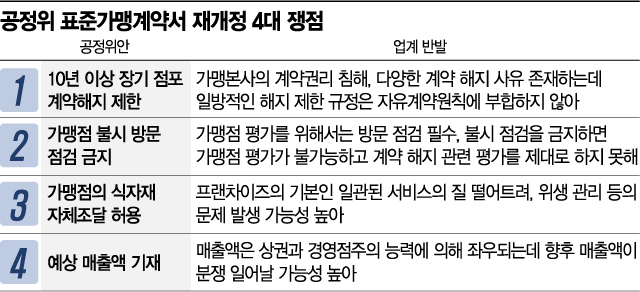
On the 1st, the franchise industry evaluated the Fair Trade Commission's draft for the establishment and amendment of the standard franchise contracts as "a revision that does not understand the very concept of franchising," adding that "it has become difficult to maintain not only the quality of service but also the unique identity of franchise brands." The most contentious points are ▲ restrictions on terminating long-term store contracts of over 10 years ▲ allowing franchisees to procure ingredients independently ▲ specifying expected sales revenue ▲ prohibition of unannounced inspections of franchise stores.
◆ Prohibition of unannounced inspections leads to decline in service quality = The parts the industry most strongly opposes are the prohibition of unannounced visits to franchise stores and restrictions on terminating long-term store contracts. The Fair Trade Commission introduced a clause that prohibits refusal to renew contracts for franchise stores that have operated for more than 10 years without special reasons. Unannounced inspections have also become impossible. Inspections must be notified in advance and conducted during business hours with the franchise owner accompanying, to check service and hygiene conditions. This is to prevent some franchise headquarters from abusing inspections as a means to pressure franchisees.
The franchise industry emphasized that under the pretext of protecting franchisees' rights, the contractual rights of franchise headquarters are being infringed upon, and normal business activities will be hindered. A representative from a chicken company said, "Proper evaluation of franchise stores is necessary to terminate contracts, but blocking unannounced inspections is a clear contradiction," adding, "This measure fundamentally blocks contract termination with problematic franchise stores and will lead to a decline in service quality across the franchise industry." A representative from a coffee company said, "There are many reasons for terminating store contracts, and if proper evaluation of franchise stores becomes impossible, disputes between franchise headquarters and franchisees will only intensify."
◆ Independent procurement of ingredients makes brand management difficult = Allowing franchisees to procure ingredients independently is also expected to lower the quality of the franchise industry. The Fair Trade Commission stated that if the franchise headquarters find it difficult to supply raw materials and ingredients, franchisees can purchase necessary items first and obtain approval from the headquarters afterward. A representative from a Korean cuisine company said, "Consumers should enjoy consistent service and the same taste at any A-brand restaurant location, so the supply of ingredients by the franchise headquarters is the most important factor driving the business," adding, "Since quality varies depending on the freshness of ingredients, if franchisees procure ingredients arbitrarily, proper brand management cannot be maintained."
A representative from another Korean cuisine company pointed out, "Fresh ingredients must be procured, and if franchisees fail to do so properly due to their own judgment, hygiene management issues may arise." A representative from a pizza company said, "We do not criticize the clause allowing franchisees to procure ingredients directly in cases where the headquarters cannot supply due to natural disasters, etc.," but added, "There is concern that this clause could be abused."
◆ Specifying expected sales triggers disputes = The requirement to specify expected sales in the standard franchise contract is also widely seen as a potential cause of disputes. Among 333 dispute mediation applications in the chicken, pizza, and coffee sectors between 2016 and 2019, 42 cases (12.6%) were related to expected sales, making it the most frequent cause of disputes. Therefore, the Fair Trade Commission believes it is necessary for prospective franchisees to confirm the expected sales information provided by the franchise headquarters through the franchise contract. A representative from a Chinese cuisine company said, "Expected sales should be estimated based on various criteria such as the previous franchisee's experience, operational ability, and commercial district, and it can vary greatly depending on the franchisee's skills after opening the store," expressing concern that "if there is a difference between expected sales and actual results due to franchisee negligence, it could easily lead to disputes."
Across the industry, there is skepticism about whether to adopt the standard franchise contract. Franchisees prefer to sign contracts based on the Fair Trade Commission's standard franchise contract because it offers advantages during investigations by the commission when conflicts arise. According to a 2018 survey, 91.8% of franchises were using the Fair Trade Commission's standard franchise contract. However, the industry views that the recent amendments may lead to movements to avoid using the standard franchise contract.
© The Asia Business Daily(www.asiae.co.kr). All rights reserved.
![User Who Sold Erroneously Deposited Bitcoins to Repay Debt and Fund Entertainment... What Did the Supreme Court Decide in 2021? [Legal Issue Check]](https://cwcontent.asiae.co.kr/asiaresize/183/2026020910431234020_1770601391.png)















