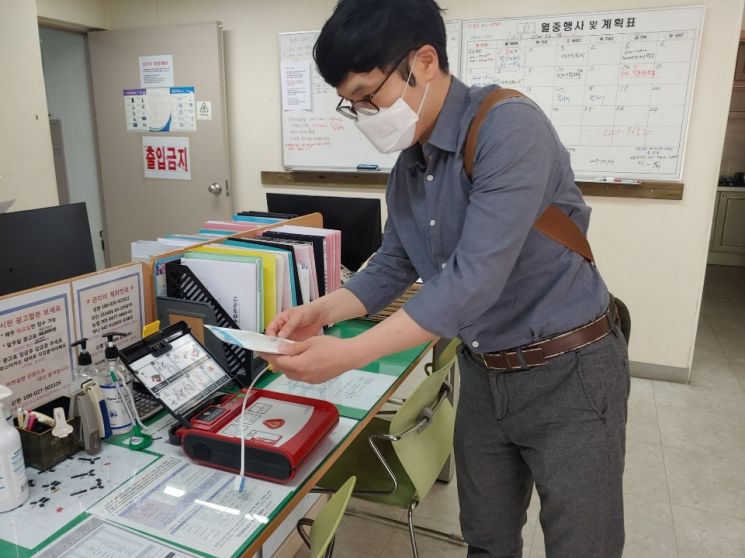
[Asia Economy (Suwon) = Reporter Lee Young-gyu] It has been revealed that one out of three institutions required to install automated external defibrillators (AEDs) in Gyeonggi-do still possess broken devices, indicating poor management that threatens the safety of residents.
An automated external defibrillator is emergency medical equipment that allows for quick and simple emergency treatment at the scene while waiting for an ambulance in cases of sudden cardiac arrest.
The current "Emergency Medical Services Act" requires owners, occupiers, or managers of facilities such as apartment complexes with more than 500 households, railway stations, passenger vehicle terminals, and port waiting rooms to equip devices capable of performing cardiopulmonary resuscitation, including AEDs.
Gyeonggi-do announced on the 1st that, as a result of a special audit conducted jointly with 29 citizen auditors from the 1st to the 19th of last month targeting 479 mandatory AED installation institutions (2,142 AED units) in the province, 761 units at 155 locations, accounting for 33%, were found to be malfunctioning.
In particular, the total number of AEDs held by these 155 locations was 1,020, meaning that 74.6% of all devices they possessed were broken.
Currently, there are 5,187 AED units installed at 2,908 mandatory installation institutions across the province.
In this audit, the province conducted a full inspection of 321 apartment complexes with fewer than 600 households, which were expected to have relatively weak management, covering 558 units; a sample inspection of 145 apartment complexes with more than 600 households holding five or more units, covering 1,555 units; and a full inspection of 13 multi-use facilities such as railway stations, passenger vehicle terminals, and ports, covering 29 units.
Among the violations found during the inspection, some batteries had expiration dates as far back as 2016, four years ago, and some devices were stored in security office dormitory bathrooms.
Based on the results of this investigation, the province plans to instruct and recommend improvements regarding AED management to city, county, and district health centers. Additionally, it will propose to the Ministry of Health and Welfare to specify installation standards and revise laws and guidelines to allow sanctions in cases of poor management.
Kim Jong-gu, the province’s chief audit officer, pointed out, "AEDs should be quickly usable by anyone in emergency situations such as cardiac arrest, but one out of three locations had defective devices."
© The Asia Business Daily(www.asiae.co.kr). All rights reserved.
![User Who Sold Erroneously Deposited Bitcoins to Repay Debt and Fund Entertainment... What Did the Supreme Court Decide in 2021? [Legal Issue Check]](https://cwcontent.asiae.co.kr/asiaresize/183/2026020910431234020_1770601391.png)















